
Tesamorelin: The Only FDA-Approved Peptide With Hard Data on Visceral Fat Reduction in Men
Published on:
Updated on:
People are asking...
What are the best peptides to pair with TRT for getting lean?...
In terms of current official pharmacy offerings, providers often recommend Sermorelin as a good boost. Anecdotally, Ipamorelin / CJC with or without dac is often described as a solid peptide for fitne... See Full Answer
How about stacking TRT with peptide therapy. Are Sermorelin, Tesamorelin, or CJC w/ Ipamorelin actually safe to use with TRT? What are the real benef...
These are perfectly reasonable options. Currently, licensed providers can prescribe Sermorelin, though not long ago it was permissible to work with the other peptides you mentioned as well. Many men h... See Full Answer
Can guys at 18% bodyfat benefit from adding the anorectic peptides like semaglutide, trizep, etc for a weight loss phase? Or is it only feasible for ...
Anyone will lose weight by adding a GLP-1RA like semaglutide or tirzepatide. They are the most popular drugs on the market and work well, regardless of the amount of weight someone needs to lose. The ... See Full Answer
Have a question? Ask us.
At AlphaMD, we're here to help. Feel free to ask us any question you would like about TRT, medical weightloss, ED, or other topics related to men's health. Or take a moment to browse through our past questions.
Most peptides discussed in men's health circles are backed by promise, not proof. Tesamorelin is the exception, and that distinction matters more than most people realize.
Tesamorelin: The Only FDA-Approved Peptide With Hard Data on Visceral Fat Reduction in Men is not a marketing claim. It is a factual description of where this compound sits in the clinical landscape, and understanding why requires looking at what the evidence actually shows, how it works, and whether it might be relevant to your health goals.
What Makes Tesamorelin Different From Every Other Peptide
The peptide space online is crowded with compounds that have theoretical mechanisms, animal data, or anecdotal reports from early adopters. Tesamorelin is not in that category. It carries formal FDA approval, which means it went through rigorous phase II and phase III clinical trials with defined endpoints, independent review, and a documented safety profile before it was ever prescribed to a patient.
That process matters because "hard data" is not just a buzzword. It means randomized controlled trials, placebo groups, measurable outcomes tracked with imaging technology, and results that held up to peer review. For a peptide targeting visceral fat, that level of evidence is genuinely rare. Most compounds discussed in this space have never been tested in a controlled human trial at all.
Visceral Fat in Men: More Than a Waist Problem
Before getting into the mechanism, it helps to understand what visceral fat actually is and why it draws clinical attention.
Visceral fat is the fat stored deep inside the abdominal cavity, wrapped around organs like the liver, pancreas, and intestines. This is distinct from subcutaneous fat, which sits just beneath the skin and is the kind you can pinch. Visceral fat is metabolically active in ways that subcutaneous fat is not. It releases inflammatory signals, disrupts insulin signaling, and contributes to a cluster of metabolic problems including elevated triglycerides, reduced HDL cholesterol, blood pressure dysregulation, and increased cardiometabolic risk.
In men, visceral fat tends to accumulate preferentially with age, especially as growth hormone output from the pituitary declines. This is one reason waist circumference alone is an imperfect proxy for metabolic risk. Two men with the same waist size can have dramatically different visceral fat burdens depending on their hormonal status, genetics, and body composition. The clinically meaningful measurement is not the tape measure number. It is what is happening beneath the surface, which is why studies use imaging tools like CT or MRI to quantify visceral adipose tissue directly.
According to research summarized by the National Institutes of Health on abdominal obesity and cardiometabolic risk, excess visceral fat is associated with a significantly elevated risk of cardiovascular disease and metabolic syndrome independent of overall body weight.
How Tesamorelin Works: The Growth Hormone Axis Explained
Tesamorelin is a synthetic analog of growth hormone-releasing hormone, or GHRH. To understand what that means, a quick explanation of the growth hormone axis is useful.
The hypothalamus, a region of the brain, normally releases GHRH in pulses. This signals the pituitary gland to produce and secrete growth hormone. Growth hormone then travels through the bloodstream and stimulates the liver to produce IGF-1, which is the primary mediator of many of growth hormone's effects on body composition, including fat metabolism and lean tissue maintenance.
As men age, GHRH output from the hypothalamus declines, pituitary response diminishes, and the entire downstream axis quiets. The result is reduced growth hormone pulsatility, lower IGF-1 levels, and a shift in body composition toward more fat accumulation, particularly visceral fat, and less lean mass.
Tesamorelin mimics the body's own GHRH signal. Rather than introducing exogenous growth hormone directly, it stimulates the pituitary to produce its own. This means the feedback loops that regulate growth hormone secretion remain largely intact. The body does not simply receive a flood of growth hormone regardless of context. It responds to a more physiologically patterned signal, which is one reason the mechanism is considered more refined than direct growth hormone administration.
The downstream effect on fat tissue is driven primarily through enhanced lipolysis, the breakdown of stored triglycerides in fat cells. Visceral fat depots appear to be particularly responsive to growth hormone signaling, which explains why the fat reduction observed in clinical trials is not uniform across the body but specifically targeted at the visceral compartment.
What the Clinical Evidence Actually Shows
The clinical trials supporting tesamorelin's FDA approval focused on a specific population: people with HIV-associated lipodystrophy, a condition characterized by abnormal fat distribution, including significant visceral fat accumulation, related to HIV infection and antiretroviral therapy. This population provided a clear, measurable model for studying visceral adipose tissue changes.
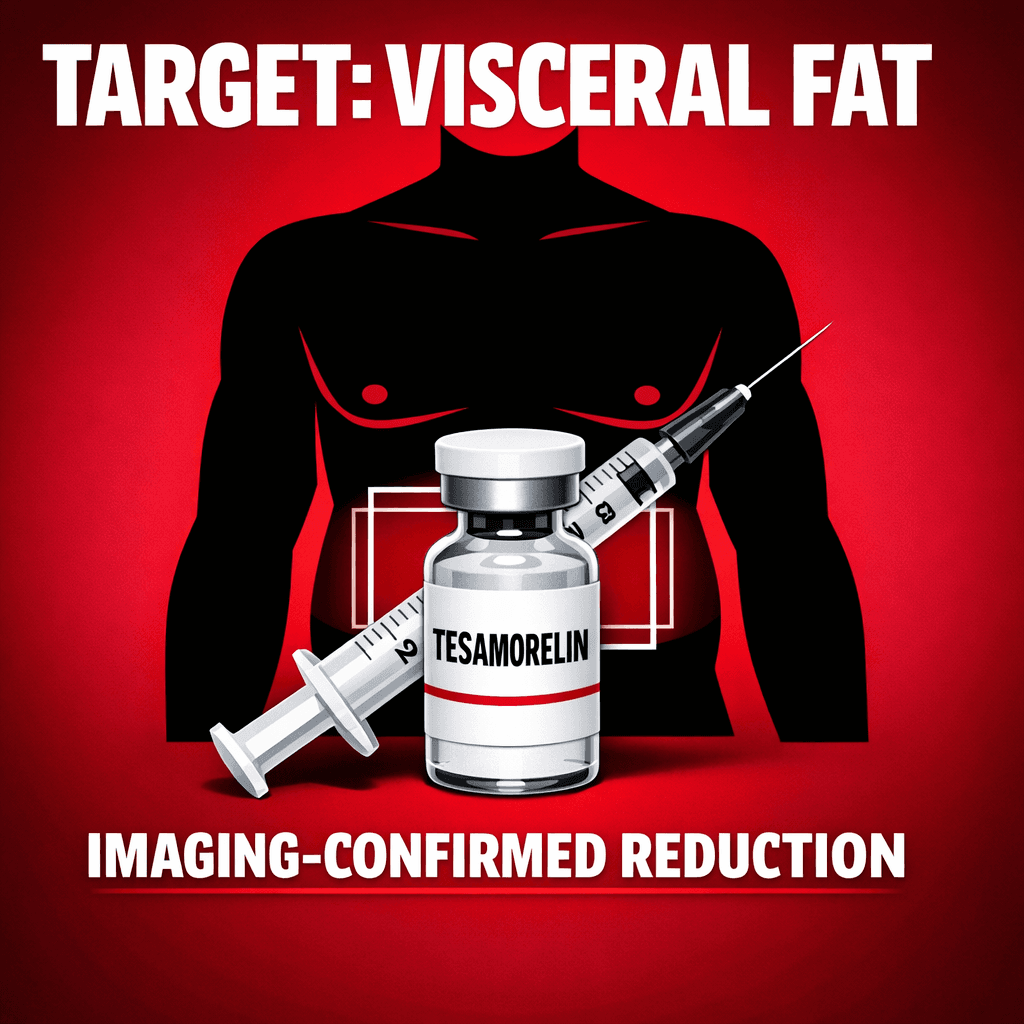
Trials used imaging-confirmed visceral adipose tissue as the primary endpoint, not waist circumference, not self-reported outcomes. The studies were double-blind, placebo-controlled, and conducted over periods long enough to assess sustained effects. What they found was a statistically significant and clinically meaningful reduction in visceral adipose tissue in the treatment group compared to placebo.
An important detail is that the reductions were specific to visceral fat. Subcutaneous fat and lean mass were not meaningfully affected in the same way, which supports the mechanism-based prediction that visceral fat is the primary target.
The FDA's official prescribing information and approval history for tesamorelin provides the full regulatory record for anyone who wants to examine the documentation directly.
While the approval was in the HIV lipodystrophy context, the underlying mechanism, stimulating the growth hormone axis to reduce visceral fat, has generated clinical interest in other populations where visceral adiposity and age-related decline in growth hormone are present. This is an area where clinician judgment and ongoing evaluation matter significantly.
Who Tesamorelin May and May Not Be Appropriate For
Tesamorelin is not a compound that is appropriate for everyone, and clinician evaluation is not a formality. It is a genuine screening process.
Candidates who may benefit from evaluation are generally men with documented visceral fat accumulation, signs of growth hormone axis decline, and metabolic concerns that have not been adequately addressed through lifestyle measures alone. Men with active malignancy, pituitary disorders, or certain other conditions may not be appropriate candidates. This is why a thorough intake process, including relevant lab work and medical history review, is an essential part of any medically supervised pathway.
Tesamorelin also interacts with glucose regulation. Growth hormone has known effects on insulin sensitivity, and this means glucose and metabolic markers are part of the monitoring picture for anyone using this therapy. Men with pre-existing concerns in this area require particularly careful evaluation and follow-up.
The importance of a personalized assessment cannot be overstated. The same compound in the same context produces different risk-benefit profiles depending on the individual.
Side Effects and Safety: What to Know Without Alarming Yourself
Tesamorelin's safety profile, as established in clinical trials, includes side effects that are generally consistent with growth hormone axis stimulation. The most commonly reported include fluid retention-related symptoms such as joint discomfort, swelling, and in some cases tingling or numbness, particularly in the extremities. These are generally manageable and often dose-related.
Glucose considerations are relevant, as noted above. Monitoring metabolic markers during therapy is standard practice in a well-run program.
Serious adverse events are uncommon in the clinical data, but that does not mean tesamorelin is without risk. It means the known risks are identifiable, manageable with appropriate oversight, and weighed against meaningful clinical benefit for the right patient. This is exactly the kind of nuanced risk-benefit conversation that should happen between a patient and a qualified clinician, not a decision made based on online forums or peptide vendor descriptions.
How Tesamorelin Compares to Other Options
Men researching visceral fat reduction will inevitably encounter several other approaches, and a fair comparison is worth making.
Lifestyle changes, meaning structured resistance training, cardiovascular activity, and dietary modification, remain foundational. They reduce visceral fat, improve insulin sensitivity, support hormonal health, and carry essentially no clinical downside. Tesamorelin does not replace these. In clinical trials, subjects were not exempted from lifestyle guidance. The compound was studied as an addition to standard care, not a substitute.
Sermorelin is another GHRH analog that is commonly discussed online. It shares a similar mechanism in that it stimulates the pituitary to release growth hormone. The key difference is the evidence base. Sermorelin does not carry FDA approval for visceral fat reduction and has not been studied in large placebo-controlled trials with imaging endpoints. That does not make it without merit, but it does mean the comparison between the two is a comparison between documented clinical evidence and a more limited data set.
Direct human growth hormone administration is sometimes compared to GHRH analogs. The distinction worth understanding is that injecting growth hormone bypasses the body's own feedback regulation. GHRH analogs like tesamorelin stimulate the pituitary within its normal regulatory context. The clinical implication is that the physiological pulsatility of growth hormone release is better preserved with the analog approach, which is one reason endocrinologists often view stimulators differently from direct growth hormone replacement.
Testosterone replacement therapy is a separate but related area of men's metabolic health. Low testosterone is associated with increased fat accumulation and reduced lean mass, and TRT can influence body composition in men with documented deficiency. However, the mechanism and the target are different from tesamorelin's effects on the growth hormone axis. For some men, evaluation of both axes is appropriate. For others, one or the other is more relevant. This is another reason individualized clinical assessment matters.
Common Misconceptions Worth Addressing Directly
A few beliefs circulate persistently in online discussions about tesamorelin that deserve direct correction.
The idea of spot reduction, that you can target fat loss in a specific area through any intervention, is generally not how fat metabolism works. Tesamorelin does not create spot reduction in the traditional sense. Rather, it preferentially reduces visceral fat because visceral fat depots are specifically sensitive to growth hormone signaling. That is a mechanism-based effect, not selective targeting in the way the term is usually used.
Tesamorelin is not the same as human growth hormone. This is a meaningful distinction. It does not introduce growth hormone into the body. It signals the body to produce its own, within its own regulatory framework.
The compound does not work instantly. Clinical trials measured effects over months, not days. Men expecting rapid transformation after a few doses are not reading the evidence correctly.
Perhaps most importantly, tesamorelin does not replace diet and training. No approved therapeutic does. It may support body composition goals in a medically appropriate context, but it functions alongside good lifestyle habits, not instead of them.
What a Medically Supervised Pathway Looks Like
For men who want to explore whether tesamorelin may be relevant to their situation, the process begins with a proper clinical evaluation. This typically includes a comprehensive review of symptoms and goals, relevant bloodwork to assess hormonal status, metabolic markers, and other baseline health indicators, and a conversation about medical history that might affect candidacy.
Goals should be defined in measurable terms where possible. Monitoring during therapy includes follow-up lab work to assess how the body is responding, particularly around metabolic parameters. A well-designed program has clear benchmarks and a plan for reassessment, not an open-ended prescription with no follow-up.
This kind of structured, evidence-informed approach is what separates medically supervised hormone and metabolic optimization from self-directed peptide use based on forum recommendations.
Evidence, Safety, and the Path Forward
Tesamorelin: The Only FDA-Approved Peptide With Hard Data on Visceral Fat Reduction in Men holds that distinction because the clinical work was done, the data was scrutinized, and the outcomes were real. For men who are serious about addressing visceral fat accumulation as a metabolic health concern rather than an aesthetic one, that evidence base is meaningful.
The decision to pursue any hormonal or peptide-based therapy should be made with a qualified clinician who can evaluate your individual profile, explain the risks and benefits honestly, and monitor your response over time. AlphaMD works with men navigating exactly this kind of evidence-based hormone and metabolic optimization, providing the clinical oversight that makes the difference between a well-managed therapeutic program and guesswork.
Have a question? Ask us.
At AlphaMD, we're here to help. Feel free to ask us any question you would like about TRT, medical weightloss, ED, or other topics related to men's health. Or take a moment to browse through our past questions.
People are asking...
What are the best peptides to pair with TRT for getting lean?...
In terms of current official pharmacy offerings, providers often recommend Sermorelin as a good boost. Anecdotally, Ipamorelin / CJC with or without dac is often described as a solid peptide for fitne... See Full Answer
How about stacking TRT with peptide therapy. Are Sermorelin, Tesamorelin, or CJC w/ Ipamorelin actually safe to use with TRT? What are the real benef...
These are perfectly reasonable options. Currently, licensed providers can prescribe Sermorelin, though not long ago it was permissible to work with the other peptides you mentioned as well. Many men h... See Full Answer
Can guys at 18% bodyfat benefit from adding the anorectic peptides like semaglutide, trizep, etc for a weight loss phase? Or is it only feasible for ...
Anyone will lose weight by adding a GLP-1RA like semaglutide or tirzepatide. They are the most popular drugs on the market and work well, regardless of the amount of weight someone needs to lose. The ... See Full Answer
Get $30 off your first month’s order
Enter your email address now to receive $30 off your first month’s cost, other discounts, and additional information about TRT.
Legal Disclaimer
This website is a repository of publicly available information and is not intended to form a physician-patient relationship with any individual. The content of this website is for informational purposes only. The information presented on this website is not intended to take the place of your personal physician's advice and is not intended to diagnose, treat, cure, or prevent any disease. Discuss this information with your own physician or healthcare provider to determine what is right for you. All information is intended for your general knowledge only and is not a substitute for medical advice or treatment for specific medical conditions. The information contained herein is presented in summary form only and intended to provide broad consumer understanding and knowledge. The information should not be considered complete and should not be used in place of a visit, phone or telemedicine call, consultation or advice of your physician or other healthcare provider. Only a qualified physician in your state can determine if you qualify for and should undertake treatment.