
Started TRT to Look Better, Now Your Pants Don't Fit
Published on:
Updated on:
People are asking...
I am: 42 yo male, 5'11" 280 lbs with a BMI of 40 and 42% body fat. Pre trt blood work: TESTOSTERONE, TOTAL, MS 242 L TESTOSTERONE, FREE 35.7 I star...
In most cases a provider would want a patient to wait at least past the 6-7 week mark before adjusting dosages because that's around the point that your body truly accepts the extra Testosterone as it... See Full Answer
What you are doing is awesome guys! I would highly appreciate your input on my case. I have been working out in the gym/calisthenics/swimming/jogging...
To answer your questions in order: Varicocele is one of the only truly reversible causes of hypogonadism. It is a fairly minor procedure, so if you can get it taken care of now, there is a possibility... See Full Answer
Thanks to glp1's, I have lost 28% bodyweight in 11 months. Taken my BMI from over 50 to 39. I am 6'3 and 54 years old. 30 years ago I was a hyper resp...
It would be wise to check your T levels. There is no harm in knowing, and this conversation may be moot if your T levels are normal. As you say, your doctor is old school, so he may not be up to date ... See Full Answer
Have a question? Ask us.
At AlphaMD, we're here to help. Feel free to ask us any question you would like about TRT, medical weightloss, ED, or other topics related to men's health. Or take a moment to browse through our past questions.
You started testosterone replacement therapy to finally see your abs and walk around with a shirt that fits like it's supposed to. Three months in, your favorite jeans won't button, your dress shirts pull across the shoulders, and you're wondering if you made a huge mistake.
The frustration is real, but the panic might be misplaced. When guys begin TRT with aesthetic goals in mind, they often fixate on one metric: the waistline. Tighter pants feel like failure, especially when you expected to shrink out of your clothes, not grow out of them. What most men don't anticipate is that testosterone doesn't just rearrange fat. It rebuilds you from the inside out, adding muscle in places you weren't tracking, shifting water around in ways that confuse the scale, and changing your body composition in ways that make clothing fit completely differently, even when you're leaner than before.
Understanding why your pants don't fit anymore requires a deeper look at what TRT actually does to your body, and why the changes you're experiencing might be exactly what you wanted, just not in the package you expected.
You Wanted Abs, Not New Jeans
Most men come to TRT with a vision: less belly fat, more definition, better energy to crush workouts, and maybe a physique that doesn't require constant explaining at the beach. The marketing around testosterone therapy leans hard into these promises, and to be fair, TRT can absolutely support those goals when testosterone levels are clinically low.
What the glossy ads don't show is the guy standing in his closet, holding jeans that fit perfectly six weeks ago, now unable to get them past his thighs.
This is where expectations collide with biology. Testosterone is an anabolic hormone, meaning it promotes tissue growth, particularly lean muscle mass. When you optimize low testosterone levels, your body doesn't just start burning fat. It starts building. Your quads get thicker. Your glutes fill out. Your back broadens. Your chest adds density. All of this happens whether you're actively trying to bulk up or not, especially if you're training with any consistency.
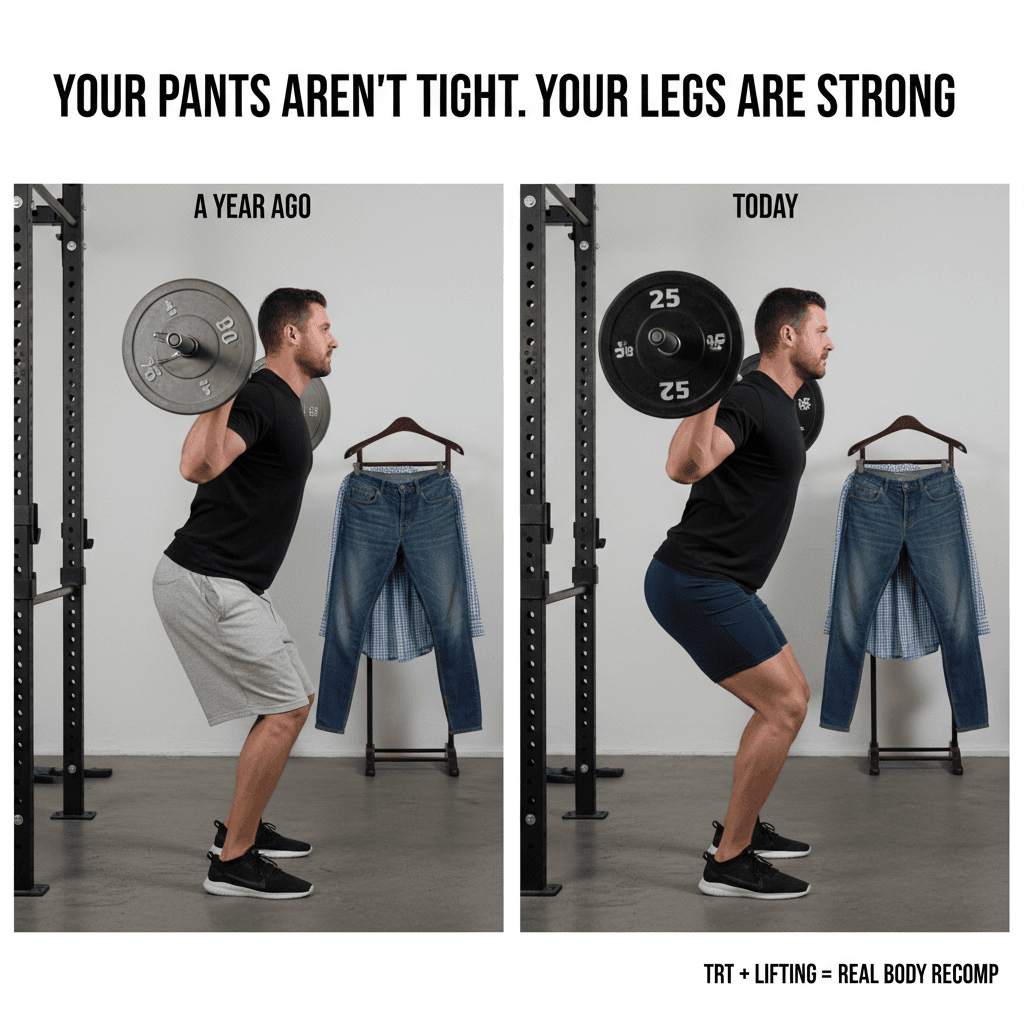
The result? Pants that fit snugly in the legs and seat, shirts that pull across the upper back and shoulders, and a waistband that might feel tighter even though your actual waist circumference is shrinking. The problem isn't that you're getting fat. The problem is that you're getting bigger in places you weren't paying attention to.
Muscle Shows Up Where You Weren't Looking
When men think about building muscle, they usually picture arms, chest, and abs. Those are the mirror muscles, the ones you see first when you check your progress. Testosterone doesn't discriminate like that. It builds muscle systemically, and some of the most dramatic changes happen in the lower body and posterior chain.
Your glutes and hamstrings are large muscle groups with significant growth potential. When testosterone levels rise and you're training regularly, these areas respond aggressively. Add in compound movements like squats, deadlifts, or even consistent walking with better recovery, and your lower body can pack on size faster than your upper body.
The same goes for your back. Lat width, trap thickness, and the small stabilizing muscles along your spine all respond to testosterone. A shirt that fit comfortably six months ago might now pull across your shoulder blades, not because you've gotten fatter, but because you've gotten wider.
This is actually a good thing. Muscle is metabolically active tissue. It burns more calories at rest, improves insulin sensitivity, supports joint health, and contributes to the lean, defined look most men are chasing. But muscle also takes up space, and it can make clothes fit awkwardly during the transition period when your body is still recomposing.
The Scale Lies, Especially At First
One of the most confusing early experiences on TRT is stepping on the scale and seeing the number go up, sometimes significantly, even when you feel leaner and your gym performance is skyrocketing.
Testosterone influences water retention, particularly in the early months of therapy. Your body is adjusting to new hormone levels, and intracellular water increases as muscle cells swell and store more glycogen. This isn't the puffy, bloated water retention you get from eating too much salt or sitting on a plane for six hours. It's the kind that makes your muscles look fuller and your skin look tighter, but it still registers as extra pounds on the scale.
This can add several pounds of bodyweight in the first few weeks, and it can make your pants feel snug even if you haven't gained an ounce of fat. For men who are used to equating weight gain with failure, this is a mental hurdle. You're doing everything right, eating clean, training hard, and the scale is moving in the wrong direction.
Except it's not the wrong direction. It's just a different direction than you expected. Body composition, not body weight, is the metric that matters. You can weigh more and look significantly leaner if the extra weight is muscle and water, not fat.
When Tight Pants Are Actually A Win
There's a critical distinction that gets lost in the frustration of tight clothing: where are your clothes tight, and why?
If your pants are snug in the thighs and glutes but looser in the waist, that's not a red flag. That's progress. If your shirts are pulling across your shoulders and upper back but hanging looser around your midsection, you're recomping successfully. These are signs that you're gaining muscle in the right places and losing fat in the areas that matter most for health and aesthetics.
On the other hand, if your waistband is digging in, your belly is pushing over your belt, and you're noticing fat accumulation rather than muscle growth, that's worth investigating. TRT alone doesn't cause fat gain, but it also doesn't prevent it. If your nutrition is off, your training is inconsistent, or your sleep is terrible, testosterone won't magically override those problems.
The key is learning to assess your progress with more nuance than a single measurement. Take progress photos from multiple angles. Track your strength in the gym. Pay attention to how your clothes fit in different areas, not just whether they fit at all. Notice your energy, recovery, and how you feel day to day.
These are the real indicators of whether TRT is working for you, not whether you can still button last year's jeans.
TRT Isn't A Shortcut, It's A Foundation
This is the part that doesn't get said enough: testosterone replacement therapy is a medical treatment for clinically low testosterone, not a cosmetic enhancement for guys who want to look better without putting in the work.
If your testosterone levels are genuinely low, TRT can be life changing. It can restore energy, improve mood, support sexual function, enhance recovery, and make it significantly easier to build muscle and lose fat. But it doesn't do the work for you. You still need to train intelligently, eat in a way that supports your goals, sleep enough to recover, and stay consistent over time.
Testosterone optimizes the environment for change. It doesn't create the change on its own.
This is why some men start TRT with high expectations and end up disappointed. They assume the therapy itself will melt fat and build muscle, and when that doesn't happen automatically, they blame the treatment or their dosage or their genetics. The reality is simpler: TRT makes it easier to get results, but you still have to do the things that produce results.
If you're not training with progressive overload, if you're eating in a caloric surplus without tracking macros, if you're sleeping five hours a night and crushing stress with caffeine and willpower, TRT will help, but it won't fix everything. Your pants might still get tighter, but not for the reasons you want.
What To Do When Changes Feel Extreme
Most men adapt to the body changes that come with TRT within a few months. The initial water weight stabilizes, muscle growth becomes predictable, and fat loss follows a logical pattern if nutrition and training are dialed in. Clothes start fitting differently in a way that feels good, not confusing.
But what if the changes feel extreme? What if you're gaining weight rapidly, retaining significant water, or feeling uncomfortably bulky in a way that doesn't align with your goals?
This is a conversation for your clinician, not a forum or a friend who's also on TRT. Hormone therapy requires individualized monitoring, and what works for one person might not work for another. Your provider can assess whether your dosage is appropriate, whether your estrogen levels need attention, and whether other factors like thyroid function or cortisol are playing a role.
It's also worth discussing your lifestyle. Are you training in a way that matches your goals? Are you eating for muscle gain when you actually want to lean out? Are you sleeping enough to manage cortisol and inflammation? These variables interact with TRT in complex ways, and sometimes the solution isn't adjusting the medication, it's adjusting the behavior around it.
A good provider won't just write a prescription and disappear. They'll help you understand what's happening, why it's happening, and how to adjust your approach to get the results you're actually looking for.
Aligning Training And Nutrition With Your Goals
If you started TRT to look better and your pants don't fit, the first step is figuring out whether that's a problem or a milestone. If you're gaining muscle and losing fat, even if the scale isn't cooperating, you're on the right track. If you're gaining size in places you don't want it, your training and nutrition need attention.
For men who want to lean out while on TRT, the approach is straightforward: maintain a moderate caloric deficit, prioritize protein, and train with a focus on strength and muscle retention. Testosterone makes it much easier to preserve lean mass while losing fat, which is one of its biggest aesthetic advantages. You can cut without feeling like you're shrinking, and you can maintain strength without the constant fatigue that usually accompanies a deficit.
For men who want to add size, TRT allows for more efficient muscle growth with better recovery. You can train more frequently, handle higher volumes, and bounce back faster between sessions. A slight caloric surplus with adequate protein supports this process without excessive fat gain, especially if testosterone levels are optimized.
The most important thing is knowing what you're trying to achieve and structuring your habits accordingly. TRT amplifies the results of good habits. It doesn't replace them.
Finding Support That Matches Your Needs
Navigating body changes on TRT is easier when you have informed, consistent support. Not every provider understands the nuances of hormone therapy, and not every clinic takes the time to educate patients about what to expect beyond the prescription.
AlphaMD is an online men's health platform where licensed providers approach TRT with a focus on individualized care, ongoing monitoring, and education rather than quick fix promises. They recognize that optimizing testosterone is about more than just normalizing lab values. It's about helping men understand how their bodies are changing, why those changes are happening, and how to adjust their lifestyle to support their goals.
Whether you're just starting to explore TRT or you're already on therapy and feeling confused about the changes you're experiencing, working with a provider who takes the time to listen and educate makes a significant difference.
Your Pants Don't Fit Because You're Changing
Tight jeans aren't a failure. They're feedback. Your body is responding to optimized testosterone levels by building muscle, shifting body composition, and changing in ways that don't always align with outdated ideas about what progress should look like.
The scale might go up. Your clothes might fit differently. Your thighs might be thicker and your waist might be smaller, and your brain might struggle to reconcile those two facts. That's normal. Body recomposition is messy and nonlinear, and it doesn't follow the simple narratives we've been sold about weight loss and muscle gain.
What matters is whether you're moving toward your goals, not whether your old pants still button. With the right guidance, realistic expectations, and a willingness to assess progress with more nuance than a single number, TRT can absolutely help you look better, feel better, and perform better. Sometimes that just means buying new jeans.
Have a question? Ask us.
At AlphaMD, we're here to help. Feel free to ask us any question you would like about TRT, medical weightloss, ED, or other topics related to men's health. Or take a moment to browse through our past questions.
People are asking...
I am: 42 yo male, 5'11" 280 lbs with a BMI of 40 and 42% body fat. Pre trt blood work: TESTOSTERONE, TOTAL, MS 242 L TESTOSTERONE, FREE 35.7 I star...
In most cases a provider would want a patient to wait at least past the 6-7 week mark before adjusting dosages because that's around the point that your body truly accepts the extra Testosterone as it... See Full Answer
What you are doing is awesome guys! I would highly appreciate your input on my case. I have been working out in the gym/calisthenics/swimming/jogging...
To answer your questions in order: Varicocele is one of the only truly reversible causes of hypogonadism. It is a fairly minor procedure, so if you can get it taken care of now, there is a possibility... See Full Answer
Thanks to glp1's, I have lost 28% bodyweight in 11 months. Taken my BMI from over 50 to 39. I am 6'3 and 54 years old. 30 years ago I was a hyper resp...
It would be wise to check your T levels. There is no harm in knowing, and this conversation may be moot if your T levels are normal. As you say, your doctor is old school, so he may not be up to date ... See Full Answer
Get $30 off your first month’s order
Enter your email address now to receive $30 off your first month’s cost, other discounts, and additional information about TRT.
Legal Disclaimer
This website is a repository of publicly available information and is not intended to form a physician-patient relationship with any individual. The content of this website is for informational purposes only. The information presented on this website is not intended to take the place of your personal physician's advice and is not intended to diagnose, treat, cure, or prevent any disease. Discuss this information with your own physician or healthcare provider to determine what is right for you. All information is intended for your general knowledge only and is not a substitute for medical advice or treatment for specific medical conditions. The information contained herein is presented in summary form only and intended to provide broad consumer understanding and knowledge. The information should not be considered complete and should not be used in place of a visit, phone or telemedicine call, consultation or advice of your physician or other healthcare provider. Only a qualified physician in your state can determine if you qualify for and should undertake treatment.