
Sleep Apnea Is Doubling Your Hematocrit Risk—Not Your TRT Dose
Published on:
Updated on:
People are asking...
What can I do for lowering hematocrit even on such a minor dose? 70mg weekly split into 3x dose. I was recently diagnosed with sleep apnea so I have ...
Initiating CPAP lowers hematocrit by an average of 2.4% within the first month, and up to 4.6% within 6 months of continuous CPAP use. If you are doing intramuscular injections, switching to subcutane... See Full Answer
I quit trt in February cause my hematocrits would get to about 50 and I would donate every 8 weeks and I was tired on donating, my dose was only 100mg...
Since you have started CPAP and are now on naringen, it may well be fair to give TRT another try — something a licensed provider can evaluate with you. You may consider trying the creams next time, as... See Full Answer
Is Trt safe for an overweight individual who needs a CPAP to sleep?...
Yes, it is safe. One thing to bear in mind is that you need to tell your TRT provider this. Because you can expect some muscle response on TRT, TRT can make sleep apnea worse at first while you adjust... See Full Answer
Have a question? Ask us.
At AlphaMD, we're here to help. Feel free to ask us any question you would like about TRT, medical weightloss, ED, or other topics related to men's health. Or take a moment to browse through our past questions.
Your bloodwork comes back flagged, your hematocrit is climbing, and the first instinct is to blame your testosterone dose. That instinct may be costing you the real answer.
For men on testosterone replacement therapy (TRT), elevated hematocrit is one of the most common lab findings that prompts concern, and often, a reflexive push to reduce the dose. But dose is only one piece of the picture. There is a quieter, frequently overlooked driver that can be doing far more damage in the background: untreated sleep apnea. Understanding the relationship between these two factors is not just medically useful. It can change the entire direction of your care.
What Hematocrit Actually Measures and Why It Matters
Hematocrit is the proportion of your blood made up of red blood cells. Think of your bloodstream as a river. A healthy river moves fluidly, carries nutrients efficiently, and doesn't strain its banks. When your hematocrit rises, that river gets thicker. The blood becomes more viscous, meaning the heart has to work harder to push it through vessels, and circulation to vital organs can become less efficient.
This matters for several reasons. Thicker blood is associated with increased strain on the cardiovascular system, and in extreme cases, it raises the risk of clotting events. That is why clinicians who prescribe TRT monitor hematocrit at regular intervals. It is not a formality. It is a meaningful safety checkpoint.
Elevated hematocrit caused by an underlying condition or medication is called secondary erythrocytosis. The key word is secondary. Something is driving it. Identifying that something is the entire point.
How TRT Influences Red Blood Cell Production
Testosterone has a well-established effect on red blood cell production. It stimulates the release of erythropoietin, a hormone made primarily by the kidneys that signals bone marrow to produce more red blood cells. This is partly why men naturally have higher hematocrit levels than women, and it is why TRT can push those levels higher in some men.
That said, the relationship is not uniform. Individual responses to TRT vary considerably based on genetics, age, the delivery method used, dosing intervals, and baseline physiology. Some men on TRT show minimal changes in hematocrit over years of therapy. Others see it climb more quickly. Delivery method in particular plays a role, with some forms of TRT associated with greater fluctuations in hormone levels, which can influence red blood cell production more dramatically.
So yes, TRT can raise hematocrit. But assuming it is always the primary cause when levels rise is a clinical shortcut that can leave an important problem unaddressed.
The Oxygen Debt Your Body Pays Every Night
Sleep apnea is a condition in which breathing repeatedly stops and restarts during sleep. In obstructive sleep apnea, the most common form, the muscles at the back of the throat relax too much, partially or fully blocking the airway. The result is a pattern of intermittent oxygen drops throughout the night, sometimes dozens or even hundreds of times per hour.
Each time oxygen levels fall, the body interprets this as a threat. It responds the way it would to living at high altitude: by increasing erythropoietin output to stimulate more red blood cell production. More red blood cells mean more oxygen-carrying capacity. It is a compensatory mechanism, and over time, it is an effective one. Unfortunately, what it compensates for is a problem that keeps recurring every single night.
This is the core of the issue. Untreated sleep apnea creates a chronic, nightly stimulus for red blood cell overproduction. Night after night, the signal fires. Night after night, the bone marrow responds. Hematocrit climbs, not because of a single event, but because of a relentless, invisible cycle that most men are completely unaware of while it is happening.
When a man on TRT also has untreated sleep apnea, these two mechanisms stack. The testosterone raises the baseline. The sleep apnea adds repeated nocturnal surges. The combined effect on hematocrit can be substantially greater than either factor would produce alone. Treating only one without addressing the other means the problem is never fully resolved.
The Apnea That Doesn't Look Like Apnea
Here is where the situation gets genuinely tricky. Most men with sleep apnea do not know they have it, and many would not suspect it based on their own experience of sleep.
The cultural image of sleep apnea is a heavyset man who snores loudly and falls asleep at his desk. That picture is real, but it is incomplete. Sleep apnea affects men across a wide range of body types, including men who are normal weight or even lean. It affects men who sleep a full eight hours and still feel exhausted in the morning. It affects men who do not snore loudly at all, or whose snoring has been dismissed as normal.
The symptoms worth paying attention to are easy to miss or misattribute. Waking with a headache that fades after being up for a while. Getting up to urinate once or twice a night without an obvious reason. Feeling unrested despite adequate sleep duration. Difficulty concentrating or a persistent mental fog during the day. Elevated blood pressure that does not respond as expected to lifestyle changes. A partner who mentions that breathing seems to pause during sleep, or who has moved to a different room to avoid the noise.
None of these symptoms announces itself as a breathing problem. That is exactly why sleep apnea goes undiagnosed for years in a significant number of men, often while causing systemic damage in the background.
Connecting the Dots Between Sleep, Labs, and TRT Outcomes
When a man on TRT presents with rising hematocrit, the clinical conversation should be broader than dose adjustment. A thorough evaluation asks: What else might be driving this? Are there symptoms or risk factors for sleep apnea? Has he ever had a sleep study? How is his blood pressure? Is he well hydrated? What is his cardiovascular baseline?
Sleep screening should be a standard part of that workup, not an afterthought. A sleep study, which can often be completed at home with a portable monitoring device, is the definitive way to diagnose or rule out sleep apnea. If significant apnea is present, treating it becomes a clinical priority, not just for hematocrit management, but for overall health.
CPAP therapy, which delivers continuous positive airway pressure to keep the airway open during sleep, is the most established treatment for obstructive sleep apnea. For men who do not tolerate CPAP, alternatives exist, including oral appliances and positional therapies depending on the severity and pattern of apnea. The key is consistent, effective treatment, because partial adherence produces only partial benefit.
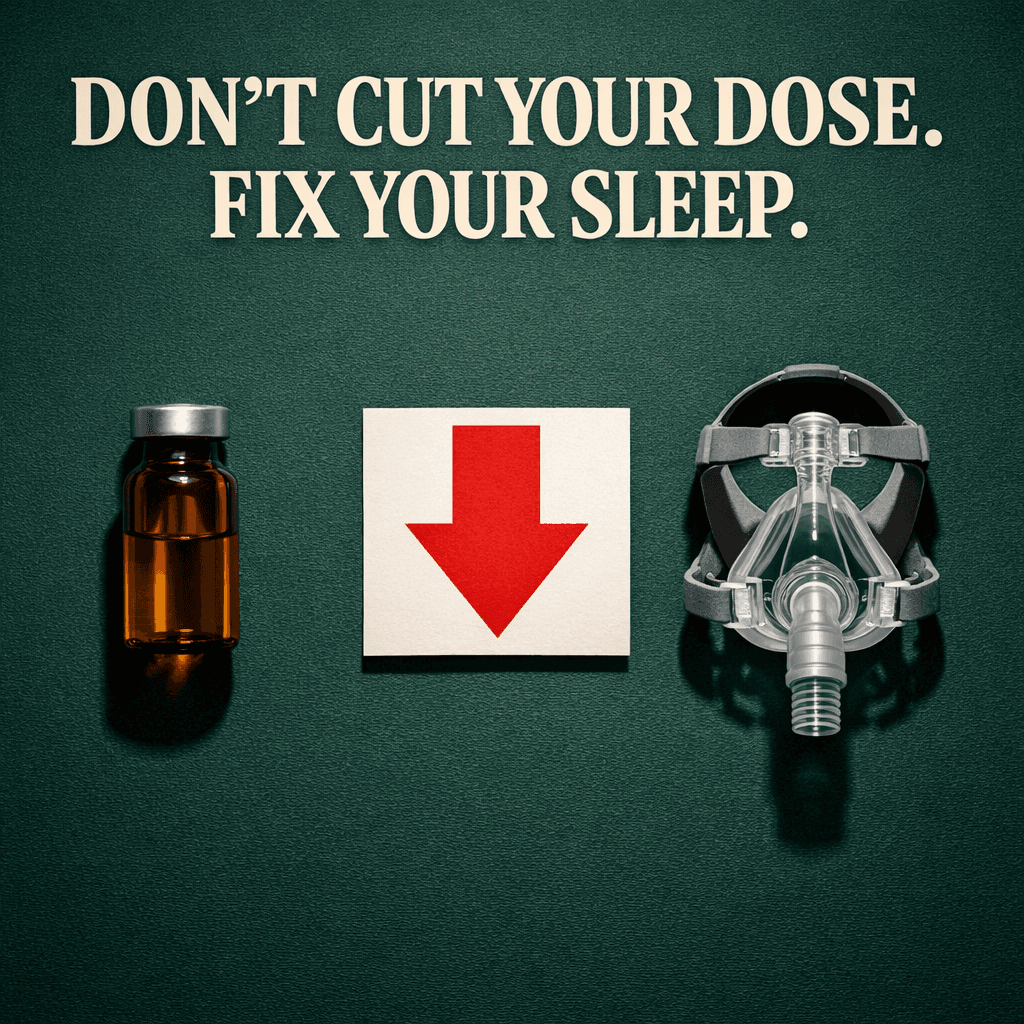
Once sleep apnea is properly treated, many men see meaningful stabilization or improvement in their hematocrit without any reduction in their TRT dose. That is a significant finding. It means the dose was never the primary problem.
What You Should Not Do on Your Own
The instinct to take action when a lab value is flagged is understandable. But some actions do more harm than good when taken without clinical guidance.
Do not self-adjust your TRT dose in response to a high hematocrit reading. Changing your dose without guidance can create hormonal imbalances, destabilize your response to therapy, and make it harder for your clinician to accurately assess what is driving the problem.
Do not rush to donate blood as a way to bring hematocrit down. Therapeutic phlebotomy can be appropriate in certain situations, but it is not without considerations. Some men have contraindications, and donating blood repeatedly without addressing the underlying cause is a temporary fix that does nothing to treat the root problem. This decision belongs in a clinical conversation, not a solo decision made between lab appointments.
Do not ignore symptoms. Morning headaches, persistent fatigue, and disrupted sleep are not just quality-of-life issues. They are signals worth taking seriously.
Treating Apnea Is Treating Your TRT Protocol
This point deserves to be stated plainly. Sleep apnea treatment is not separate from TRT management. It is part of it.
When sleep apnea is effectively treated, the benefits extend well beyond hematocrit. Sleep quality improves, often dramatically. Energy levels increase. Blood pressure frequently comes down. Cognitive clarity returns. Libido, which is suppressed by poor sleep and chronic low oxygen, tends to improve. The body's ability to respond to testosterone therapy optimizes, because the hormonal environment stabilizes alongside better sleep architecture.
In other words, getting your sleep apnea treated may do more for your TRT outcomes than any dose adjustment ever could.
Lifestyle factors also matter in this picture. Staying well hydrated reduces blood viscosity independent of hematocrit levels. Maintaining cardiovascular fitness supports circulation. Minimizing alcohol, which can worsen airway relaxation during sleep, is worth considering for men with apnea.
Getting the Full Picture Before Making Changes
Sleep apnea is one of the most underdiagnosed conditions in men's health, and its connection to elevated hematocrit in men on TRT is one of the most underappreciated clinical relationships in the field. The dose is not always the problem. Sometimes the problem is what is happening between midnight and six in the morning, quietly, while everything else looks fine on the surface.
Clinics that take this seriously approach elevated hematocrit with a full clinical lens rather than a reflexive dose reduction. AlphaMD is one example of an online men's health platform where the providers overseeing TRT incorporate sleep screening, regular lab monitoring, and coordinated care into how they manage therapy, recognizing that what drives hematocrit changes is rarely just one thing.
If your labs are trending in the wrong direction, the most useful question to ask is not "how much do we reduce the dose?" It is "what is actually driving this?" The answer, more often than most men expect, is sleeping quietly right next to them every night.
Have a question? Ask us.
At AlphaMD, we're here to help. Feel free to ask us any question you would like about TRT, medical weightloss, ED, or other topics related to men's health. Or take a moment to browse through our past questions.
People are asking...
What can I do for lowering hematocrit even on such a minor dose? 70mg weekly split into 3x dose. I was recently diagnosed with sleep apnea so I have ...
Initiating CPAP lowers hematocrit by an average of 2.4% within the first month, and up to 4.6% within 6 months of continuous CPAP use. If you are doing intramuscular injections, switching to subcutane... See Full Answer
I quit trt in February cause my hematocrits would get to about 50 and I would donate every 8 weeks and I was tired on donating, my dose was only 100mg...
Since you have started CPAP and are now on naringen, it may well be fair to give TRT another try — something a licensed provider can evaluate with you. You may consider trying the creams next time, as... See Full Answer
Is Trt safe for an overweight individual who needs a CPAP to sleep?...
Yes, it is safe. One thing to bear in mind is that you need to tell your TRT provider this. Because you can expect some muscle response on TRT, TRT can make sleep apnea worse at first while you adjust... See Full Answer
Get $30 off your first month’s order
Enter your email address now to receive $30 off your first month’s cost, other discounts, and additional information about TRT.
Legal Disclaimer
This website is a repository of publicly available information and is not intended to form a physician-patient relationship with any individual. The content of this website is for informational purposes only. The information presented on this website is not intended to take the place of your personal physician's advice and is not intended to diagnose, treat, cure, or prevent any disease. Discuss this information with your own physician or healthcare provider to determine what is right for you. All information is intended for your general knowledge only and is not a substitute for medical advice or treatment for specific medical conditions. The information contained herein is presented in summary form only and intended to provide broad consumer understanding and knowledge. The information should not be considered complete and should not be used in place of a visit, phone or telemedicine call, consultation or advice of your physician or other healthcare provider. Only a qualified physician in your state can determine if you qualify for and should undertake treatment.