
He Fixed 5 Years of ED by Changing This One Thing About His Testosterone
Published on:
Updated on:
People are asking...
I felt great on aas. Physically and mentally. I never felt bad or lacked ambition anyway, but it made me more confident. Broke plateaus in the gym. Ma...
Great explanation. You felt better when your T was higher, it was good for your life, though the AAS were potentially illegal or bad for your organs. It was good that you swapped providers to someone ... See Full Answer
Recently had a massive drop in quality of life over the last 10 months, after being fit all my life and a natural bodybuilder for the last 8 years. ...
So there is this strange rumor that somehow developed that hCG can “kickstart” normal testicular function. I’m not sure where it started other than it used to help restore function in men who suppres... See Full Answer
What you are doing is awesome guys! I would highly appreciate your input on my case. I have been working out in the gym/calisthenics/swimming/jogging...
To answer your questions in order: Varicocele is one of the only truly reversible causes of hypogonadism. It is a fairly minor procedure, so if you can get it taken care of now, there is a possibility... See Full Answer
Have a question? Ask us.
At AlphaMD, we're here to help. Feel free to ask us any question you would like about TRT, medical weightloss, ED, or other topics related to men's health. Or take a moment to browse through our past questions.
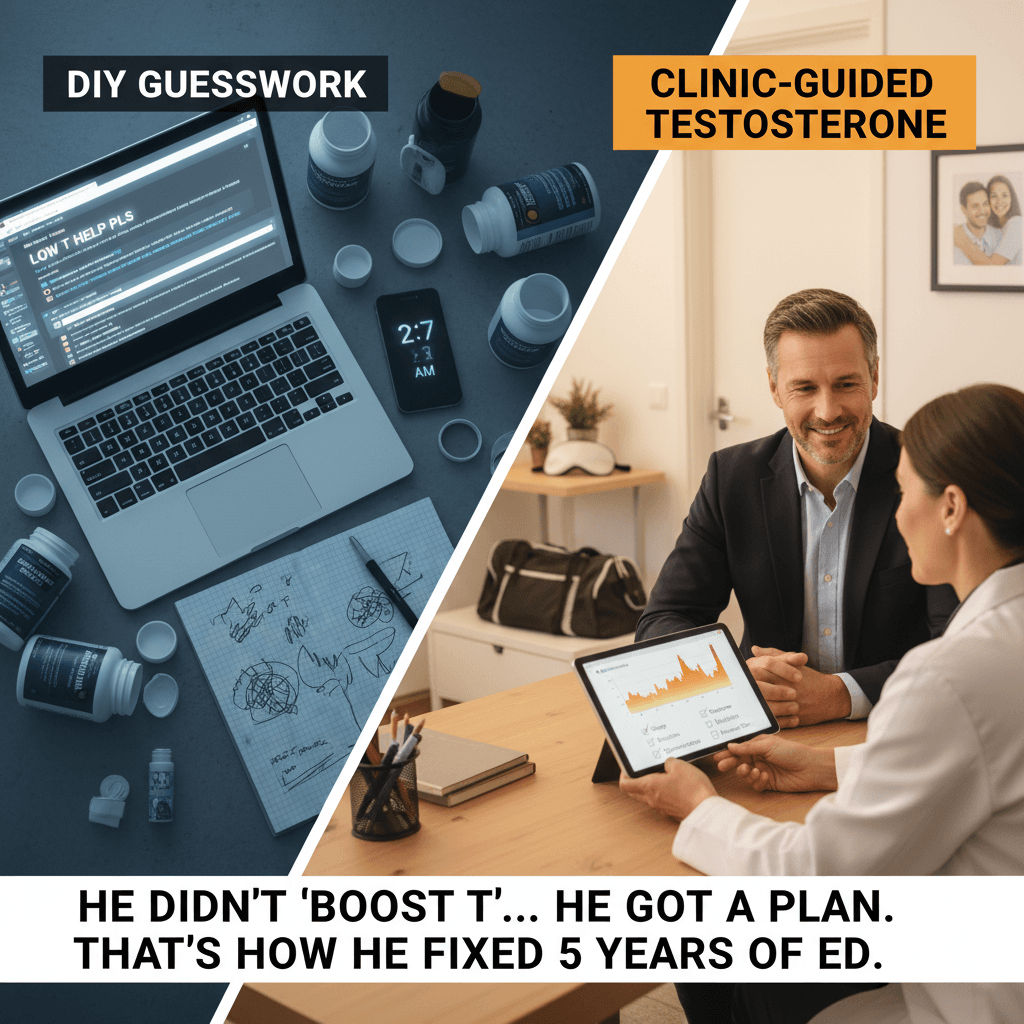
James spent five years trying everything to fix his erections, from pills to supplements to wishful thinking, until he finally understood that the problem was not his testosterone level, but how inconsistently and carelessly he had been treating it. What changed everything was not boosting his numbers higher, but managing his hormone health with proper medical guidance and consistency.
His story is more common than most men realize. Erectile dysfunction affects millions, and while low testosterone can play a significant role, the real breakthrough often comes from understanding how to address hormone health as part of a complete picture rather than chasing quick fixes or going it alone.
When Every Fix Fails In The Bedroom
James noticed the problem in his early forties. What started as occasional difficulty became a pattern he could not ignore. The spontaneity disappeared first, then the confidence, and finally the desire to even try. He felt like he was losing a fundamental part of himself.
Like many men, he started searching online. The internet told him it was probably low testosterone, so he convinced himself that was the answer. He tried over-the-counter boosters that promised miraculous results. When those did nothing, he experimented with other approaches, some more questionable than others. He avoided doctors because he felt embarrassed and thought he could solve this on his own.
Nothing worked consistently. Some days were better than others, but the underlying problem remained. Five years passed with the same frustration, the same defeat, the same quiet shame that he rarely talked about with anyone.
The Testosterone Connection That Everyone Gets Wrong
Testosterone plays an undeniable role in male sexual function, but not in the simple, direct way that most men assume. This hormone influences sexual desire, the physiological processes that lead to erections, and overall energy levels that affect intimate relationships. When testosterone is genuinely low, men often notice decreased libido, difficulty achieving or maintaining erections, reduced energy, and changes in mood.
But the relationship between testosterone and erections is more nuanced than many realize. Testosterone primarily drives desire and supports the complex cascade of events that make erections possible. It helps maintain the health of tissues involved in sexual function and contributes to overall vitality. However, having low testosterone does not automatically cause ED, and having normal or even high testosterone does not guarantee perfect erections.
The mistake James made, and the mistake countless men make, is assuming that more testosterone is always better and that fixing ED is simply a matter of boosting hormone levels through any means necessary. That approach ignores the real complexity of sexual function and hormone health.
Why More Testosterone Is Not Always The Answer
Erectile dysfunction has multiple potential causes, and testosterone is only one piece of a larger puzzle. Cardiovascular health plays a massive role because erections depend on healthy blood flow. The blood vessels that supply the penis are relatively small, which means they often show signs of vascular problems before larger vessels do. In many cases, ED serves as an early warning sign of heart disease or circulation issues.
Psychological factors matter enormously as well. Stress, anxiety, depression, and relationship difficulties can all interfere with sexual function, regardless of hormone levels. Performance anxiety creates a vicious cycle where worry about ED actually causes or worsens the problem. Many men experience a combination of physical and psychological contributors that feed into each other.
Metabolic health cannot be overlooked either. Obesity, insulin resistance, and diabetes all increase the risk of ED through multiple pathways. These conditions affect blood flow, nerve function, and hormone production. Poor sleep disrupts hormone regulation and contributes to both low testosterone and sexual difficulties. Alcohol, smoking, and certain medications can interfere with erections independently of testosterone status.
James eventually learned that his ED was not just about testosterone being too low. His hormone levels were actually somewhat reduced, but that was only part of the story. He was also dealing with stress from work, had gained weight over the years, was not sleeping well, and had developed some early signs of metabolic problems. Focusing only on testosterone while ignoring everything else was never going to work.
The One Change That Made All The Difference
The breakthrough came when James finally saw a doctor who specialized in men's health and took the time to evaluate his complete situation. The key change was not a dramatic increase in testosterone or some secret supplement. It was shifting from haphazard self-experimentation to consistent, medically supervised hormone management as part of a comprehensive approach.
Instead of trying random products or making guesses about his hormone status, James started working with a physician who ordered proper testing, identified that his testosterone was indeed suboptimal, and developed an appropriate treatment plan. More importantly, the doctor helped him understand that managing testosterone effectively requires consistency, proper monitoring, and attention to the factors that influence hormone health.
The "one thing" James changed was replacing inconsistency and guesswork with evidence-based, steady medical care. He stopped chasing quick fixes and started following a sustainable approach that included proper hormone management when indicated, along with lifestyle modifications that supported his overall health.
The Quiet Role Of Daily Habits
Alongside medical guidance for his hormone health, James made changes to the daily habits that were working against him. He started prioritizing sleep, recognizing that chronic sleep deprivation was undermining his testosterone production and overall wellbeing. He gradually lost weight through sustainable dietary changes rather than crash diets.
Exercise became a regular part of his routine, particularly resistance training and movement that supported cardiovascular health. He reduced his alcohol intake significantly and worked on managing stress through techniques that actually fit his life. None of these changes were dramatic or extreme, but together they created an environment where his body could function better.
These lifestyle factors did not replace medical treatment for his hormone health, but they worked synergistically with it. Healthy habits supported better testosterone production and also addressed some of the other contributors to his ED. Meanwhile, appropriate hormone management gave him the energy and motivation to stick with those healthier habits.
Beyond The Physical Mechanics
James also had to address the psychological weight he had been carrying for five years. The anxiety and shame around his ED had become barriers in themselves. Working with his doctor to develop a comprehensive plan helped reduce the anxiety because he finally felt like he was doing something effective rather than flailing in the dark.
He also had honest conversations with his partner that he had been avoiding for years. Opening up about his struggles and his efforts to address them improved their relationship and reduced the performance pressure he had been putting on himself. The psychological relief was not instant, but it built over time as he saw genuine progress.
Sexual function involves the body and the mind working together. Addressing the physical contributors while ignoring the mental and emotional aspects rarely leads to complete resolution. James found that as his physical health improved through consistent medical care and lifestyle changes, his confidence gradually returned, which further improved his sexual function in a positive feedback loop.
When To Seek Medical Evaluation
Any man experiencing persistent erectile dysfunction should consult a qualified healthcare provider rather than trying to diagnose and treat himself. ED can be a warning sign of serious health conditions, including cardiovascular disease, diabetes, and hormonal disorders that require proper medical attention.
A thorough evaluation typically includes a discussion of symptoms, medical history, lifestyle factors, and medications. Testing may be recommended to check hormone levels, metabolic markers, and cardiovascular health. This comprehensive approach helps identify the specific contributors to ED in each individual case.
Testosterone replacement or optimization may be appropriate for some men with confirmed low levels and symptoms, but it should always be done under medical supervision with proper monitoring. Self-treatment with testosterone or related compounds carries significant risks, including cardiovascular problems, fertility issues, and hormone imbalances that can actually worsen symptoms.
A Smarter Approach To Hormone Health
The lesson from James's experience is that treating ED effectively often requires changing how we think about testosterone and male health in general. Instead of viewing testosterone as a simple fix or something to manipulate on your own, it helps to understand hormone health as one component of overall wellbeing that deserves proper medical attention.
Medically guided hormone care means working with providers who understand the nuances of testosterone management, who monitor for potential issues, and who consider the complete health picture rather than just one lab value. It means consistency rather than sporadic treatment, and it means addressing lifestyle factors that influence hormone production and sexual function.
For men dealing with ED related to hormone issues, the path forward is not about finding a miracle cure or a secret trick. It is about getting appropriate medical evaluation, following evidence-based treatment when indicated, and making sustainable lifestyle changes that support long-term health.
Finding The Right Support
Accessing thoughtful, comprehensive men's health care has become easier with the growth of specialized services. AlphaMD represents one option for men seeking convenient access to medical professionals who focus on hormone health, sexual function, and related concerns. Providers available through the platform emphasize proper evaluation of symptoms, appropriate testing, and treatment plans that consider individual needs and overall health context.
Whether through AlphaMD or another avenue, the key is finding medical professionals who take ED seriously, who understand the role of hormones in male health, and who are willing to look beyond simplistic solutions. The right provider will help you understand what is contributing to your symptoms and develop a comprehensive approach rather than just writing a prescription and sending you on your way.
The Real Transformation
James did not fix his ED overnight, and his story is not about a miracle transformation. What changed was that after five years of frustration, he finally addressed his testosterone and overall health in a smart, consistent, medically supported way. He stopped guessing and started working with professionals who could guide him properly.
His erections improved significantly over several months as his hormone health stabilized, his lifestyle habits improved, and his anxiety decreased. The transformation was gradual but real. More importantly, it was sustainable because it was built on a solid foundation of proper medical care and healthy daily choices rather than quick fixes that never last.
For the millions of men dealing with ED, the path forward often requires changing not just testosterone levels, but the entire approach to hormone health and wellbeing. That shift from inconsistency to proper care, from guesswork to medical guidance, from isolation to support - that is the one thing that can make all the difference.
Have a question? Ask us.
At AlphaMD, we're here to help. Feel free to ask us any question you would like about TRT, medical weightloss, ED, or other topics related to men's health. Or take a moment to browse through our past questions.
People are asking...
I felt great on aas. Physically and mentally. I never felt bad or lacked ambition anyway, but it made me more confident. Broke plateaus in the gym. Ma...
Great explanation. You felt better when your T was higher, it was good for your life, though the AAS were potentially illegal or bad for your organs. It was good that you swapped providers to someone ... See Full Answer
Recently had a massive drop in quality of life over the last 10 months, after being fit all my life and a natural bodybuilder for the last 8 years. ...
So there is this strange rumor that somehow developed that hCG can “kickstart” normal testicular function. I’m not sure where it started other than it used to help restore function in men who suppres... See Full Answer
What you are doing is awesome guys! I would highly appreciate your input on my case. I have been working out in the gym/calisthenics/swimming/jogging...
To answer your questions in order: Varicocele is one of the only truly reversible causes of hypogonadism. It is a fairly minor procedure, so if you can get it taken care of now, there is a possibility... See Full Answer
Get $30 off your first month’s order
Enter your email address now to receive $30 off your first month’s cost, other discounts, and additional information about TRT.
Legal Disclaimer
This website is a repository of publicly available information and is not intended to form a physician-patient relationship with any individual. The content of this website is for informational purposes only. The information presented on this website is not intended to take the place of your personal physician's advice and is not intended to diagnose, treat, cure, or prevent any disease. Discuss this information with your own physician or healthcare provider to determine what is right for you. All information is intended for your general knowledge only and is not a substitute for medical advice or treatment for specific medical conditions. The information contained herein is presented in summary form only and intended to provide broad consumer understanding and knowledge. The information should not be considered complete and should not be used in place of a visit, phone or telemedicine call, consultation or advice of your physician or other healthcare provider. Only a qualified physician in your state can determine if you qualify for and should undertake treatment.