
Can You Drink on TRT? Here's the Uncomfortable Truth...
Published on:
Updated on:
People are asking...
Is there one diet that’s best or optimal for TRT? I usually eat following the Mediterranean diet. Frankly I never even thought about this until I just...
Mediterranean diet. That's a good diet to be on. It does depend on your goals. In general as long as you're eating healthy, regularly, and getting food fats in that's the mort important. It's more abo... See Full Answer
Can you donate plasma while on TRT?...
Yes. You can donate plasma while on prescribed TRT.... See Full Answer
Is getting on TRT a lifetime commitment? Should I expect bad side effects from coming off of it? Just wondering if I’ll be a 80 year old one day on TR...
Yes & no. It's better to think of it this way: If you have low Testosterone & do not treat it, you are committing to a life-time of low Testosterone symptoms that will for a fact always worsen with ag... See Full Answer
Have a question? Ask us.
At AlphaMD, we're here to help. Feel free to ask us any question you would like about TRT, medical weightloss, ED, or other topics related to men's health. Or take a moment to browse through our past questions.
You want testosterone replacement therapy to give you back the energy, muscle, and drive you used to have. But you also want to keep enjoying drinks with the guys, unwinding with a beer after work, or having a few cocktails on the weekend. The question is whether you can have both, and the answer is more complicated than a simple yes or no.
Most men starting TRT have been told they need it because their natural testosterone production has dropped to the point where it's affecting their quality of life. The symptoms are familiar: constant fatigue, brain fog, difficulty building or maintaining muscle, stubborn body fat that won't budge, low sex drive, and a general feeling of being less than you used to be. TRT promises to restore what's been lost, bringing back vitality, strength, mental clarity, and confidence. For many men, it delivers on that promise. But only if you hold up your end of the deal.
You Want TRT To Work, But You Also Want To Drink
This is where the tension lives. You're investing time, money, and effort into optimizing your hormones. You're getting regular blood work, injecting medication, and paying attention to your body in ways you never did before. You want results. But you also don't want to become some monk who can't enjoy life.
The uncomfortable truth is that alcohol and TRT are working against each other. Not in a catastrophic, one-drink-will-ruin-everything way, but in a slow, grinding, benefit-stealing way that most guys don't want to acknowledge.
You can drink on TRT. Technically, you can do whatever you want. But whether you should, and how much, depends entirely on what you're trying to accomplish and how honest you're willing to be with yourself about the tradeoffs.
What Alcohol Really Does To Your Hormones
Alcohol doesn't play nice with your endocrine system. When you drink, your body prioritizes metabolizing the alcohol because, from a biological standpoint, ethanol is a toxin. Everything else takes a back seat, including the processes that regulate your hormones.
Alcohol interferes with testosterone production at multiple levels. It disrupts the signals between your brain and your testicles that tell your body to make testosterone. It increases the activity of an enzyme called aromatase, which converts testosterone into estrogen. This means even if you're injecting testosterone regularly, alcohol is working to convert some of that testosterone into estrogen, throwing off the balance you're trying to achieve.
For men on TRT, this creates a frustrating dynamic. You're supplementing testosterone to bring your levels up, but drinking alcohol is simultaneously pushing your estrogen higher and potentially reducing the effectiveness of the testosterone you're putting in. The result is that you don't feel as good as you should, your body composition doesn't improve the way you expected, and you start wondering why TRT isn't working.
The liver is also central to this story. Your liver metabolizes both alcohol and hormones, including testosterone and estrogen. When you drink regularly, your liver is constantly busy processing alcohol, which can impair its ability to efficiently clear excess estrogen from your system. This is why men who drink heavily often develop more estrogen-related symptoms, like increased body fat around the midsection, water retention, and even gynecomastia.
The Quiet Damage To Sleep, Recovery, And Muscle
Beyond the direct hormonal effects, alcohol undermines TRT in subtler but equally important ways. Sleep is one of the biggest casualties.
You might fall asleep faster after drinking, but the quality of that sleep is terrible. Alcohol suppresses REM sleep and disrupts your sleep architecture, leaving you less rested even if you're in bed for eight hours. Poor sleep tanks your testosterone levels, increases cortisol, and impairs recovery from training. If you're on TRT hoping to build muscle, lose fat, and feel energized, but you're drinking enough to wreck your sleep multiple nights a week, you're sabotaging yourself.
Muscle growth and body composition also take a hit. Alcohol reduces protein synthesis, the process your body uses to build and repair muscle tissue. It increases cortisol, a stress hormone that promotes fat storage and muscle breakdown. It dehydrates you and depletes nutrients that are essential for recovery and performance.
Even moderate drinking can blunt the training adaptations you're working hard for in the gym. If you're lifting weights, eating well, and doing everything right, but then drinking several nights a week, you're leaving significant gains on the table.
Then there's the motivation and decision-making aspect. Alcohol affects your prefrontal cortex, the part of your brain responsible for impulse control, planning, and sticking to your goals. A few drinks make it easier to skip the gym, order takeout instead of cooking, stay up too late, and generally make choices that don't align with your health goals. Over time, this pattern becomes a quiet erosion of the progress you're trying to make.
Moderate Drinking vs Heavy Drinking: The Difference Actually Matters
When we talk about alcohol and TRT, context is everything. Having a couple of drinks at a wedding once a month is not the same as having three or four drinks every Friday and Saturday. And neither of those is the same as drinking every night.
Moderate, occasional drinking means you're giving your body plenty of time to recover between drinking episodes. Your liver gets a break. Your sleep normalizes. Your hormones stabilize. The impact on your TRT results is minimal because alcohol isn't a constant presence in your system.
But when drinking becomes frequent, even if the amounts aren't extreme, the effects start to compound. Your liver is perpetually busy processing alcohol. Your sleep is chronically disrupted. Your hormone balance never fully stabilizes. Your body composition stalls. The benefits you're supposed to get from TRT start to fade into the background, masked by the ongoing interference from alcohol.
Heavy drinking, whether it's binge drinking on weekends or drinking significant amounts most nights, is directly incompatible with getting good results from TRT. At that level, you're not just blunting the benefits. You're actively working against everything TRT is trying to do for you.
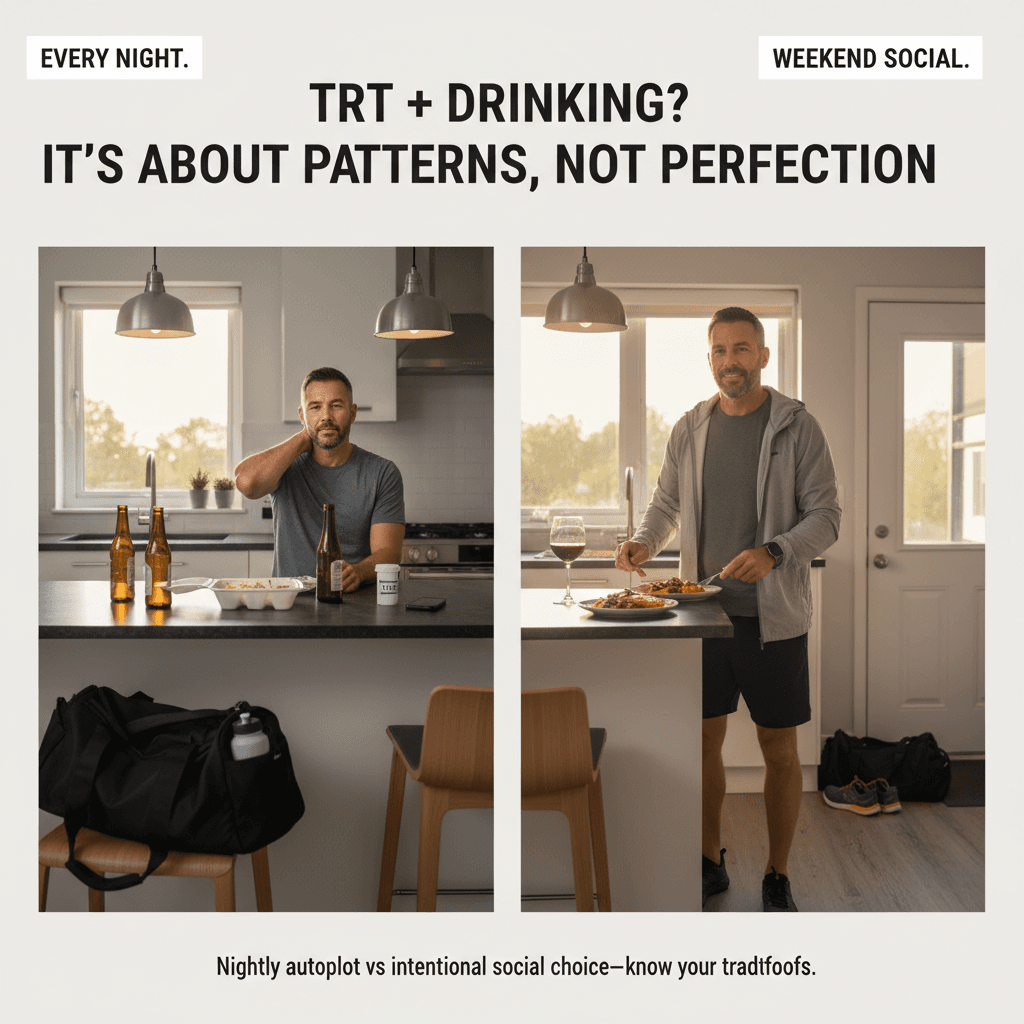
Weekend Drinker vs Nightly Drinker: Real Scenarios
Consider the guy who drinks socially on weekends. He has three or four drinks on Friday night and maybe the same on Saturday. The rest of the week, he's dialed in: training hard, eating well, sleeping enough, staying disciplined. His drinking is contained, predictable, and doesn't spill into the rest of his life. He'll see solid results from TRT, though probably not quite as good as if he didn't drink at all. The key is that his drinking isn't chronic, and his body has time to recover.
Now consider the guy who has a couple of drinks most nights. It's not a lot, just two beers or two glasses of wine to unwind. He tells himself it's no big deal. But those drinks add up over the course of a week, and his body never gets a real break. His sleep is impaired multiple nights a week. His liver is constantly managing alcohol. His hormone balance is perpetually nudged in the wrong direction. He starts TRT expecting dramatic improvements, but they never fully materialize. He's confused and frustrated, not realizing that his nightly habit is the anchor holding him back.
Then there's the guy whose drinking has clearly crossed a line. He's drinking heavily multiple nights a week, or binge drinking regularly, or using alcohol to cope with stress, anxiety, or depression. For him, TRT isn't going to work the way he hopes. The alcohol is too disruptive, too constant, and too damaging. He needs to address the drinking first, or at the very least acknowledge that TRT can't override the effects of chronic heavy alcohol use.
The Myth That TRT Will Fix Everything
One of the most dangerous misconceptions is the belief that TRT is a magic bullet that will compensate for poor lifestyle choices. Some men think that once they're on TRT, they can keep drinking the same way they always have and still get the body, energy, and performance they want. This is pure fantasy.
TRT is powerful, but it's not a miracle. It optimizes one critical variable, your testosterone levels, but it doesn't make you immune to the negative effects of alcohol. If you're drinking in a way that undermines sleep, liver function, hormone balance, and recovery, TRT can only do so much. You'll get some benefit, sure, but you'll never reach the level of results you're capable of.
Think of TRT as providing the raw materials and the right hormonal environment for your body to thrive. But you still have to build the house. If you're constantly knocking down walls with alcohol, the house never gets finished.
When Drinking On TRT Becomes A Red Flag
There are certain patterns that should raise immediate concerns. If you find yourself drinking more after starting TRT, that's a red flag. Some men experience mood changes or increased impulsivity early in treatment, and alcohol can amplify those effects.
If you're drinking to manage anxiety, stress, or low mood, and you're hoping TRT will fix those issues so you can stop drinking, you need to have an honest conversation with your healthcare provider. TRT can improve mood and mental health for many men, but it's not a substitute for addressing underlying issues with alcohol.
If your drinking is affecting your relationships, your work, or your ability to stick to your health goals, that's a sign that alcohol is a bigger problem than whether it's technically compatible with TRT. At that point, the focus needs to shift to getting help for the drinking itself.
Designing A Drinking Strategy That Supports Your Goals
The most important question you can ask yourself is this: What do I actually want from TRT?
If you want more energy, better body composition, improved libido, mental clarity, and the confidence that comes with feeling strong and healthy, then you need to be honest about whether your drinking supports or sabotages those goals.
For most men, the sweet spot is drinking occasionally and moderately. That might mean a few drinks once or twice a week, in social settings, without making it a nightly habit. It means paying attention to how alcohol affects your sleep, your recovery, and your motivation, and adjusting accordingly.
It also means being willing to cut back or cut out alcohol entirely for periods of time, especially early in your TRT journey when your body is adjusting and you're trying to gauge how well the treatment is working. You can't accurately assess TRT's effects if alcohol is muddying the waters.
Some men find that once they start feeling better on TRT, they naturally lose interest in drinking. They have more energy, better mood, and less need to use alcohol as a crutch for stress or boredom. For others, drinking remains a social enjoyment that they can manage in moderation without compromising their results.
The key is self-awareness and honesty. If you're drinking more than you think you should, if it's interfering with your goals, or if you're not getting the results you expected from TRT, alcohol is one of the first places to look.
Talk To Your Provider, Not The Internet
Every man's situation is different. Your overall health, liver function, medications, family history, mental health, and individual response to TRT all factor into how alcohol will affect you.
This is why having an honest conversation with your healthcare provider is critical. Don't downplay your drinking. Don't tell them what you think they want to hear. If you're drinking every night, say so. If you binge drink on weekends, say so. They need the full picture to give you accurate guidance and monitor your health appropriately.
Some men have underlying liver issues, take medications that interact with alcohol, or have risk factors that make even moderate drinking a bad idea. Your provider can help you understand your specific situation and make informed decisions.
What This Really Comes Down To
You can absolutely drink while on TRT. Nobody is going to tell you that a single beer will ruin your treatment. But how much you drink, how often, and in what context will directly determine how well TRT works for you.
If you're serious about getting results, if you're investing in TRT because you want to feel like yourself again, then you owe it to yourself to be honest about alcohol's role in your life. Pretending that you can drink heavily and still get everything you want from TRT is self-deception. The biology doesn't care about your rationalizations.
The good news is that you have control over this. You get to decide what matters more: the immediate gratification of drinking whenever you want, or the long-term benefits of optimizing your health and getting the most out of TRT. For most men, the answer is somewhere in the middle, a thoughtful, moderate approach that allows for occasional enjoyment without constant interference.
If you're looking to start TRT with a provider who prioritizes honest conversations about lifestyle factors like alcohol, the providers you'll connect with through AlphaMD focus on realistic expectations and sustainable approaches to men's health. They understand that optimizing testosterone is only part of the equation, and that factors like drinking, sleep, nutrition, and stress management all play a role in your results. It's about building a plan you can actually live with, not pretending that TRT exists in a vacuum.
The uncomfortable truth is that you can have both TRT and alcohol in your life, but only if you're willing to be strategic, moderate, and honest about the tradeoffs. Anything else is just hoping for results you're not willing to work for.
Have a question? Ask us.
At AlphaMD, we're here to help. Feel free to ask us any question you would like about TRT, medical weightloss, ED, or other topics related to men's health. Or take a moment to browse through our past questions.
People are asking...
Is there one diet that’s best or optimal for TRT? I usually eat following the Mediterranean diet. Frankly I never even thought about this until I just...
Mediterranean diet. That's a good diet to be on. It does depend on your goals. In general as long as you're eating healthy, regularly, and getting food fats in that's the mort important. It's more abo... See Full Answer
Can you donate plasma while on TRT?...
Yes. You can donate plasma while on prescribed TRT.... See Full Answer
Is getting on TRT a lifetime commitment? Should I expect bad side effects from coming off of it? Just wondering if I’ll be a 80 year old one day on TR...
Yes & no. It's better to think of it this way: If you have low Testosterone & do not treat it, you are committing to a life-time of low Testosterone symptoms that will for a fact always worsen with ag... See Full Answer
Get $30 off your first month’s order
Enter your email address now to receive $30 off your first month’s cost, other discounts, and additional information about TRT.
Legal Disclaimer
This website is a repository of publicly available information and is not intended to form a physician-patient relationship with any individual. The content of this website is for informational purposes only. The information presented on this website is not intended to take the place of your personal physician's advice and is not intended to diagnose, treat, cure, or prevent any disease. Discuss this information with your own physician or healthcare provider to determine what is right for you. All information is intended for your general knowledge only and is not a substitute for medical advice or treatment for specific medical conditions. The information contained herein is presented in summary form only and intended to provide broad consumer understanding and knowledge. The information should not be considered complete and should not be used in place of a visit, phone or telemedicine call, consultation or advice of your physician or other healthcare provider. Only a qualified physician in your state can determine if you qualify for and should undertake treatment.