
Weekend TRT Myths That Are Stressing You Out for Nothing
Published on:
Updated on:
People are asking...
Just started 200 mg split in 2 doses a week. Felt great first few week with high sex drive, full erections, morning wood, and strength in the gym. Wee...
There is a very common phenomenon around the 6 week mark of TRT, where some of the benefits seem to diminish. No one knows why that is, though we believe it is because that is the usual time window wh... See Full Answer
What you are doing is awesome guys! I would highly appreciate your input on my case. I have been working out in the gym/calisthenics/swimming/jogging...
To answer your questions in order: Varicocele is one of the only truly reversible causes of hypogonadism. It is a fairly minor procedure, so if you can get it taken care of now, there is a possibility... See Full Answer
TLDR: high output / high stress life. Physically and mentally. Last 2 years feeling sluggish, burned out, and find doing challenging things extremely...
Providers very often hear "I have been feeling like shit for 6 months for 2 years, I have symptoms of low T" from people trying to figure out if TRT is right for them. It sounds like you're doing it r... See Full Answer
Have a question? Ask us.
At AlphaMD, we're here to help. Feel free to ask us any question you would like about TRT, medical weightloss, ED, or other topics related to men's health. Or take a moment to browse through our past questions.
And why real life on TRT looks a lot more normal than you've been told
You've probably seen the guy at the gym who treats his testosterone protocol like a military operation. He's got his meal prep containers stacked like ammunition, his injection schedule synced to an atomic clock, and he looks at your beer like you're drinking liquid estrogen.
Here's the thing: that's not what TRT actually requires, and it's definitely not how most guys who are successful on it actually live.
Weekends are where most TRT myths come out to play. Friday night rolls around, routines loosen up, and suddenly guys start wondering:
- "Did I mess something up if I didn't inject at the exact same time?"
- "Can I even have a drink?"
- "Do I have to live like a bodybuilder forever now?"
Short answer: No. No. And definitely no.
TRT is meant to support your life—not turn weekends into a rigid checklist. Let's clear up some of the most common TRT lifestyle myths that tend to surface once the workweek ends.
Myth #1: "If You Miss Your Shot by 12 Hours, Your Levels Will Crash"
This one causes more unnecessary stress than almost anything else.
Reality: Your testosterone levels don't cliff-dive because you injected Tuesday morning instead of Monday night.
What actually happens:
- Testosterone cypionate and enanthate have a half-life of 7-8 days
- If you inject 200mg on Monday, you'll still have roughly 100mg in your system the following Monday
- Your levels decline gradually and predictably, not suddenly
- Consistency over weeks matters—precision down to the hour doesn't
Think about what a half-life actually means. Your testosterone doesn't evacuate your system the moment you're "late" for a shot. Being 12 hours off schedule might shift your peak and trough timing slightly, but it's not going to tank your results or make you feel like garbage.
The real issue is consistency over time, not precision. If you're supposed to inject twice a week and you make it three times one week, once the next, and skip a week entirely, then yeah, you're going to feel it.
Weekend takeaway: Stick to your plan, but don't panic if real life intervenes. Moving your regular Monday injection to Tuesday because you're traveling isn't a crisis.
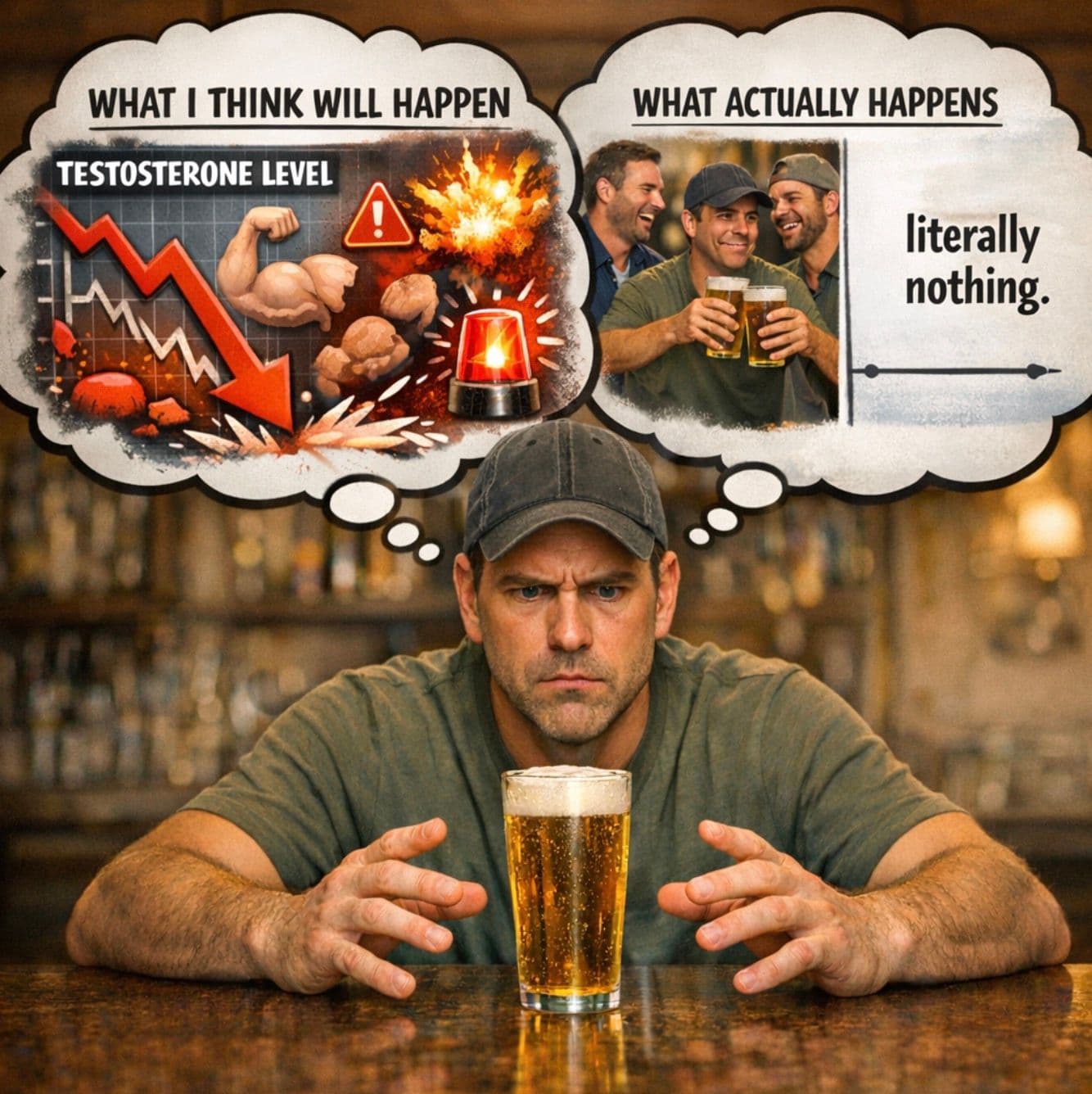
Myth #2: "Alcohol Will Completely Wreck Your Protocol"
This gets repeated so often it's become gospel in some circles.
Reality: Moderate alcohol consumption is not automatically incompatible with TRT.
What does matter:
- You're on exogenous testosterone—your body isn't producing it naturally anymore
- A couple beers on Saturday won't stop the testosterone cypionate in your system from doing its job
- Heavy drinking does affect sleep quality, recovery, and protein synthesis
- Chronic alcohol can increase aromatization (conversion of testosterone to estrogen)
Yes, alcohol lowers testosterone production in natural men. But you're getting testosterone from your injections now. What alcohol affects is everything else that makes TRT work well—sleep architecture, protein synthesis, recovery, body composition.
Having 2-3 drinks on a Friday night is very different from getting hammered every weekend. The first won't sabotage months of work. The second will work against you, but not because the alcohol is chemically neutralizing your testosterone—you're just making it harder for your body to use it effectively.
Weekend takeaway: Balance beats extremes. Have a beer at a barbecue or wine with dinner. Just don't make every weekend a marathon. Most guys on TRT naturally moderate anyway because they feel better when they don't overdo it.
Myth #3: "You Have to Live Like a Bodybuilder"
There's this weird idea that being on TRT means you're obligated to live like you're prepping for a show.
Reality: TRT is hormone replacement. The goal is getting you back to normal, healthy levels—not turning you into someone who needs to maximize every advantage 24/7.
Some men on TRT:
- Train hard and love it
- Count macros and meal prep
Others:
- Lift a few days a week
- Walk more and stay active
- Just want steady energy and better recovery
What TRT actually does:
- Gives you the hormonal foundation to make progress when you do put in work
- Makes recovery easier and consistent training more sustainable
- Doesn't require constant perfect execution
You can absolutely take weekends off from training. Sleep in on Sunday. Have a lazy Saturday where you don't hit any macros and just eat whatever sounds good. The testosterone in your system doesn't evaporate because you took a rest day or had pancakes for breakfast.
Weekend takeaway: You're not "wasting" anything by living a normal life. TRT supports the lifestyle you choose—it doesn't force one on you. Sustainable beats extreme.
Myth #4: "One Cheat Meal Ruins Your Whole Week"
This one bleeds over from general fitness culture but gets amplified in TRT circles.
Reality: Your body doesn't work in seven-day accounting periods.
What actually matters:
- Overall dietary pattern, not individual meals
- With better recovery and nutrient partitioning, you have more flexibility
- Higher muscle mass maintains a higher metabolic rate
- One indulgent meal doesn't erase the nutritious ones you ate Monday through Saturday
If anything, testosterone gives you a bigger buffer for dietary variation. That's not permission to eat garbage constantly, but it does mean pizza and wings while watching football on Sunday isn't a catastrophe.
The guys who stress about this the most tend to be the ones who don't actually enjoy their protocol. They're white-knuckling through a restrictive approach and then spiraling when real life intervenes. That's not sustainable, and it's not necessary.
Weekend takeaway: Focus on your overall pattern, not individual meals. TRT actually gives you more flexibility here, not less.
Myth #5: "You Can't Stay Out Late Because You'll Tank Your Recovery"
Sleep matters. Everyone knows this. But TRT forums will have you believing that if you're not in bed by 9:30pm, you're destroying your hormones.
Reality: One late night isn't going to derail everything.
What sleep actually affects on TRT:
- Natural testosterone production happens during sleep—but you're on exogenous testosterone now
- Your levels aren't being created during sleep anymore
- What does matter: recovery, protein synthesis, how well your body uses the testosterone it has
- Chronic sleep deprivation will work against you—occasional late nights won't
Think about it practically. Sometimes you're going to stay up late for a concert, a friend's going-away party, or because you're traveling across time zones. If your protocol can't handle normal human behavior occasionally, it's not a sustainable protocol.
Weekend takeaway: Prioritize sleep most of the time, but don't treat every weekend like you're in training camp. TRT should make your life more livable, not less.
The Bigger Picture: TRT Is a Lifestyle Support Tool
The common thread in all these myths is the assumption that TRT requires perfection.
In reality, effective TRT should:
- Reduce anxiety around routines, not increase it
- Improve recovery and resilience
- Make weekends more enjoyable, not more stressful
- Create flexibility to enjoy social events, family time, and rest days
Providers on the AlphaMD platform see this all the time—guys who start TRT thinking they need to overhaul their entire existence, then realize they actually just needed their testosterone at healthy levels. The lifestyle changes that stick are the ones you want to make because you feel better, not the ones you force yourself into out of fear.
Your weekend plans don't need approval from your testosterone protocol. Have the beer. Sleep in. Skip the gym. Take the trip. Just keep the overall pattern consistent, and you'll be fine.
That's the whole point of optimization—it should make your life better, not turn it into a rigid checklist.
Have a question? Ask us.
At AlphaMD, we're here to help. Feel free to ask us any question you would like about TRT, medical weightloss, ED, or other topics related to men's health. Or take a moment to browse through our past questions.
People are asking...
Just started 200 mg split in 2 doses a week. Felt great first few week with high sex drive, full erections, morning wood, and strength in the gym. Wee...
There is a very common phenomenon around the 6 week mark of TRT, where some of the benefits seem to diminish. No one knows why that is, though we believe it is because that is the usual time window wh... See Full Answer
What you are doing is awesome guys! I would highly appreciate your input on my case. I have been working out in the gym/calisthenics/swimming/jogging...
To answer your questions in order: Varicocele is one of the only truly reversible causes of hypogonadism. It is a fairly minor procedure, so if you can get it taken care of now, there is a possibility... See Full Answer
TLDR: high output / high stress life. Physically and mentally. Last 2 years feeling sluggish, burned out, and find doing challenging things extremely...
Providers very often hear "I have been feeling like shit for 6 months for 2 years, I have symptoms of low T" from people trying to figure out if TRT is right for them. It sounds like you're doing it r... See Full Answer
Get $30 off your first month’s order
Enter your email address now to receive $30 off your first month’s cost, other discounts, and additional information about TRT.
Legal Disclaimer
This website is a repository of publicly available information and is not intended to form a physician-patient relationship with any individual. The content of this website is for informational purposes only. The information presented on this website is not intended to take the place of your personal physician's advice and is not intended to diagnose, treat, cure, or prevent any disease. Discuss this information with your own physician or healthcare provider to determine what is right for you. All information is intended for your general knowledge only and is not a substitute for medical advice or treatment for specific medical conditions. The information contained herein is presented in summary form only and intended to provide broad consumer understanding and knowledge. The information should not be considered complete and should not be used in place of a visit, phone or telemedicine call, consultation or advice of your physician or other healthcare provider. Only a qualified physician in your state can determine if you qualify for and should undertake treatment.