
Your TRT Passport: What You Need to Know Before Flying International
Published on:
Updated on:
People are asking...
How is traveling overseas with TRT? Especially in strict countries like the Arab countries. Do you provide a note? Any tips?...
You hit the nail on the head with that second part. Traveling with TRT tends to go two ways: It's a total non-issue or you need to do some work ahead of time. Most of the time you can travel to any co... See Full Answer
I travel internationally quite often for work, and just recently started TRT. Do you guys provide an actual prescription that I can include in my lug...
Yes sir. Your prescription should be right on the vial or the container that the vial comes in from the compounding pharmacy that fills your prescription. You can also show anyone who needs to see you... See Full Answer
Do you provide us with an actual prescription for testosterone? In case I travel, I want to have the script to show that my meds are prescribed to me ...
Yes sir, any Testosterone given out in the USA requires a prescription. Your prescription comes from the licensed provider overseeing your care. You'll see your medication listed on the AlphaMD websit... See Full Answer
Have a question? Ask us.
At AlphaMD, we're here to help. Feel free to ask us any question you would like about TRT, medical weightloss, ED, or other topics related to men's health. Or take a moment to browse through our past questions.
So you're finally taking that trip to Europe, planning a business conference in Tokyo, or heading to Australia for a month-long adventure. Exciting stuff. There's just one small detail you need to figure out: how the hell do you travel internationally with testosterone?
Look, traveling with TRT isn't exactly like packing your toothbrush, but it's also not the logistical nightmare some guys make it out to be. The key is knowing what you're dealing with before you're standing at customs trying to explain why you have vials of Schedule III controlled substances in your carry-on.
Why Testosterone Makes Border Agents Twitchy
Here's the thing: testosterone is a controlled substance in most countries. Not because governments are trying to ruin your gains, but because it has legitimate abuse potential and they want to track it. That means traveling with it requires some actual preparation, not just tossing it in your bag and hoping for the best.
Different countries have wildly different rules about bringing in controlled substances. Some are pretty chill about it if you have documentation. Others treat it like you're smuggling contraband, even with a valid prescription. Knowing which category your destination falls into can save you from having a really awkward conversation with customs officials.
The Documentation You Actually Need
Before you start Googling country-specific regulations, get your paperwork in order. This is non-negotiable regardless of where you're going.
First up: a letter from your prescribing physician on official letterhead. This isn't your prescription label. This is a formal letter that states your name, the medication name (use both the generic and brand name), dosage, frequency, and confirms it's medically necessary. Have your doctor date it within 30 days of your departure and include their contact information and medical license number.
Keep your medication in its original pharmacy-labeled container. Yes, even if it's inconvenient. Yes, even if you normally transfer it to a smaller vial. That pharmacy label with your name, the prescribing doctor, and the medication details is your first line of defense at customs.
Pack copies of your actual prescription too. Not photos on your phone - physical copies or PDFs you can pull up instantly. Some countries require you to declare controlled substances in advance, and having everything readily available makes that process infinitely smoother.
The EU: Generally Straightforward (With Caveats)
If you're heading to most European Union countries for under 90 days, you're in luck. The EU has a system where you can carry a 90-day supply of prescription medication for personal use with proper documentation. That means your doctor's letter and prescription should be sufficient for countries like France, Germany, Italy, or Spain.
The UK (post-Brexit) follows similar logic. Bring your prescription, your doctor's letter, and keep everything properly labeled. You're good for up to three months' worth of medication.
That said, always check the specific embassy website of your destination country. Regulations can change, and some EU countries have additional requirements for controlled substances. Better to spend 10 minutes confirming than to deal with your medication being confiscated at Heathrow.
Japan: Plan Ahead or Don't Bring It
Japan takes medication regulations seriously. Like, really seriously. You cannot just show up with testosterone and a prescription - you'll need to apply for a Yakkan Shoumei (import certificate) in advance. This process takes several weeks and requires you to submit your doctor's letter, prescription, and detailed information about your medication before you travel.
The good news? If you do this properly, Japan will let you bring in up to a month's supply. The bad news? If you don't do it and try to bring it anyway, you're risking having it seized, paying hefty fines, or potentially facing legal consequences. Not worth the risk for a two-week trip.
For longer stays in Japan, you'll need to coordinate with local medical providers. It's doable, but it requires advanced planning.
Australia: Declare Everything
Australia's customs declarations are famously thorough, and medications are no exception. The good news is that Australia recognizes legitimate medical prescriptions for testosterone. The crucial part is declaring it on your incoming passenger card and having your documentation ready.
You can bring up to three months' supply with a valid prescription and doctor's letter. Just don't try to be clever and not declare it. Australian customs has seen every trick in the book, and "forgetting" to mention controlled substances rarely ends well.
The Middle East: Proceed with Extreme Caution
This is where things get tricky. Many Middle Eastern countries have extremely strict regulations around controlled substances, and testosterone can fall into a gray area depending on the country and the individual customs official's interpretation.
For places like the UAE (Dubai, Abu Dhabi), you theoretically can bring controlled substances with proper documentation and pre-approval, but the requirements are stringent. You'll likely need to coordinate with the Ministry of Health in advance and possibly have your medication verified before entry.
Some guys opt to schedule their injections around trips to these regions rather than risking complications. If your trip is short, this might be the path of least resistance. If it's a longer stay, you'll need to do serious research and possibly work with a local physician.
Packing Smart: Carry-On vs. Checked Luggage
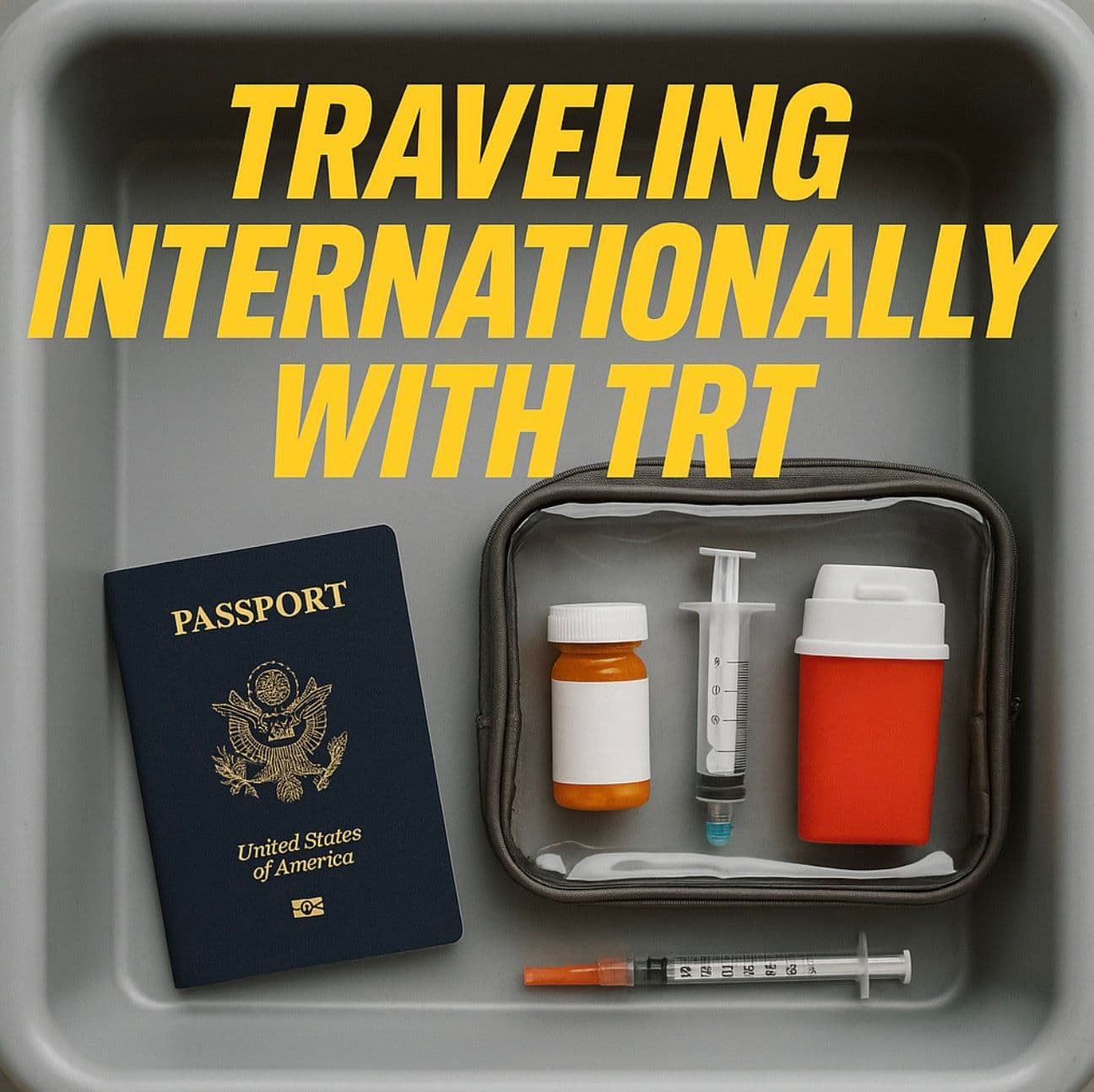
Always pack testosterone in your carry-on. Yes, even though it means dealing with TSA and their liquid restrictions. Here's why: if your checked bag gets lost, delayed, or sent to the wrong continent (and all three happen more often than you'd think), you don't want to be stuck in Barcelona without your medication.
For injectable testosterone, you can bring syringes and needles in your carry-on as long as they're accompanied by your medication and prescription. TSA agents see this all the time. Just be prepared to explain if asked. Having that doctor's letter easily accessible makes this conversation about 30 seconds instead of 30 minutes.
Keep everything together in a clear plastic bag. Your medication, syringes, alcohol wipes, and documentation all in one place. It shows you're organized and legitimate, and it makes everyone's job easier.
What If You Get Stopped?
Let's say you're at customs and an agent wants to inspect your medication. Stay calm. This happens. Be straightforward: "This is my prescription testosterone therapy. Here's my doctor's letter, prescription, and the medication in its original container."
Don't volunteer extra information or get defensive. Answer their questions directly. Most customs officials deal with prescription medications constantly and are just making sure everything's legitimate. Your documentation does the heavy lifting here.
If there's a language barrier, having your documents in both English and the local language (if possible) helps tremendously. Many doctor's offices can provide translated letters if you ask in advance.
The Real Talk on Long Trips
If you're planning to be abroad for longer than three months, your best bet is usually to establish care with a local physician who can prescribe and monitor your TRT. This is standard practice for expats and long-term travelers. Most developed countries have endocrinologists or men's health clinics that handle hormone therapy.
Research this before you leave. Find out if your insurance covers international care, what the process looks like for getting established with a new provider, and whether you'll need to do new blood work or can transfer your existing results.
Making It Work
International travel with TRT requires planning, but it shouldn't stop you from going anywhere you want to go. The guys who run into problems are usually the ones who treated their medication like an afterthought and figured they'd deal with it at the airport.
Start your preparation at least a month before departure. That gives you time to get proper documentation, research destination requirements, and handle any special permits or approvals. If you're a patient on the AlphaMD platform, the provider overseeing your care can help you get the necessary letters and documentation for international travel.
The world's a big place, and being on TRT doesn't mean you're stuck at home. Just do your homework, pack smart, and you'll clear customs without breaking a sweat.
Have a question? Ask us.
At AlphaMD, we're here to help. Feel free to ask us any question you would like about TRT, medical weightloss, ED, or other topics related to men's health. Or take a moment to browse through our past questions.
People are asking...
How is traveling overseas with TRT? Especially in strict countries like the Arab countries. Do you provide a note? Any tips?...
You hit the nail on the head with that second part. Traveling with TRT tends to go two ways: It's a total non-issue or you need to do some work ahead of time. Most of the time you can travel to any co... See Full Answer
I travel internationally quite often for work, and just recently started TRT. Do you guys provide an actual prescription that I can include in my lug...
Yes sir. Your prescription should be right on the vial or the container that the vial comes in from the compounding pharmacy that fills your prescription. You can also show anyone who needs to see you... See Full Answer
Do you provide us with an actual prescription for testosterone? In case I travel, I want to have the script to show that my meds are prescribed to me ...
Yes sir, any Testosterone given out in the USA requires a prescription. Your prescription comes from the licensed provider overseeing your care. You'll see your medication listed on the AlphaMD websit... See Full Answer
Get $30 off your first month’s order
Enter your email address now to receive $30 off your first month’s cost, other discounts, and additional information about TRT.
Legal Disclaimer
This website is a repository of publicly available information and is not intended to form a physician-patient relationship with any individual. The content of this website is for informational purposes only. The information presented on this website is not intended to take the place of your personal physician's advice and is not intended to diagnose, treat, cure, or prevent any disease. Discuss this information with your own physician or healthcare provider to determine what is right for you. All information is intended for your general knowledge only and is not a substitute for medical advice or treatment for specific medical conditions. The information contained herein is presented in summary form only and intended to provide broad consumer understanding and knowledge. The information should not be considered complete and should not be used in place of a visit, phone or telemedicine call, consultation or advice of your physician or other healthcare provider. Only a qualified physician in your state can determine if you qualify for and should undertake treatment.