
Your Total T Is 700 and You Feel Terrible - This Is Exactly Why
Published on:
Updated on:
People are asking...
What are the perfect number?! Let's say I would like my total T to be around 1000.......
The perfect number has to do with your individual goals of therapy. Most men just want to feel better and get relief from their low T symptoms. For them ideal may mean a TT around 600. Some men desire... See Full Answer
With T fluctuations being so drastic from any given hour, day, week, how can you really know if someone has a hormonal imbalance?...
That is why symptoms are king, and numbers should be used as a guide post for what treatment is appropriate and how responsive someone is. Your 500 and my 500 will feel completely different to each of... See Full Answer
Hi. I am 46 and about normal weight for my height. I have all the low T symptoms except for ED for past few years. However My test is 750, my free T i...
Unfortunately, there is an almost certainty that your natural testosterone production is permanently compromised due to your use of a SSRI (Prozac). Knowing that, it is possible you are experiencing ... See Full Answer
Have a question? Ask us.
At AlphaMD, we're here to help. Feel free to ask us any question you would like about TRT, medical weightloss, ED, or other topics related to men's health. Or take a moment to browse through our past questions.
Your doctor said your testosterone is normal. Your body is saying something completely different, and both of those things can be true at the same time.
The Number on Your Lab Report Is Not the Whole Story
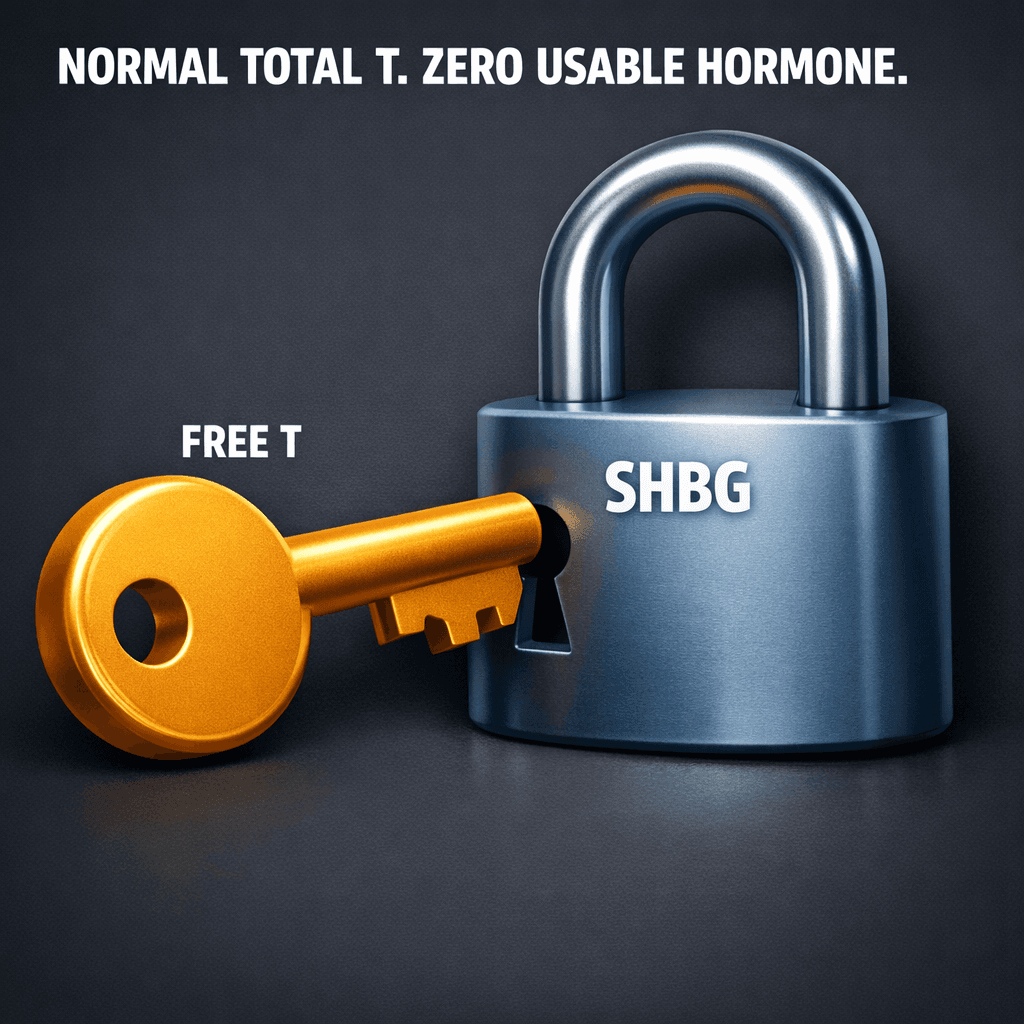
Total testosterone is the most commonly ordered hormone test in men's health, and it is also one of the most frequently misunderstood. When a result lands in the "normal" range, many clinicians stop there. Case closed. But total testosterone measures all the testosterone circulating in your blood, including the portion that is chemically bound to proteins and completely unavailable for your body to actually use.
Think of it this way. If you have a thousand dollars in the bank but nine hundred of it is locked in a vault you cannot access, you do not have a thousand dollars to spend. You have a hundred. Your total balance looks fine on paper. Your lived experience is very different.
That gap between what the test shows and what you feel is not imaginary. It has real biological explanations, and understanding them matters.
Free Testosterone, Bioavailable Testosterone, and the Protein Problem
Testosterone travels through the bloodstream attached to proteins, primarily sex hormone-binding globulin, or SHBG, and albumin. The testosterone bound tightly to SHBG is essentially inactive. It cannot bind to receptors in muscle, brain, bone, or other target tissues. The testosterone loosely attached to albumin, along with the small amount that floats freely, is what your body can actually put to work. Together, the free and albumin-bound fractions are called bioavailable testosterone.
SHBG levels vary enormously between individuals and shift significantly across a lifetime. They tend to rise with age, with liver conditions, with hyperthyroidism, and with certain medications. They tend to fall with obesity, insulin resistance, and hypothyroidism. Two men with identical total testosterone readings can have dramatically different amounts of free testosterone depending on how much SHBG each man carries.
A man with a total T of 700 and elevated SHBG may have less free testosterone than a man with a total T of 450 and low SHBG. The total number, in isolation, tells you almost nothing about hormone availability at the cellular level. This is why clinicians who take men's hormone health seriously typically look at free testosterone and SHBG alongside total T, and why relying on a single number to dismiss symptoms is a mistake.
What Else Can Make a Man With "Normal" Testosterone Feel Terrible
Even when free testosterone is genuinely adequate, there are many other physiological factors that can produce symptoms identical to hypogonadism: fatigue, low libido, poor mood, difficulty concentrating, reduced strength, and disrupted sleep.
Sleep is often the most underestimated variable. The majority of daily testosterone production occurs during sleep, particularly during slow-wave and REM stages. Men who are getting six hours or less of fragmented, poor-quality sleep are running a testosterone deficit that a morning blood draw will not fully capture. Obstructive sleep apnea, a condition affecting a substantial portion of middle-aged men and many younger ones, suppresses testosterone production, drives up cortisol, and creates a hormonal environment that mimics low T almost perfectly.
Stress does significant damage on its own. Cortisol, the body's primary stress hormone, competes with testosterone at the receptor level and suppresses the signaling cascades that drive testosterone production. Chronically elevated cortisol from work pressure, relationship strain, financial stress, or any persistent psychological burden can leave the hormonal system suppressed even when labs look clean. This is not a weakness or a mental health failure. It is basic endocrinology.
Depression and anxiety deserve particular attention here because the relationship between mood disorders and testosterone is genuinely bidirectional. Low testosterone can cause depression. But depression itself, independent of testosterone levels, produces fatigue, low libido, anhedonia, and cognitive fog. A man managing untreated or under-treated depression may feel every symptom associated with low testosterone regardless of where his labs fall.
Training, Eating, and Drinking Your Testosterone Away
The lifestyle factors that men least expect to be culprits are sometimes the most powerful ones.
Overtraining, meaning pushing training volume and intensity beyond the body's ability to recover, suppresses the hypothalamic-pituitary-gonadal axis. The HPG axis is the hormonal communication chain that tells the testes to produce testosterone. When the body is under chronic physical stress without adequate recovery, that chain goes quiet. Testosterone drops. Cortisol rises. The man training six or seven days a week without enough sleep or food often feels worse than the man doing far less.
Caloric deficits compound the problem. The body treats significant energy restriction as a survival threat, and testosterone production is not a survival priority. Men pursuing aggressive fat loss, particularly with very low dietary fat intake, frequently see hormone levels decline even when their starting levels were healthy. Fat is the direct precursor to steroid hormones. Too little of it, and hormone production simply does not have the raw materials it needs.
Alcohol is frequently overlooked. Regular drinking, even at moderate levels, interferes with testicular testosterone synthesis, increases conversion of testosterone to estrogen, disrupts sleep architecture, and elevates cortisol. It is one of the most efficient ways to feel hormonally suboptimal while maintaining a technically normal total T on a lab test.
The Estradiol Equation Most Men Have Never Considered
Testosterone and estradiol exist in a dynamic balance in the male body. Testosterone converts to estradiol through a process called aromatization, and estradiol plays important roles in bone density, cardiovascular health, libido, and cognitive function in men. The common assumption that estradiol is strictly a female hormone is wrong.
But balance matters. Estradiol that climbs too high relative to testosterone can cause fatigue, mood changes, reduced libido, water retention, and difficulty with body composition. Estradiol that falls too low, which can happen in certain clinical contexts, produces its own set of symptoms including joint pain, low libido, mood instability, and bone loss. The point is not to chase a specific number but to recognize that estradiol is part of the hormonal picture and should not be ignored when evaluating symptoms.
Prolactin, Thyroid, and the Hormones That Get Left Off the Panel
Prolactin is a hormone most commonly associated with lactation, but it is present in men and, when elevated, can significantly suppress testosterone and cause symptoms including reduced libido, fatigue, and even fertility issues. Mildly elevated prolactin can result from chronic stress, certain medications including antidepressants and antipsychotics, or from a small benign pituitary growth called a prolactinoma. It is worth measuring, particularly when a man's symptoms do not match his testosterone levels.
Thyroid dysfunction is another common masquerader. Both hypothyroidism and hyperthyroidism alter SHBG, affect energy metabolism, disrupt sleep, and cause mood changes that overlap substantially with low testosterone symptoms. A man with undiagnosed or undertreated hypothyroidism can feel exhausted, foggy, and unmotivated regardless of his testosterone level.
Insulin resistance, which often precedes type 2 diabetes by years or decades, is closely linked to hormonal disruption. It tends to lower SHBG, which sounds like it would help by increasing free testosterone, but insulin resistance also drives inflammation, disrupts sleep, promotes fat accumulation, and sets the stage for a broad pattern of metabolic and hormonal dysfunction that leaves men feeling unwell in ways that resist simple categorization.
Why a Single Lab Draw at an Arbitrary Time Cannot Tell the Full Story
Testosterone follows a circadian rhythm. Levels are highest in the early morning, typically between 7 and 10 a.m., and fall through the day. A blood draw at 3 p.m. can show levels meaningfully lower than a morning draw from the same man on the same day. Labs that test later in the day without accounting for this shift can produce results that underestimate a man's true baseline.
Acute illness, even something as minor as a cold, temporarily suppresses testosterone. So does significant psychological stress immediately before a draw. Lab methodology and reference ranges also differ between laboratories, meaning a number that falls in the normal range at one facility might be flagged differently at another.
A single measurement is a snapshot of one moment in a system that fluctuates constantly. Trends across multiple tests, considered alongside symptoms and lifestyle context, offer far more meaningful information than any single data point.
What a Thorough Evaluation Actually Looks Like
A genuinely useful clinical evaluation for a man who feels consistently unwell despite normal total testosterone typically goes well beyond a single hormone panel. It starts with a detailed symptom inventory, not just a checklist but a real conversation about onset, severity, and how symptoms interact with sleep, stress, activity, and diet.
Sleep screening matters, including consideration of sleep apnea if there are risk factors like snoring, daytime sleepiness, or a partner's observations. A lifestyle review covering training load, caloric intake, alcohol use, and psychological stressors can surface causes that no blood test will catch.
Lab evaluation for this kind of presentation often includes free testosterone, SHBG, estradiol, prolactin, thyroid function markers, metabolic markers, and sometimes a full blood count and inflammatory markers depending on the clinical picture. The goal is not to search for a single abnormal value to fix but to understand the system as a whole.
This kind of evaluation takes time and clinical judgment. It treats symptoms as real and meaningful data, not as a sign that the patient is confused about his own lab results.
Feeling Bad Is Real. The Range Is Not the Ceiling.
Reference ranges for testosterone were built from population averages. They define what is statistically common, not what is optimal for any specific individual. Two men at the same point within that range can have profoundly different experiences of physical and mental health based on their SHBG levels, their sleep quality, their stress burden, their other hormone levels, and dozens of additional variables.
When a man feels persistently fatigued, mentally foggy, low in libido, and physically off, and a clinician responds to a normal total T result by saying there is nothing wrong, that response is incomplete. The symptoms are real. The question is what is actually driving them.
Providers practicing through AlphaMD take this more complete approach, looking at free and bioavailable testosterone, the broader hormonal environment, lifestyle factors, and symptom patterns together rather than treating a single number as a verdict. Because a number in range is not the same thing as a man who feels well. Those are two different things, and confusing them helps no one.
Have a question? Ask us.
At AlphaMD, we're here to help. Feel free to ask us any question you would like about TRT, medical weightloss, ED, or other topics related to men's health. Or take a moment to browse through our past questions.
People are asking...
What are the perfect number?! Let's say I would like my total T to be around 1000.......
The perfect number has to do with your individual goals of therapy. Most men just want to feel better and get relief from their low T symptoms. For them ideal may mean a TT around 600. Some men desire... See Full Answer
With T fluctuations being so drastic from any given hour, day, week, how can you really know if someone has a hormonal imbalance?...
That is why symptoms are king, and numbers should be used as a guide post for what treatment is appropriate and how responsive someone is. Your 500 and my 500 will feel completely different to each of... See Full Answer
Hi. I am 46 and about normal weight for my height. I have all the low T symptoms except for ED for past few years. However My test is 750, my free T i...
Unfortunately, there is an almost certainty that your natural testosterone production is permanently compromised due to your use of a SSRI (Prozac). Knowing that, it is possible you are experiencing ... See Full Answer
Get $30 off your first month’s order
Enter your email address now to receive $30 off your first month’s cost, other discounts, and additional information about TRT.
Legal Disclaimer
This website is a repository of publicly available information and is not intended to form a physician-patient relationship with any individual. The content of this website is for informational purposes only. The information presented on this website is not intended to take the place of your personal physician's advice and is not intended to diagnose, treat, cure, or prevent any disease. Discuss this information with your own physician or healthcare provider to determine what is right for you. All information is intended for your general knowledge only and is not a substitute for medical advice or treatment for specific medical conditions. The information contained herein is presented in summary form only and intended to provide broad consumer understanding and knowledge. The information should not be considered complete and should not be used in place of a visit, phone or telemedicine call, consultation or advice of your physician or other healthcare provider. Only a qualified physician in your state can determine if you qualify for and should undertake treatment.