
Your Gut Microbiome Is Converting Your Testosterone Into Estrogen. Here's the Mechanism.
Published on:
Updated on:
People are asking...
What do i do if i am fat(37 BMI) and and have low SHGB(11 nmol/l) low test(1-2 ng/ml over several measurements). I do go to the gym 4 times a week, ha...
Additional Testosterone is converted into Estrogen because the body sees it as "maintaining the balance" and isn't directly related to body fat content. Estrogen is fat soluble which does mean that wh... See Full Answer
With continued estrogenification of our environment in societal wide decreases in testosterone and sperm count, not everyone is going to necessarily f...
The question really comes down to do you have primary or secondary hypogonadism. If you have primary hypogonadism, you could take all the enclomiphene in the world and it would not adequately raise th... See Full Answer
Why does testosterone increase my anxiety ?...
Most men who use testosterone actually report a decrease in anxiety. Men who use testosterone that aromatize to excess (ie convert the testosterone to estrogen) are often the ones who complain of incr... See Full Answer
Have a question? Ask us.
At AlphaMD, we're here to help. Feel free to ask us any question you would like about TRT, medical weightloss, ED, or other topics related to men's health. Or take a moment to browse through our past questions.
Most men have never considered that the trillions of bacteria living in their digestive tract have anything to do with their testosterone levels. The evidence says otherwise, and the mechanism is worth understanding.
This is not a story about some fringe supplement claim. There is a growing body of research connecting gut microbiome composition to sex hormone metabolism, estrogen clearance, and the systemic inflammation that drives aromatase activity. If your energy is low, your body composition has shifted, your libido has faded, or you just feel off in ways you cannot explain, the gut-hormone axis may be a piece of the puzzle you have not looked at yet.
The Body Does Not Run Hormones in Isolation
Before getting into the gut specifically, it helps to understand the basic control system for male sex hormones. The hypothalamic-pituitary-gonadal axis, often called the HPG axis, is the chain of command that governs testosterone production. The hypothalamus sends a signal down to the pituitary, which then signals the testes to produce testosterone. This feedback loop is sensitive. When estrogen levels rise, the hypothalamus detects it and can suppress the signal that drives testosterone production. Less drive from above means less testosterone output below.
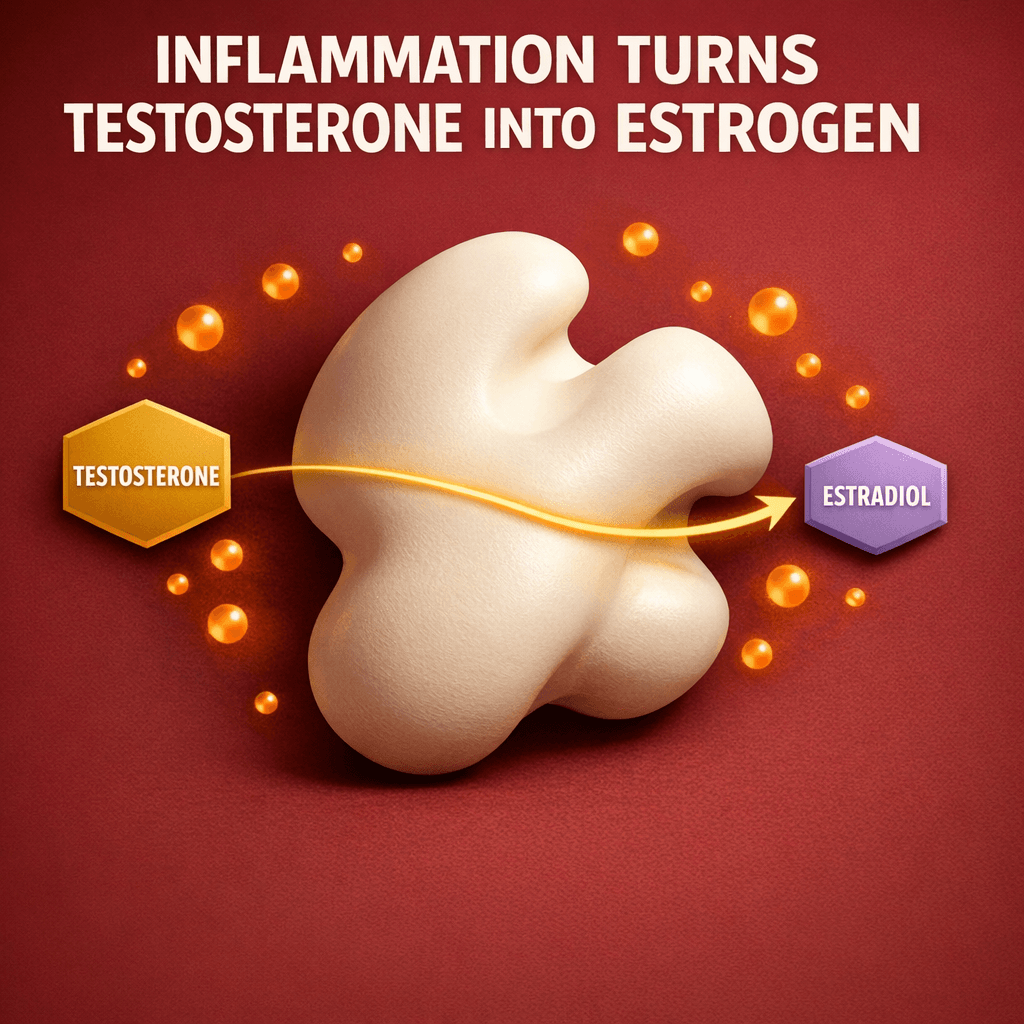
This matters because estrogen in men is not just about what the testes produce directly. A significant portion of estrogen in the male body comes from the conversion of testosterone into estradiol by an enzyme called aromatase. Aromatase lives in fat tissue, the liver, the brain, and elsewhere. The more aromatase activity a man has, the more of his testosterone gets converted. And a number of factors that are deeply connected to gut health, including systemic inflammation, insulin resistance, and excess adiposity, are among the most potent drivers of aromatase activity.
What Gut Dysbiosis Actually Does
A healthy gut microbiome is a diverse ecosystem. When that diversity collapses, when opportunistic bacteria crowd out beneficial species, it is called dysbiosis. Dysbiosis is not just a digestive problem. It has systemic effects that reach the liver, the endocrine system, and the brain.
One of the most important consequences of dysbiosis is increased intestinal permeability, sometimes called leaky gut. The gut lining is designed to be selectively permeable, letting nutrients through while keeping bacterial byproducts out. When the lining is compromised, fragments of bacterial cell walls, particularly a molecule called lipopolysaccharide or LPS, can pass into the bloodstream.
LPS is a potent trigger of the innate immune system. Even at low concentrations, chronic LPS exposure drives the production of inflammatory cytokines, including tumor necrosis factor-alpha and various interleukins. This state of low-grade systemic inflammation is not dramatic enough to feel like an infection, but it is persistent, and it has real consequences for hormone metabolism. Inflammatory cytokines have been shown to upregulate aromatase expression. More aromatase means more conversion of testosterone to estradiol. This is one of the clearest links between a disrupted gut and a shift in sex hormone balance.
Inflammation also worsens insulin sensitivity. Insulin resistance, in turn, promotes fat accumulation, particularly visceral fat. Visceral fat is metabolically active and loaded with aromatase. The cycle feeds itself: dysbiosis drives inflammation, inflammation promotes insulin resistance, insulin resistance promotes fat gain, fat gain increases aromatase activity, and aromatase converts more testosterone into estrogen.
The Estrobolome: Your Gut's Role in Estrogen Clearance
Here is where the mechanism gets more specific. The gut microbiome contains a community of bacteria collectively referred to as the estrobolome. These bacteria produce an enzyme called beta-glucuronidase, and what this enzyme does has a direct effect on how much estrogen circulates in the body.
The liver processes estrogens and prepares them for excretion by attaching a glucuronic acid molecule to them in a process called glucuronidation. This conjugation renders the estrogen water-soluble and ready to be eliminated through bile into the intestine and then out through stool. Under normal circumstances, this is how estrogen leaves the body.
Beta-glucuronidase breaks that bond. When gut bacteria produce high levels of this enzyme, they cleave the glucuronic acid off the conjugated estrogen, deconjugating it and returning it to an active, absorbable form. The estrogen then gets reabsorbed through the intestinal wall and re-enters circulation via the portal vein. This recycling process is part of what is called enterohepatic circulation.
The result is an increased total estrogen burden. The liver worked to package and dispose of that estrogen, and the gut effectively sent it back. Over time, in men with high beta-glucuronidase activity driven by an imbalanced microbiome, this can meaningfully elevate circulating estrogen levels or slow the rate at which estrogen is cleared from the system.
To be precise about the claim in the title: the gut microbiome does not directly convert testosterone into estrogen the way an enzyme factory would. The conversion itself is done by aromatase, which is a human enzyme. What the gut does is create the inflammatory and metabolic conditions that increase aromatase activity, and separately, it can reduce estrogen clearance through the beta-glucuronidase mechanism. The net effect on a man's estrogen burden and estrogen-to-testosterone ratio can be significant, but it is indirect. That distinction matters if you are trying to actually address the problem.
What This Feels Like in Real Life
Men rarely come in saying their estrobolome is overactive. They come in saying they feel tired all the time, that their drive in the gym has dropped, that their mood is flat, that they are carrying more fat around the chest and midsection than they used to, that sex does not interest them the way it once did, or that they wake up groggy no matter how much they sleep.
Relatively elevated estrogen or a poor testosterone-to-estrogen ratio can contribute to all of these. Gynecomastia, the development of breast tissue in men, is strongly associated with elevated estradiol relative to androgens. Water retention, mood instability, difficulty building and holding muscle, and reduced erectile function are all symptoms that men and their clinicians may attribute to low testosterone, when in some cases the picture is more nuanced: testosterone may not be dramatically low, but estrogen handling may be impaired, and the ratio matters as much as the absolute number.
Brain fog is another symptom worth mentioning. The gut-brain axis is real, and estrogen receptors exist throughout the central nervous system. When gut dysbiosis drives systemic inflammation, that inflammation can cross into neurological territory, affecting mood, cognition, and the kind of mental sharpness men associate with feeling like themselves.
Lifestyle Levers That Work on Both Systems at Once
The good news is that the same lifestyle factors that support a healthier microbiome tend to support healthier hormone metabolism, and many of them work on multiple points of the mechanism simultaneously.
Dietary fiber diversity is one of the most consistently supported ways to promote microbiome health. Different types of fiber feed different beneficial bacterial species. A diet heavy in ultra-processed foods and low in plant variety tends to reduce microbial diversity and can shift the balance toward bacterial populations that produce more beta-glucuronidase. Eating a wider range of vegetables, legumes, whole grains, and fruits provides a broader range of fermentable substrates.
Adequate protein intake matters for body composition, for preserving muscle mass, and for supporting the liver's detoxification and conjugation pathways. The liver needs amino acid precursors and cofactors to properly process and clear estrogens. Nutritional adequacy supports that capacity.
Alcohol has a direct impact on liver function and on the gut microbiome. Even moderate chronic intake can reduce liver clearance of estrogen and alter gut bacteria in ways that are not favorable for hormone metabolism. Reducing intake is one of the more impactful single changes a man can make.
Sleep is a significant lever that tends to be underestimated. Poor sleep drives cortisol elevation, which in turn suppresses testosterone production and promotes inflammation. Sleep deprivation also disrupts gut motility and can worsen intestinal permeability over time. Addressing constipation matters here too, because slow gut transit time increases the window for estrogen reabsorption.
Resistance training consistently improves insulin sensitivity, reduces visceral fat, and supports testosterone levels through multiple pathways. It also has favorable effects on gut motility and microbial diversity in the longer term. The effect on reducing aromatase-rich visceral fat is particularly relevant to this discussion.
Stress management deserves mention not as a platitude but as a mechanistic point. Chronic psychological stress elevates cortisol, which suppresses the HPG axis directly and also increases intestinal permeability by disrupting tight junction proteins in the gut lining.
Probiotics and prebiotics are frequently marketed for hormone health. The evidence is generally encouraging but inconsistent, and individual responses vary substantially based on existing microbiome composition. They are not a substitute for the dietary and lifestyle foundations, and specific strains produce different effects. General guidance from a clinician is more useful than following supplement marketing.
Medications and Medical Conditions That Intersect Here
Several commonly used medications interact with gut and hormone metabolism in ways men should be aware of, at least in general terms. Antibiotics can dramatically disrupt microbiome composition, sometimes for extended periods. This does not mean avoiding necessary antibiotic treatment, but it is worth discussing with a physician and supporting gut recovery afterward.
Proton pump inhibitors, used widely for acid reflux, alter the gastric environment in ways that can shift microbial populations in the upper GI tract. Long-term use has been associated with microbiome changes.
GLP-1 receptor agonists, a class of medications now widely used for weight loss and diabetes management, appear to have favorable effects on gut function and metabolic inflammation, and weight loss itself meaningfully reduces aromatase activity. Metformin, a first-line diabetes medication, has demonstrated prebiotic-like effects on gut bacteria in some research.
Underlying conditions also matter. Liver disease directly impairs estrogen conjugation and clearance. Hypothyroidism slows liver metabolism and gut motility, both of which can affect hormone handling. If any of these conditions are in the picture, hormone symptoms need to be evaluated in that broader context.
When to Get a Professional Evaluation
Self-treating hormone symptoms can backfire in ways that are not always obvious. Estrogen is not simply a villain in male physiology. It is essential for bone density, cardiovascular health, cognitive function, and libido. Aggressively trying to suppress it without understanding the underlying picture can cause its own set of problems.
If you are experiencing persistent symptoms, a clinical evaluation is the appropriate starting point. A clinician may look at a range of factors: total and free testosterone, estradiol, sex hormone binding globulin, markers of inflammation, metabolic markers including insulin sensitivity, thyroid function, and liver function. The goal is to understand the whole picture rather than to optimize a single number.
For men whose symptoms and bloodwork suggest a meaningful hormonal imbalance, addressing root causes, including gut health, metabolic health, sleep, and body composition, is often a necessary part of any effective plan. Hormone therapy without addressing the underlying drivers tends to produce incomplete results.
On the AlphaMD platform, providers evaluate exactly this kind of complexity, looking at symptoms, lab findings, and lifestyle factors together as part of a men's hormone health assessment. That kind of integrated evaluation is more likely to produce durable improvement than chasing a single variable.
The gut microbiome is not a peripheral footnote in the story of male hormone health. It sits at the intersection of inflammation, metabolism, liver function, and estrogen clearance in ways that can meaningfully shift how testosterone is metabolized, how estrogen is processed, and how a man feels day to day. Taking gut health seriously is not a trend. For men interested in optimizing how they feel and function, it may be one of the most underappreciated places to start.
Have a question? Ask us.
At AlphaMD, we're here to help. Feel free to ask us any question you would like about TRT, medical weightloss, ED, or other topics related to men's health. Or take a moment to browse through our past questions.
People are asking...
What do i do if i am fat(37 BMI) and and have low SHGB(11 nmol/l) low test(1-2 ng/ml over several measurements). I do go to the gym 4 times a week, ha...
Additional Testosterone is converted into Estrogen because the body sees it as "maintaining the balance" and isn't directly related to body fat content. Estrogen is fat soluble which does mean that wh... See Full Answer
With continued estrogenification of our environment in societal wide decreases in testosterone and sperm count, not everyone is going to necessarily f...
The question really comes down to do you have primary or secondary hypogonadism. If you have primary hypogonadism, you could take all the enclomiphene in the world and it would not adequately raise th... See Full Answer
Why does testosterone increase my anxiety ?...
Most men who use testosterone actually report a decrease in anxiety. Men who use testosterone that aromatize to excess (ie convert the testosterone to estrogen) are often the ones who complain of incr... See Full Answer
Get $30 off your first month’s order
Enter your email address now to receive $30 off your first month’s cost, other discounts, and additional information about TRT.
Legal Disclaimer
This website is a repository of publicly available information and is not intended to form a physician-patient relationship with any individual. The content of this website is for informational purposes only. The information presented on this website is not intended to take the place of your personal physician's advice and is not intended to diagnose, treat, cure, or prevent any disease. Discuss this information with your own physician or healthcare provider to determine what is right for you. All information is intended for your general knowledge only and is not a substitute for medical advice or treatment for specific medical conditions. The information contained herein is presented in summary form only and intended to provide broad consumer understanding and knowledge. The information should not be considered complete and should not be used in place of a visit, phone or telemedicine call, consultation or advice of your physician or other healthcare provider. Only a qualified physician in your state can determine if you qualify for and should undertake treatment.