
Why You Feel Better Training Fasted on TRT (But Grow Better Fed)
Published on:
Updated on:
People are asking...
You mentioned TRT is proven to be good for blood pressure , but why does it feel like my heart beat is much much stronger on TRT? Especially when lyin...
Testosterone therapy has been proven to do a few things, it reduces afterload (systemic vascular resistance), stimulates repolarization of cardiac myocytes by stimulating the ultra-rapid potassium cha... See Full Answer
I'm trying to settle an internal debate that I've got going about whether TRT would truly help to solve my issues or if it would cause more headaches ...
While starting TRT would certainly increase your IGF-1, which would increase muscle mass over time, starting TRT is not always the answer. To be honest, it’s not clear that TRT would be the fix for yo... See Full Answer
Fitness question: Many men think about starting TRT with their natural T levels in the 200-400 range. How much improvement in the gym would such patie...
In general, men who have levels in those ranges & who are experiencing low Testosterone symptoms will already have difficulty putting on muscle mass, maintaining it, and keeping fat off due to those f... See Full Answer
Have a question? Ask us.
At AlphaMD, we're here to help. Feel free to ask us any question you would like about TRT, medical weightloss, ED, or other topics related to men's health. Or take a moment to browse through our past questions.
There is a specific kind of clarity that hits when you train fasted on TRT - a sharpness, a readiness, an almost electric focus that makes you wonder if you have been doing it wrong every time you ate beforehand. The problem is, that feeling is not the whole story.
The Catecholamine Rush You Are Probably Misreading as Optimal
When you train in a fasted state, your body responds to the stress of exercise and low blood glucose by releasing catecholamines - primarily adrenaline and noradrenaline. These hormones are responsible for the heightened alertness, the tunnel vision, and the aggressive energy that fasted training is famous for. They mobilize stored fat for fuel, sharpen cognitive focus, and suppress appetite in the short term. For a lot of men, this feels like peak performance.
On TRT, this effect can feel amplified. Testosterone supports the sensitivity and output of your adrenergic system, meaning the catecholamine response during fasted training can feel more pronounced than it did before you were optimized. Your nervous system is better primed, your baseline mood and drive are higher, and you are simply more reactive to the physiological triggers that fasted exercise produces. The result is a training session that feels dialed-in, focused, and energized.
But feeling energized and actually performing at your ceiling are two very different things.
Why Your Body Performs Differently Than It Feels
Acute training performance - meaning what you can actually do in a session in terms of load, volume, and quality reps - depends heavily on substrate availability. Your muscles run primarily on glucose during moderate-to-high intensity work. That glucose comes from two places: circulating blood glucose and stored muscle glycogen. When you train fasted, both of these are lower than they would be after a proper meal.
The result is often a performance ceiling that is lower than you realize in the moment. Because catecholamines are suppressing your perception of fatigue and effort, a fasted session can feel great even as your actual output - total volume, peak force, rep quality in later sets - quietly declines. You might leave the gym feeling satisfied, even accomplished, while having left real muscle-building stimulus on the table.
This is the key distinction between feeling better and growing better. Subjective experience and objective training output are not always aligned, and in the context of long-term hypertrophy, it is the output that counts.
What TRT Actually Changes, and What It Does Not
Testosterone replacement therapy meaningfully improves a man's capacity for muscle protein synthesis, recovery between sessions, lean mass retention, and overall training readiness. These are real, significant advantages. Men on TRT typically recover faster, tolerate higher training volumes, and respond more robustly to progressive overload than men with clinically low testosterone.
What TRT does not do is eliminate the physiology of nutrition. Your muscles still need glycogen to contract forcefully. Your anabolic signaling pathways still respond to insulin and amino acid availability. Your cortisol response to intense exercise is still influenced by blood glucose levels, and chronically elevated cortisol from repeated fasted, high-intensity training can still blunt muscle-building progress over time.
TRT raises your ceiling. It does not remove the floor.
Total training volume, nutritional timing, sleep quality, and stress management remain the primary drivers of whether you actually build muscle. TRT makes those inputs more powerful - it does not make them optional.
The Physiology of Eating Before You Train
Consuming carbohydrates and protein before a session does several things that matter for hypertrophy. It raises blood glucose, sparing muscle glycogen for the work ahead. It elevates insulin modestly, which in the context of exercise is not the enemy it is sometimes portrayed as - it is an anabolic signal that shuttles nutrients into muscle tissue. It also provides a pre-loaded source of amino acids that can reduce muscle protein breakdown during the session itself.
The downstream effect is often measurable. Fed training sessions tend to produce better pumps, which reflect improved intramuscular blood flow and cellular hydration - conditions that support both performance and anabolic signaling. Volume capacity goes up, meaning you can do more total work before fatigue forces your form or load to drop. And when you are not depleted coming out of a session, post-workout protein and carbohydrate utilization is significantly more effective.
Over weeks and months, those extra sets, heavier loads, and better nutrient partitioning compound into meaningfully more muscle.
When Fasted Training Actually Makes Sense
This is not an argument against fasted training across the board. There are legitimate reasons a man on TRT might prefer, or even benefit from, training without eating first.
If your schedule demands early morning sessions and your gut simply does not tolerate food that close to waking, forcing a pre-workout meal can create real GI discomfort that undermines your training quality more than the fasted state does. For men prone to nausea, bloating, or sluggishness from early food intake, the lighter feeling of fasted training may genuinely produce better sessions.
Fasted training can also make sense during deliberate fat-loss phases, particularly for lower-intensity cardio or moderate-intensity lifting sessions where the primary goal is caloric deficit and fat oxidation rather than maximal muscle stimulus. Lower-stakes sessions - mobility work, technical practice, active recovery - are also fine territory for fasted work.
The sessions where fasted training is most costly are the ones that demand the most from you: high-volume leg days, heavy compound pressing and pulling, hypertrophy blocks where total weekly volume is the target, and any session longer than about sixty minutes at meaningful intensity.
Making the Middle Ground Work
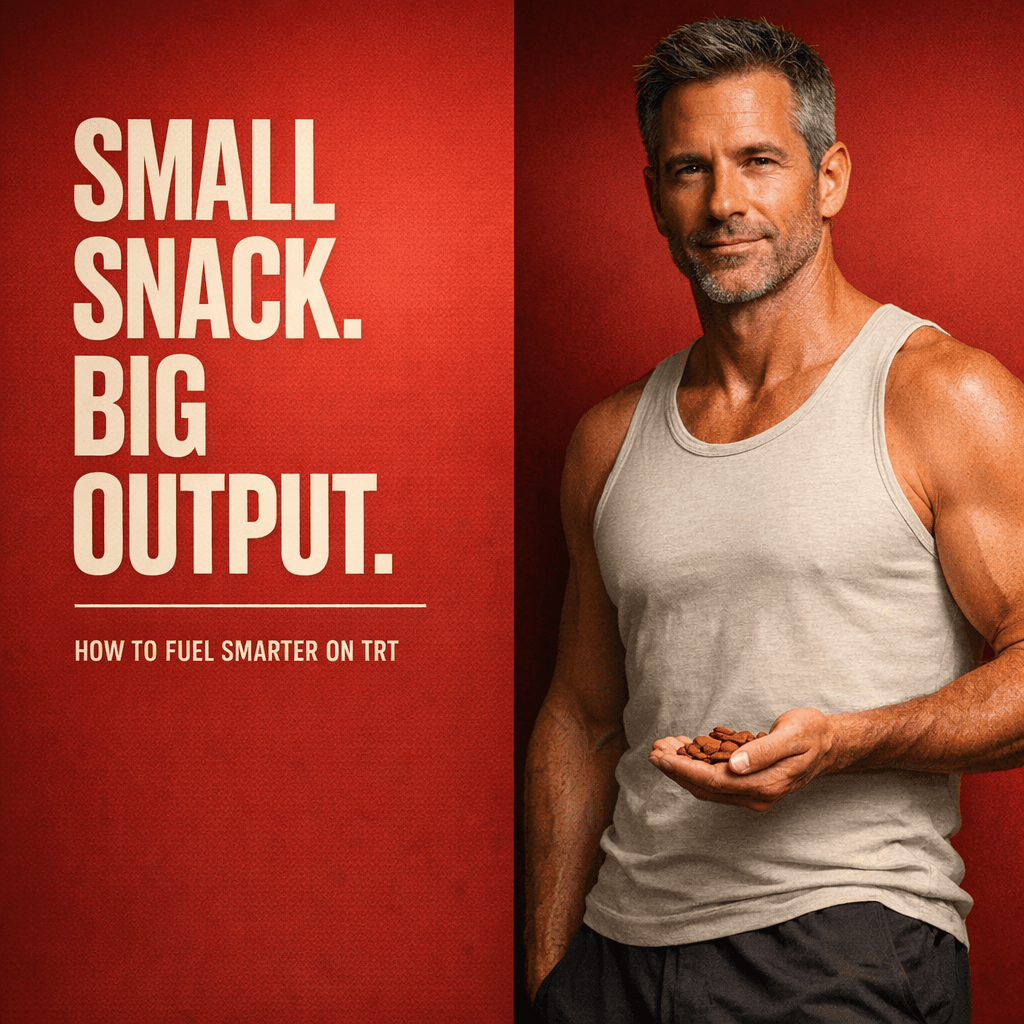
For men who want the clarity and GI comfort of fasted training but do not want to sacrifice hypertrophy, the practical middle ground is a small, easily digestible pre-workout snack rather than a full meal. Something light in protein and carbohydrates - eaten thirty to sixty minutes before training - can partially restore blood glucose and provide some amino acid availability without triggering the heaviness or gut discomfort that a full meal might.
Hydration and electrolytes matter more than most men realize in this context. Even mild dehydration impairs strength output and perceived exertion. On TRT, where training intensity is often higher and sweat rates can be elevated, going into a session underhydrated compounds the downsides of fasted training significantly. A well-hydrated athlete in a moderate fasted state will outperform a dehydrated one who ate a full meal.
Caffeine is commonly used to enhance fasted training performance, and it is genuinely effective at sharpening focus and blunting perceived fatigue. The caveat is that caffeine's effect on cortisol is additive, and when combined with the already elevated cortisol response of fasted, high-intensity training, it can push some men into a stress-hormone profile that is counterproductive to muscle gain when used as a daily pattern. Using it strategically rather than habitually tends to preserve its effectiveness and limit the cortisol accumulation issue.
Post-workout nutrition timing remains important regardless of whether you trained fasted or fed. Getting protein and carbohydrates in after a session, particularly after higher-volume work, supports glycogen replenishment and protein synthesis in the hours that matter most.
A Note on Individual Response and Medical Caution
Individual response to fasted training varies considerably, and that variability does not disappear on TRT. Some men genuinely thrive on it across most session types. Others find their performance drops sharply without food, regardless of the catecholamine boost. The only way to know your actual response is to track output honestly, not just how you feel.
For men managing diabetes, insulin resistance, or any condition that affects blood glucose regulation, fasted training carries real risks that go beyond the performance question. Hypoglycemia during a training session is a serious concern, and the intensity of TRT-supported training can accelerate glucose depletion in ways that are difficult to predict. If any of these conditions apply, this is a conversation to have directly with your treating clinician before experimenting with fasted sessions.
Even in otherwise healthy men, dizziness, unusual fatigue, or significant performance degradation during fasted training should be taken seriously and not pushed through.
Putting It Together With the Right Support
Navigating TRT alongside training and nutrition strategy is genuinely nuanced work. The hormonal optimization piece interacts with everything - sleep, recovery, body composition goals, cardiovascular health, and how you structure your eating around exercise. For men who want to make sure their training approach is actually aligned with their TRT protocol and broader health picture, working with a clinician who understands both sides of that equation matters.
Through AlphaMD, men on TRT connect with providers who help them understand not just their hormonal optimization, but how to translate it into real-world decisions around training, nutrition, and long-term health monitoring. Having that kind of support in your corner means you are not just feeling good in the gym - you are building something that lasts.
The Real Answer Is in Your Training Log, Not Your Morning Mood
Fasted training on TRT can feel exceptional. The catecholamine surge is real, the mental clarity is real, the lighter feeling is real. For early morning lifters, men with GI sensitivities, or anyone in a structured fat-loss phase, it can be a genuinely useful tool.
But feeling good in a session and maximizing what that session does for your body over time are separate outcomes. For most men pursuing serious hypertrophy on TRT, the physiology is straightforward: more fuel in means more work done, more anabolic signaling activated, and more muscle built over a training block. The feeling of fasted training is compelling. The results of well-fueled training, tracked honestly over months, tend to be more compelling still.
Have a question? Ask us.
At AlphaMD, we're here to help. Feel free to ask us any question you would like about TRT, medical weightloss, ED, or other topics related to men's health. Or take a moment to browse through our past questions.
People are asking...
You mentioned TRT is proven to be good for blood pressure , but why does it feel like my heart beat is much much stronger on TRT? Especially when lyin...
Testosterone therapy has been proven to do a few things, it reduces afterload (systemic vascular resistance), stimulates repolarization of cardiac myocytes by stimulating the ultra-rapid potassium cha... See Full Answer
I'm trying to settle an internal debate that I've got going about whether TRT would truly help to solve my issues or if it would cause more headaches ...
While starting TRT would certainly increase your IGF-1, which would increase muscle mass over time, starting TRT is not always the answer. To be honest, it’s not clear that TRT would be the fix for yo... See Full Answer
Fitness question: Many men think about starting TRT with their natural T levels in the 200-400 range. How much improvement in the gym would such patie...
In general, men who have levels in those ranges & who are experiencing low Testosterone symptoms will already have difficulty putting on muscle mass, maintaining it, and keeping fat off due to those f... See Full Answer
Get $30 off your first month’s order
Enter your email address now to receive $30 off your first month’s cost, other discounts, and additional information about TRT.
Legal Disclaimer
This website is a repository of publicly available information and is not intended to form a physician-patient relationship with any individual. The content of this website is for informational purposes only. The information presented on this website is not intended to take the place of your personal physician's advice and is not intended to diagnose, treat, cure, or prevent any disease. Discuss this information with your own physician or healthcare provider to determine what is right for you. All information is intended for your general knowledge only and is not a substitute for medical advice or treatment for specific medical conditions. The information contained herein is presented in summary form only and intended to provide broad consumer understanding and knowledge. The information should not be considered complete and should not be used in place of a visit, phone or telemedicine call, consultation or advice of your physician or other healthcare provider. Only a qualified physician in your state can determine if you qualify for and should undertake treatment.