
Why Most Resolutions Fail by January 17th (And Why Yours Won't)
Published on:
Updated on:
People are asking...
Question about the “honeymoon phase”. So I started 6 weeks ago on my protocol and felt great the first 4… energetic and kicking ass in the gym and on ...
Yes, it is very common. And your theory as to why it happens is the one providers most often point to, though there is no way of knowing exactly why it happens. The good news is that it resolves in ti... See Full Answer
Why does institutional endocrinology insist on horribly outdated treatment protocols, when modern evidence says they're wrong? eg: I asked my nearly ...
If you don't mind, I will be a bit blunt here because this kind of thing is the reason we started our company, so I hope it doesn't come off as overly rude. Providers, even specialists, are people. ... See Full Answer
I had six stents installed in my heart 10 yrs ago, why won't any trt clinics help me? I'm 65m battling low testosterone for 30yrs....
The main reason is liability & the kind of country we are with medicine. A small amount of people produce too many RBC on Testosterone therapy or experience initial upswings in BP or RHR. It's not ver... See Full Answer
Have a question? Ask us.
At AlphaMD, we're here to help. Feel free to ask us any question you would like about TRT, medical weightloss, ED, or other topics related to men's health. Or take a moment to browse through our past questions.
You know that gym membership you bought on January 2nd? The one you've visited exactly twice in the past two weeks? You're not alone, and you're right on schedule for what researchers call "Quitter's Day" - the second Friday in January, when most New Year's resolutions go to die.
The data is brutal. By January 17th, roughly 80% of New Year's resolutions have already failed. That's not a typo. Four out of five people who started the year with genuine intentions to change their lives have already given up before the month is even over. The question isn't whether resolutions fail. The question is why they fail so predictably, and more importantly, what you can do differently.
Why January 17th Keeps Beating Your Willpower
The standard explanation is that you lacked discipline. You didn't want it badly enough. You're lazy, unmotivated, or weak-willed. It's a convenient story, but it's also mostly wrong.
Resolutions fail because they're designed to fail. Most people set themselves up for disappointment without realizing it, following a pattern that's been repeated so many times it's practically a ritual. You pick something massive and vague like "get in shape" or "lose weight." You imagine a dramatic transformation. You attack it with unsustainable intensity for a few days or weeks. Then life happens, you miss a workout or eat the wrong thing, and the whole thing collapses.
This isn't a character flaw. It's a predictable outcome of approaching change the wrong way.
Vague goals are the first problem. "Get healthier" means nothing to your brain. Your brain needs specifics. It needs to know exactly what you're doing, when you're doing it, and how you'll know if you've done it. Without that clarity, every day becomes a test of willpower, and willpower is a limited resource that gets depleted by stress, poor sleep, and the thousand small decisions you make before noon.
Then there's the all-or-nothing trap. You decide you're going to work out six days a week, completely overhaul your diet, quit drinking, and start meditating. For a week, maybe two, you're a machine. Then you miss one day. Instead of getting back on track, you interpret that single miss as total failure. The perfect streak is broken, so why bother continuing? This binary thinking turns every small setback into a catastrophic event.
But here's what rarely gets discussed: your environment and your physiology might be working against you in ways you haven't considered.
When Your Body Quietly Sabotages Your Goals
You're trying to build discipline and consistency, but you're doing it while running on four hours of sleep, mainlining coffee to get through afternoon crashes, and wondering why you can't find the energy or motivation you had ten years ago. You blame yourself for lacking drive, but you're fighting with one hand tied behind your back.
Men, especially those in their mid-30s and beyond, often don't realize how much their physiology has shifted. You're juggling a career, possibly a family, mounting responsibilities, chronic stress, and sleep that's more interrupted than restorative. Your body is adapting to this environment, and not in ways that support dramatic lifestyle changes.
Low energy isn't just about needing more coffee. It's often a sign that something deeper is off. Poor sleep quality affects everything from decision-making to impulse control to how your body processes food. Chronic stress elevates cortisol, which makes it harder to lose fat, easier to gain weight around your midsection, and harder to recover from workouts. And hormones, particularly testosterone, play a much bigger role in motivation, energy, and body composition than most men realize.
Testosterone isn't just about muscle and libido, though it affects those too. It influences your drive, your mood, your ability to build and maintain muscle mass, how your body stores and burns fat, and your overall sense of vitality. When testosterone levels decline, which happens naturally with age but can be accelerated by stress, poor sleep, excess weight, and other factors, everything gets harder. Building muscle becomes more difficult. Losing fat requires more effort. Your motivation and mental clarity can take a hit. Recovery from workouts slows down.
This is where men get stuck in a vicious cycle. You feel low energy and unmotivated, so you try to force yourself to work out and eat better through sheer willpower. But your body isn't responding the way you remember. The workouts feel harder, the results come slower, and you start wondering if it's even worth it. You chalk it up to getting older or being lazy, when the reality might be that your hormonal balance and overall physiology need attention first.
The frustrating part is that these issues are invisible. You can't see low testosterone or poor sleep quality in the mirror. You just feel tired, unmotivated, and frustrated that you can't stick to your goals like you think you should.
The Systems Problem Nobody Talks About
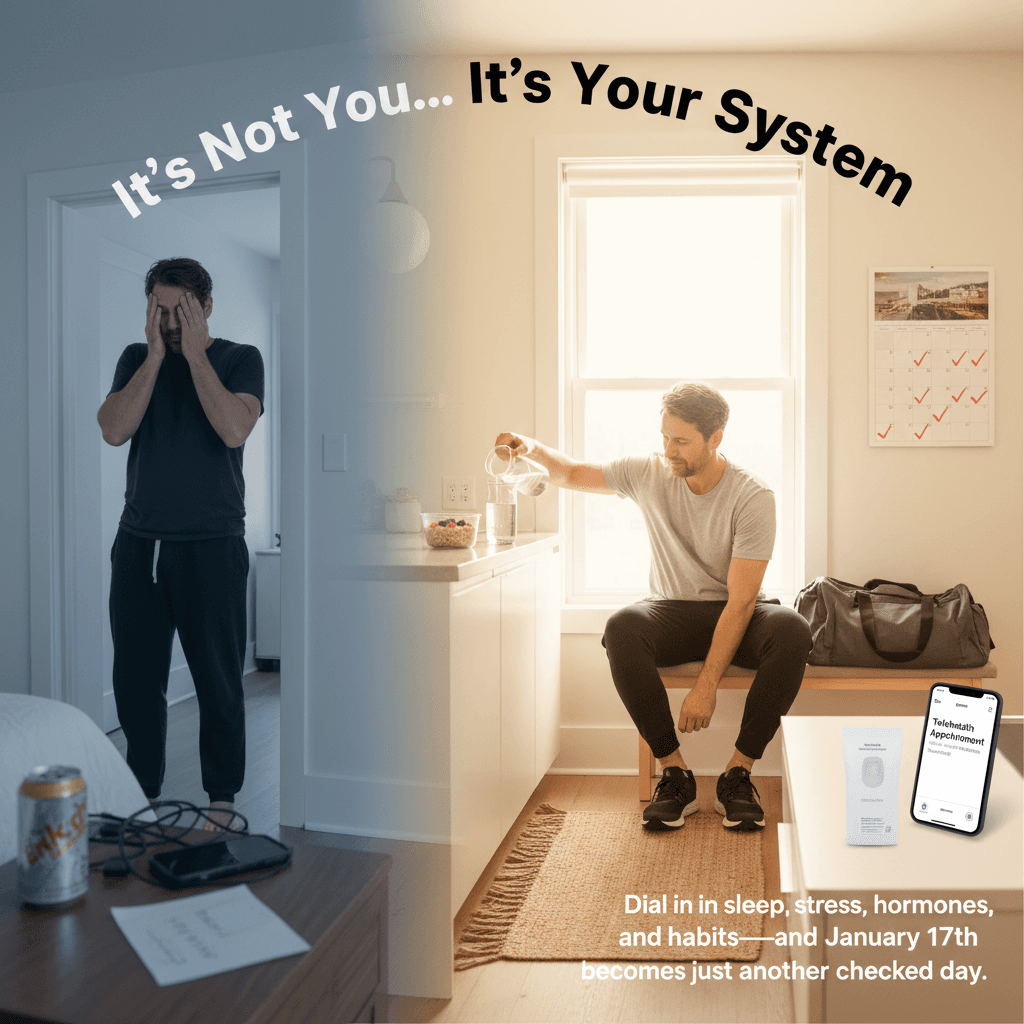
Even if your physiology was perfect, most resolutions would still fail because they ignore how behavior change actually works. You don't change your life through heroic acts of willpower. You change it by building systems and environments that make the desired behavior easier than the alternative.
Think about your current daily routine. Your environment is already optimized, just not for your new goals. Your kitchen is stocked with foods that don't support your health goals. Your gym bag isn't packed and ready. Your evenings are structured in a way that leaves no time or energy for the changes you want to make. You're trying to impose new behaviors on top of an environment and routine designed for your old behaviors.
This is why context matters more than willpower. If you have to make a difficult decision every single time you want to do the right thing, you'll eventually fail. But if you redesign your environment so that the right choice is the easy choice, you don't need superhuman discipline.
The guy who successfully works out before work doesn't have more willpower than you. He packed his gym bag the night before, laid out his workout clothes, set two alarms, and eliminated the friction between waking up and starting his workout. The guy who eats well doesn't resist temptation all day. He doesn't keep junk food in the house, he meal-preps on Sundays, and he's built routines that make healthy eating the default.
You need systems, not willpower.
From Heroic Sprints to Boring Consistency
The other shift that makes resolutions stick is moving from outcome goals to behavior goals, and from intensity to consistency.
Outcome goals are things like "lose 30 pounds" or "get a six-pack." They're not entirely in your control, and they don't tell you what to do today. Behavior goals are specific actions: "eat protein at every meal," "do three 30-minute strength sessions per week," "walk 8,000 steps daily." These are concrete, controllable, and they give you a clear daily win.
The real magic happens when you shift from thinking about goals to thinking about identity. Instead of "I want to lose weight," you start thinking "I'm the type of person who takes care of my health." Instead of "I should work out," you think "I'm someone who trains regularly." This subtle shift changes how you make decisions. You're not forcing yourself to do things you don't want to do. You're acting in alignment with who you are.
This is where small, consistent actions beat dramatic overhauls every time. You don't need to be perfect. You need to be consistent enough that the behavior becomes part of your routine, part of your identity. Two strength workouts per week, every week, will transform your body and health over time. Zero workouts per week because you burned out trying to do six won't.
Consistency also gives you feedback. When you're consistent for a few weeks and you're still not seeing results, that's valuable information. It might mean your approach needs adjusting. It might mean there are underlying factors, like hormonal imbalances or sleep issues, that need addressing. But you can't get that feedback if you quit after 17 days.
Building a Life Your Resolutions Can Survive
The hardest part of lasting change, especially for men in their 30s, 40s, and beyond, is that you're not just trying to change yourself. You're trying to change yourself while managing a career, relationships, possibly kids, aging parents, financial pressure, and all the other responsibilities that come with being an adult man.
You've likely spent years putting yourself last. Taking care of everyone else, building your career, handling what needs handling. Your health and energy have gradually declined, and you've accepted it as normal because everyone else seems tired too. You've normalized feeling subpar.
Sustainable change requires you to stop accepting that as inevitable. It requires you to prioritize your health, not in a selfish way, but in a way that recognizes you can't take care of anyone else if you're running on empty.
This might mean having honest conversations with your partner about needing time for workouts. It might mean saying no to some obligations. It might mean looking at your actual health markers, including hormones, instead of just assuming you're supposed to feel this way.
Companies like AlphaMD exist because men need more than generic advice. They need to understand what's actually happening in their bodies. A comprehensive health evaluation with a licensed provider, including hormone testing, can reveal whether low testosterone, thyroid issues, or other imbalances are making it unnecessarily difficult to lose fat, build muscle, maintain energy, and stay motivated. Once you know what you're dealing with, you can address it instead of fighting against your own biology.
Treatment options like testosterone replacement therapy aren't magic pills, and they're not for everyone. But for men whose levels are genuinely low, optimizing hormone balance can make everything else easier. The workouts start producing results again. The fat starts coming off. The energy and drive return. Suddenly, sticking to your resolutions isn't a constant battle against exhaustion and lack of motivation.
The point isn't that you need TRT to succeed. The point is that understanding and addressing the physiological factors affecting your health makes behavioral change significantly more sustainable. You stop blaming yourself for struggling and start getting the support your body actually needs.
Why Yours Won't Fail
Your resolutions won't fail this time because you're going to approach them differently. You're going to set specific, behavior-based goals instead of vague aspirations. You're going to build systems and redesign your environment to support those behaviors. You're going to aim for boring consistency instead of unsustainable intensity. You're going to think about identity and who you're becoming, not just what you're trying to achieve.
And you're going to consider whether your body is actually set up to support the changes you're trying to make. If you've been struggling with low energy, poor recovery, difficulty building muscle or losing fat, decreased motivation, or other symptoms that make change harder, you're going to get that checked out instead of assuming it's just age or laziness.
The men who succeed aren't more disciplined than you. They've just stopped fighting battles they don't need to fight. They've built systems that make success easier. They've addressed the underlying health issues that were making everything harder. They've given themselves a fair shot instead of trying to willpower their way through physiological headwinds.
January 17th has come and gone. Most resolutions have already failed, just like they do every year. But yours doesn't have to be one of them. The difference between success and failure isn't about how badly you want it. It's about how intelligently you approach it, how honestly you assess what's holding you back, and how willing you are to address the real obstacles instead of the ones you think you're supposed to have.
You can do this. You just need to stop trying to do it the way that's been failing for everyone else.
Have a question? Ask us.
At AlphaMD, we're here to help. Feel free to ask us any question you would like about TRT, medical weightloss, ED, or other topics related to men's health. Or take a moment to browse through our past questions.
People are asking...
Question about the “honeymoon phase”. So I started 6 weeks ago on my protocol and felt great the first 4… energetic and kicking ass in the gym and on ...
Yes, it is very common. And your theory as to why it happens is the one providers most often point to, though there is no way of knowing exactly why it happens. The good news is that it resolves in ti... See Full Answer
Why does institutional endocrinology insist on horribly outdated treatment protocols, when modern evidence says they're wrong? eg: I asked my nearly ...
If you don't mind, I will be a bit blunt here because this kind of thing is the reason we started our company, so I hope it doesn't come off as overly rude. Providers, even specialists, are people. ... See Full Answer
I had six stents installed in my heart 10 yrs ago, why won't any trt clinics help me? I'm 65m battling low testosterone for 30yrs....
The main reason is liability & the kind of country we are with medicine. A small amount of people produce too many RBC on Testosterone therapy or experience initial upswings in BP or RHR. It's not ver... See Full Answer
Get $30 off your first month’s order
Enter your email address now to receive $30 off your first month’s cost, other discounts, and additional information about TRT.
Legal Disclaimer
This website is a repository of publicly available information and is not intended to form a physician-patient relationship with any individual. The content of this website is for informational purposes only. The information presented on this website is not intended to take the place of your personal physician's advice and is not intended to diagnose, treat, cure, or prevent any disease. Discuss this information with your own physician or healthcare provider to determine what is right for you. All information is intended for your general knowledge only and is not a substitute for medical advice or treatment for specific medical conditions. The information contained herein is presented in summary form only and intended to provide broad consumer understanding and knowledge. The information should not be considered complete and should not be used in place of a visit, phone or telemedicine call, consultation or advice of your physician or other healthcare provider. Only a qualified physician in your state can determine if you qualify for and should undertake treatment.