
What TRT Actually Looks Like After 10 Years: The Long-Game Data Nobody Prepares You For
Published on:
Updated on:
People are asking...
I’m starting TRT when my kit arrives. What are some things I should expect? Will I experience hair loss?...
Hair loss is a possibility in anyone on TRT, though it only occurs in those who have a genetic predisposition. Basically, think of it like this: TRT ages your scalp by 10 years. If you were destined t... See Full Answer
Is getting on TRT a lifetime commitment? Should I expect bad side effects from coming off of it? Just wondering if I’ll be a 80 year old one day on TR...
Yes & no. It's better to think of it this way: If you have low Testosterone & do not treat it, you are committing to a life-time of low Testosterone symptoms that will for a fact always worsen with ag... See Full Answer
Do you have any theories as to why some people experience a honeymoon phase for a few weeks then lose the benefits of TRT?...
The most common reason for this in men tends to be a need for a simple dose adjustment. There's a general 8 week uptake period where injected levels increase week over week & then natural production ... See Full Answer
Have a question? Ask us.
At AlphaMD, we're here to help. Feel free to ask us any question you would like about TRT, medical weightloss, ED, or other topics related to men's health. Or take a moment to browse through our past questions.
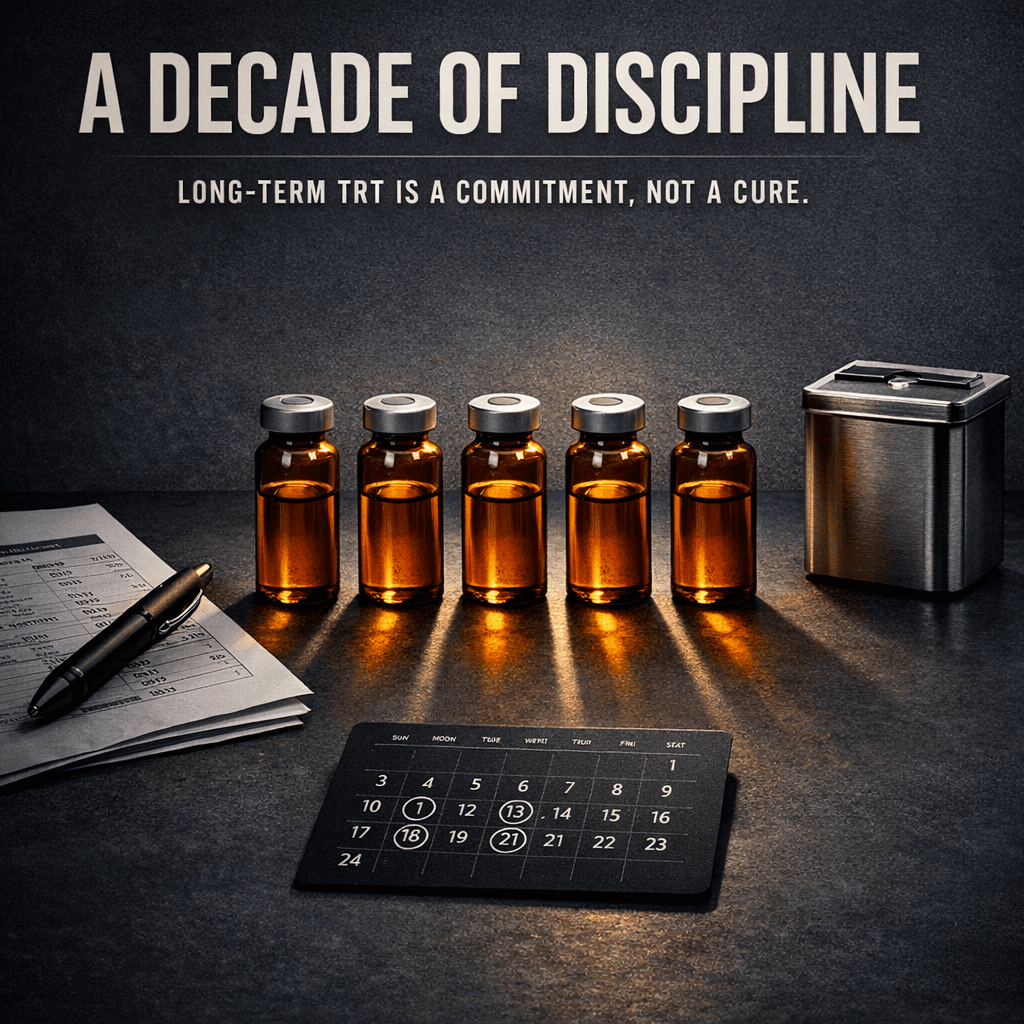
Most men start testosterone replacement therapy expecting a transformation. What they rarely expect is that ten years later, they will still be managing it, adjusting it, and learning from it.
That gap between expectation and reality is not a failure of TRT. It is simply the nature of committing to a long-term medical therapy in a world that tends to talk about it like a switch you flip once and walk away from. The long-game data, the kind that accumulates quietly across years of clinic visits, lab draws, and lived experience, tells a more nuanced story than most men hear before they start.
What the First Few Months Actually Feel Like (and Why It Can Be Misleading)
The early phase of TRT is often the most emotionally charged. Energy may return. Mood can lift noticeably. Libido, which may have been flat for years, often stirs back to life. For men who have been living with the fatigue and fog of low testosterone, those first months can feel genuinely remarkable.
The problem is that this phase sets an expectation that everything will keep climbing. It usually does not work that way.
What is happening early on is partly a correction of a deficit and partly a physiological adjustment. The body is recalibrating. Hormone levels that were suppressed for months or years are being restored, and the nervous system, muscle tissue, and mood centers of the brain are all responding to that change at the same time. It feels dramatic because it is a significant shift from a low baseline.
By months three through six, that initial surge typically levels off. Some men interpret this stabilization as the treatment "wearing off" or stopping work. It is not. It is the therapy doing exactly what it should: establishing a new, more consistent hormonal environment rather than repeatedly spiking and exciting the system.
Year One: Building the Foundation
The first full year on TRT is primarily about dialing things in. This is when clinicians are adjusting protocols based on how the individual is responding, not just to numbers on a lab panel, but to how the patient actually feels, sleeps, trains, and functions.
Some men find their first protocol works well from the start. Others cycle through adjustments before landing on an approach that fits their lifestyle and biology. This is expected and normal. Testosterone therapy is not a one-size calculation; it is an iterative process.
Year one is also when practical logistics become real. How does this fit into your weekly routine? What happens when you travel? How do you store medication, handle pharmacy refills, and keep follow-up appointments consistent? These logistical questions are not trivial. They determine whether the therapy actually works across years, or whether it becomes inconsistent and therefore less effective.
Years Two Through Five: The Quiet Middle Ground
For men who stay consistent, years two through five are often the most stable and, paradoxically, the least discussed. There is less drama here. The novelty has worn off. The protocol is reasonably well-established. Life continues.
This is where TRT starts to reveal its real character as a long-term commitment rather than a short-term fix.
During this period, most men are not chasing dramatic changes anymore. The focus shifts toward maintenance, consistency, and the interaction between TRT and everything else in their life: how they are training, how much they are drinking, how well they are sleeping, whether their stress levels are chronically elevated. All of these factors influence how well the therapy performs and how they feel.
It is also during this window that some men start to notice things they did not fully anticipate. Testicular atrophy, which occurs because the body reduces its own signal for testosterone production when it detects an external supply, is often noticeable by this point. For men who were not counseled on this before starting, it can be a surprise. It is not dangerous in most cases, but it is a physical change that deserves honest discussion upfront.
Hair changes, including acceleration of male pattern hair loss in men who are genetically predisposed, may become more apparent. Acne, which often settles in the first year, can occasionally resurface with protocol shifts or lifestyle changes.
Blood thickness, referred to clinically as elevated hematocrit, is one of the more important long-term monitoring targets. Over years of TRT, the body can produce more red blood cells in response to testosterone, which makes blood more viscous. This is manageable with regular monitoring and, when needed, therapeutic phlebotomy or protocol adjustments, but it requires attention. It does not resolve on its own if left unaddressed.
The Fertility Question and Why Timing Matters
One of the most consequential long-term considerations for younger men on TRT is fertility. Testosterone therapy suppresses the hormonal signals that drive sperm production. For some men this suppression is partial, for others it is nearly complete. The longer someone is on TRT without intervention, the longer the potential recovery period if they later decide they want to conceive.
This is not a reason to avoid TRT, but it is a reason to plan deliberately.
Men who know they want children in the future have options. Some use specific medications alongside or instead of testosterone to preserve testicular function. Some bank sperm before starting. Some delay therapy until after their family is complete. These are individualized decisions that require a direct conversation with a clinician, ideally before therapy begins, not years into it.
Composite example: Consider a man who starts TRT in his early thirties without a clear family plan. By year four, he and his partner decide they want a child. He was not counseled on fertility preservation early on, and the path back to adequate sperm production takes longer than expected and requires additional medications. The outcome is ultimately positive, but the process is harder than it needed to be. That kind of scenario is preventable with early, honest education.
Sleep, Blood Pressure, and Cardiovascular Considerations Over the Long Arc
Sleep apnea is one of the more underappreciated considerations in long-term TRT. Testosterone can worsen sleep apnea in men who already have it, and it may contribute to developing it in men who are predisposed. Given that poor sleep undermines almost every benefit TRT is supposed to provide, including energy, mood, and body composition, this is worth taking seriously.
Men who start snoring more, feeling unrested despite adequate sleep hours, or experiencing daytime fatigue they cannot explain should raise this with their clinician. A sleep study may be warranted.
Cardiovascular risk is an area of genuine scientific complexity. Large studies have produced conflicting findings, and the current consensus is that TRT in appropriately selected men who are properly monitored does not appear to significantly increase cardiovascular risk and may, in some contexts, be mildly beneficial. But the research is still evolving. Men with pre-existing cardiovascular conditions require more individualized risk-benefit conversations and closer monitoring. This is not a therapy where anyone should be cutting corners on follow-up.
Blood pressure monitoring over years is standard practice for good reason. Testosterone influences fluid retention, red blood cell production, and vascular tone, all of which can affect blood pressure over time.
Years Five Through Ten: What Stays, What Shifts
By the five-to-ten year mark, men who have stayed consistent with TRT and follow-up tend to fall into a comfortable maintenance rhythm. Labs are drawn at regular intervals. Protocol tweaks, if needed, are minor. The therapy has become integrated into daily life rather than feeling like a separate medical event.
What many men report at this stage is a clearer understanding of how their body responds to everything. They know which lifestyle choices amplify the benefits of TRT and which ones undercut it. Chronic poor sleep, heavy alcohol use, high stress, and weight gain from dietary drift can all reduce the effectiveness of therapy significantly. In fact, some men find their symptoms return despite being on a stable protocol, and the culprit turns out to be lifestyle erosion, not a problem with the therapy itself.
Prostate health becomes a more active part of the monitoring conversation as men move through their forties and into their fifties. Current evidence does not support the historical concern that TRT causes prostate cancer, but men with existing prostate concerns require individualized evaluation. Regular prostate monitoring is part of responsible long-term management.
Composite example: A man in his late forties has been on TRT for eight years. He has had consistent follow-up, stayed active, and managed his weight. His protocol has been adjusted twice in that period, both times based on how he was feeling rather than a specific number being out of range. He describes TRT not as a transformation but as a foundation that makes everything else in his health routine more effective. That is a realistic, grounded version of long-term success.
Contrast that with another man who started at the same time but stopped and restarted multiple times due to cost concerns, travel disruptions, and skipped appointments. His experience has been more variable, with periods of benefit interrupted by crashes in mood and energy during the gaps. The therapy was not the problem; the inconsistency was.
The Misconceptions That Only Surface After Years
Some things only become clear after living with TRT for a while.
The expectation that TRT alone produces significant muscle gain is one of the most common disappointments. Testosterone supports muscle protein synthesis, but it is not a shortcut to physique change. Men who train consistently and eat well over years will see the compounding benefit. Men who assume the therapy does the work for them typically do not.
The belief that libido will remain elevated and stable forever is another one. Libido is influenced by testosterone, but it is also shaped by relationship dynamics, stress, sleep quality, and overall health. TRT raises the floor. It does not override everything else.
Perhaps the most stubborn misconception is the "set it and forget it" idea, the notion that once a protocol is established, no further management is needed. The body changes over time. Weight shifts, activity levels shift, age changes how hormones are metabolized. Protocol needs evolve. The men who do best over a decade are the ones who stay engaged with their care rather than treating it as a background maintenance item.
Staying in It for the Long Run
TRT can be genuinely life-improving for men with confirmed testosterone deficiency. That is not hype; it is consistent with what the clinical evidence and patient experience tend to show when the therapy is appropriately managed. But the long game requires more than a prescription. It requires regular monitoring, honest lifestyle assessment, ongoing clinician communication, and a willingness to revisit assumptions as years pass.
Services like AlphaMD, an online men's health platform focused on provider-guided testosterone therapy and ongoing education, reflect a model that treats TRT as the long-term, monitored medical commitment it actually is, rather than a transactional process that ends when the medication ships.
Ten years from now, the men who look back on TRT as a net positive in their health story will almost universally have one thing in common: they stayed engaged with the process. Not obsessively, not anxiously, but consistently and in partnership with clinicians who took the long view alongside them.
Have a question? Ask us.
At AlphaMD, we're here to help. Feel free to ask us any question you would like about TRT, medical weightloss, ED, or other topics related to men's health. Or take a moment to browse through our past questions.
People are asking...
I’m starting TRT when my kit arrives. What are some things I should expect? Will I experience hair loss?...
Hair loss is a possibility in anyone on TRT, though it only occurs in those who have a genetic predisposition. Basically, think of it like this: TRT ages your scalp by 10 years. If you were destined t... See Full Answer
Is getting on TRT a lifetime commitment? Should I expect bad side effects from coming off of it? Just wondering if I’ll be a 80 year old one day on TR...
Yes & no. It's better to think of it this way: If you have low Testosterone & do not treat it, you are committing to a life-time of low Testosterone symptoms that will for a fact always worsen with ag... See Full Answer
Do you have any theories as to why some people experience a honeymoon phase for a few weeks then lose the benefits of TRT?...
The most common reason for this in men tends to be a need for a simple dose adjustment. There's a general 8 week uptake period where injected levels increase week over week & then natural production ... See Full Answer
Get $30 off your first month’s order
Enter your email address now to receive $30 off your first month’s cost, other discounts, and additional information about TRT.
Legal Disclaimer
This website is a repository of publicly available information and is not intended to form a physician-patient relationship with any individual. The content of this website is for informational purposes only. The information presented on this website is not intended to take the place of your personal physician's advice and is not intended to diagnose, treat, cure, or prevent any disease. Discuss this information with your own physician or healthcare provider to determine what is right for you. All information is intended for your general knowledge only and is not a substitute for medical advice or treatment for specific medical conditions. The information contained herein is presented in summary form only and intended to provide broad consumer understanding and knowledge. The information should not be considered complete and should not be used in place of a visit, phone or telemedicine call, consultation or advice of your physician or other healthcare provider. Only a qualified physician in your state can determine if you qualify for and should undertake treatment.