
What 14 Years on TRT Actually Teaches You
Published on:
Updated on:
People are asking...
I see people post on various threads on steroids and how they age substantially in a few years. Does TRT have similar effects or is that more hardcore...
For traditional TRT, aka non-bodybuilding levels of Testosterone, this is generally considered almost the opposite. Testosterone in men helps to maintain metabolism & low Testosterone often leads to i... See Full Answer
I’m starting TRT when my kit arrives. What are some things I should expect? Will I experience hair loss?...
Hair loss is a possibility in anyone on TRT, though it only occurs in those who have a genetic predisposition. Basically, think of it like this: TRT ages your scalp by 10 years. If you were destined t... See Full Answer
Is getting on TRT a lifetime commitment? Should I expect bad side effects from coming off of it? Just wondering if I’ll be a 80 year old one day on TR...
Yes & no. It's better to think of it this way: If you have low Testosterone & do not treat it, you are committing to a life-time of low Testosterone symptoms that will for a fact always worsen with ag... See Full Answer
Have a question? Ask us.
At AlphaMD, we're here to help. Feel free to ask us any question you would like about TRT, medical weightloss, ED, or other topics related to men's health. Or take a moment to browse through our past questions.
Fourteen years into testosterone replacement therapy, I can tell you the most important lesson has nothing to do with muscle gain or libido. It's this: TRT is not a magic bullet, and the men who thrive on it are the ones who stop treating it like one.
That realization doesn't come quickly. Most men starting TRT arrive with a specific set of expectations, often shaped by online forums, gym talk, or a desperate hope that finally fixing their testosterone will fix everything else. But time teaches perspective, and more than a decade on therapy reveals truths that the first six months never could.
The First Year: Expectation vs Reality
Those early months are intoxicating for some, frustrating for others, and confusing for nearly everyone. You expect to wake up different, stronger, more energized within weeks. Sometimes that happens. More often, the changes are subtle and uneven.
Energy might improve before mood does. Your recovery in the gym might get noticeably better while your motivation stays flat. Or you feel great for a few weeks, then inexplicably tired again because your dose needs adjustment or your sleep has been garbage. The first year is less about dramatic transformation and more about learning that your body is more complex than a single hormone level.
What nobody tells you upfront is how much patience this requires. TRT is not like taking an aspirin for a headache. Your body needs time to recalibrate, your clinician needs time to find your optimal protocol, and you need time to separate what's actually changing from what you hoped would change. That first year teaches you to pay attention, to track how you actually feel rather than how you think you should feel.
Energy, Mood, and the Quiet Ways Life Changes
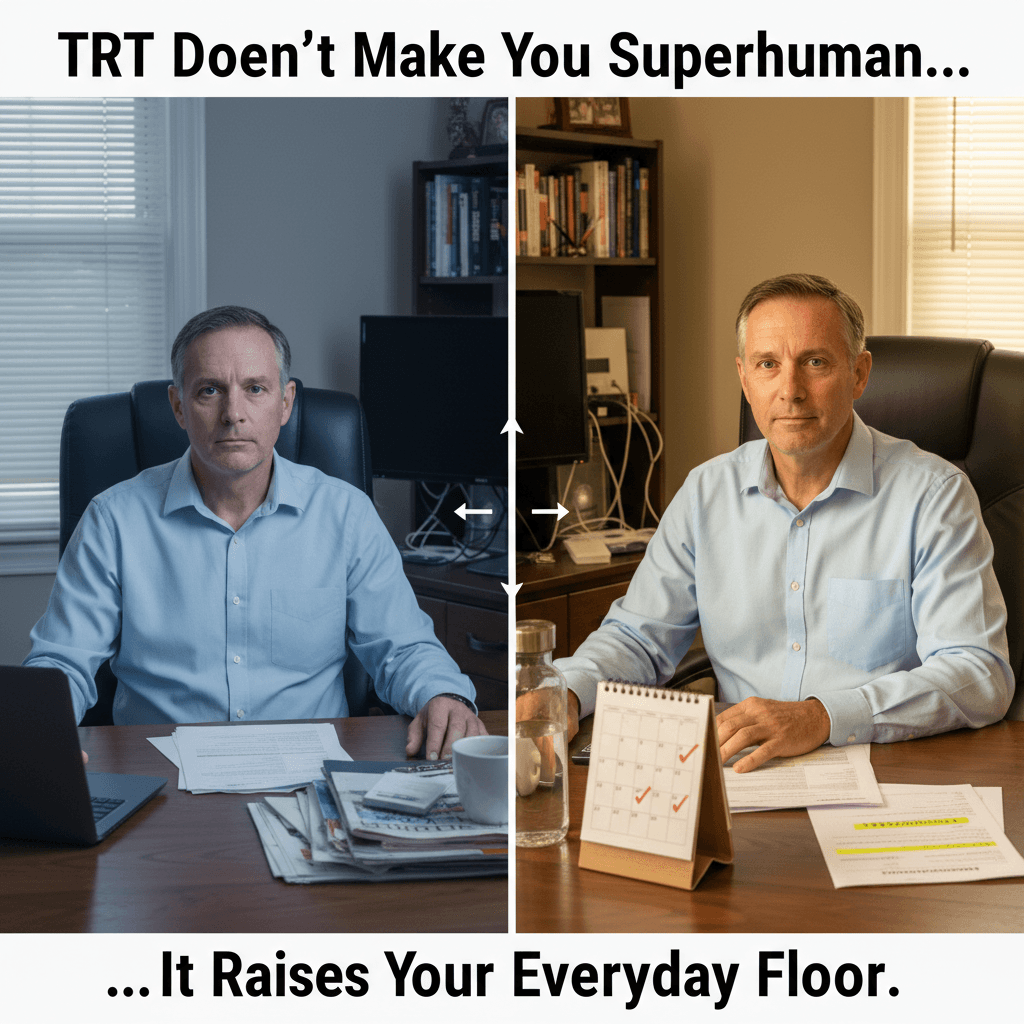
After several years on therapy, you start noticing the difference isn't always dramatic. It's more like the floor has been raised.
Bad days still happen, but they don't crater you the way they used to. You don't wake up dreading the day quite as often. The background fatigue that made everything feel like pushing through mud starts to lift, and you realize you'd been living with that weight for so long you'd forgotten what normal felt like.
Mood stability becomes one of the underrated benefits. Not euphoria, not constant optimism, but a steadier baseline. You're less reactive, less prone to irritability or that flat, numb feeling that makes nothing seem worth doing. This doesn't mean TRT cures depression or anxiety, but for men whose low testosterone was contributing to those issues, the difference can be profound.
Motivation shifts too, though not in the way you might expect. TRT doesn't magically make you want to do things you hate. It just removes some of the friction. Tasks that felt insurmountable become manageable. You have more capacity to show up, to be consistent, to actually follow through. That consistency, compounded over years, changes your life more than any single surge of energy ever could.
What Long Term TRT Really Does To Your Daily Routine
Eventually, TRT just becomes part of your life, like brushing your teeth or taking your vitamins. Whether you're doing injections, creams, or another delivery method, you develop a rhythm. It stops being this big medical intervention and becomes a maintenance routine.
The injection schedule (for those who go that route) becomes second nature. You find your preferred injection sites, your timing, your ritual. Some men obsess over this for months, tweaking injection frequency and agonizing over every detail. Others find what works and stop thinking about it. Long term experience teaches you that perfect is the enemy of good, and consistency beats optimization theater.
You also learn how TRT interacts with everything else you do. Training improves, but only if you actually train intelligently. Recovery gets better, but only if you sleep. Body composition shifts become possible, but only if your nutrition isn't a disaster. TRT doesn't compensate for neglecting the fundamentals. It amplifies what you're already doing.
This is where a lot of men get frustrated early on. They start therapy expecting it to override their lifestyle, and when it doesn't, they blame the treatment. Years into TRT, you understand that the therapy and the lifestyle work together. One without the other leaves results on the table.
Bloodwork, Side Effects, and Growing Up About Your Health
If TRT teaches you anything over 14 years, it's that you cannot ignore your bloodwork. This isn't optional, and it isn't just about testosterone levels.
Regular monitoring becomes essential. Your clinician will track not just your testosterone, but other markers that TRT can influence: red blood cell counts, lipid panels, liver function, prostate health, estrogen levels. Some men develop side effects that need management. Others sail through with minimal issues. You won't know which category you're in without consistent lab work.
Long term therapy also teaches you that your body changes over time, and what worked five years ago might need adjustment now. Doses might need tweaking. Additional interventions might become necessary to manage estrogen or other factors. This is normal. It's not a sign that TRT is failing, it's a sign that your body is dynamic and your treatment needs to be responsive.
The men who struggle most are often the ones who treat TRT like a set-it-and-forget-it solution. They skip labs, ignore symptoms, or self-adjust based on gym bro advice instead of working with their clinician. That approach might work for a while, but over years, it catches up with you. Growing up about your health means accepting that you're in this for the long haul, and shortcuts have consequences.
The Psychological Side: Identity, Confidence, and Patience
There's a psychological component to long term TRT that nobody really prepares you for. When you've been on therapy for years, it becomes part of your identity. You're a man who manages his testosterone medically. That's just a fact about you, like your height or your eye color.
For some men, that's empowering. It's taking control of your health, refusing to accept decline, actively managing your wellbeing. For others, there's a nagging sense of dependency or a worry about what it means to need this treatment indefinitely. Both reactions are valid, and most men cycle through both at different times.
Confidence shifts too, though not always in the obvious ways. Yes, some men feel more assertive, more willing to take up space, more comfortable in their skin. But the deeper confidence comes from something subtler: the knowledge that you're paying attention to your body, working with professionals, and making informed decisions about your health. That kind of self-trust matters more than any surge in bravado.
Patience becomes a virtue you learn whether you want to or not. Changes take time. Adjustments take time. Finding your optimal protocol takes time. Men who expect instant results burn out or chase increasingly extreme interventions. Men who settle in for the long game, who measure progress in years rather than weeks, tend to be the ones who look back after a decade and realize how far they've come.
Aging With TRT: What It Gives You, What It Does Not
After 14 years, you're not the same person who started therapy. You've aged. Your life has changed. Your body has changed. TRT has been part of that journey, but it hasn't stopped time.
This is crucial to understand: TRT helps you age better, but it doesn't stop aging. You'll still get older. You'll still face the normal challenges of middle age and beyond. Your recovery won't be what it was at 25. Your metabolism will slow. Injuries take longer to heal. TRT mitigates some of this, but it doesn't erase it.
What it does give you is a better foundation. You maintain muscle more easily than you would off therapy. Your energy holds up better. Your mental sharpness stays more consistent. You have more capacity to stay active, engaged, and resilient as you age. That's not nothing. For many men, it's the difference between declining gracefully and declining miserably.
But you still have to do the work. You still have to move your body, feed it well, manage stress, sleep enough, and stay mentally engaged. TRT is not a substitute for living well. It's a tool that makes living well more achievable.
The Misconceptions That Time Corrects
A decade and a half on TRT dismantles a lot of myths. You learn that more is not always better, that chasing supraphysiological levels often creates more problems than it solves. You learn that TRT is not cosmetic enhancement, it's medical treatment for a real deficiency.
You also learn that the men selling you on TRT as a fountain of youth or a shortcut to greatness are usually selling something else, too. TRT is powerful, but it's not transformative in the way marketing would have you believe. It restores what was missing. It doesn't turn you into someone you're not.
The most important misconception that time corrects is this: TRT is not a monologue, it's a conversation. A conversation between you, your body, and your healthcare team. It requires listening, adjusting, learning, and staying engaged. The men who treat it like a prescription they can ignore are the ones who end up disappointed or worse.
What 14 Years Really Teaches You
Looking back over more than a decade on testosterone replacement therapy, the biggest lesson is simple: this is about playing the long game with your health. It's about showing up consistently, working with qualified professionals, and understanding that there are no shortcuts.
TRT has given me more good years than I would have had without it. It's helped me maintain strength, energy, and clarity as I've aged. But the real value has come from the discipline it's taught me: paying attention to my body, prioritizing health markers, and accepting that managing my wellbeing is an ongoing process, not a destination.
If you're considering TRT or already on it, find a provider who treats this as the long term medical intervention it is. Platforms like AlphaMD make it easy to connect with licensed providers who deliver individualized care, recognizing that every man's needs are different and that protocols need to evolve over time. That kind of partnership matters more than any single prescription.
Fourteen years in, I'm not the person I was when I started, and I'm grateful for that. Not because TRT changed everything, but because it gave me the foundation to change what mattered. That's the real lesson: TRT is a tool, and what you build with it depends on everything else you do.
Have a question? Ask us.
At AlphaMD, we're here to help. Feel free to ask us any question you would like about TRT, medical weightloss, ED, or other topics related to men's health. Or take a moment to browse through our past questions.
People are asking...
I see people post on various threads on steroids and how they age substantially in a few years. Does TRT have similar effects or is that more hardcore...
For traditional TRT, aka non-bodybuilding levels of Testosterone, this is generally considered almost the opposite. Testosterone in men helps to maintain metabolism & low Testosterone often leads to i... See Full Answer
I’m starting TRT when my kit arrives. What are some things I should expect? Will I experience hair loss?...
Hair loss is a possibility in anyone on TRT, though it only occurs in those who have a genetic predisposition. Basically, think of it like this: TRT ages your scalp by 10 years. If you were destined t... See Full Answer
Is getting on TRT a lifetime commitment? Should I expect bad side effects from coming off of it? Just wondering if I’ll be a 80 year old one day on TR...
Yes & no. It's better to think of it this way: If you have low Testosterone & do not treat it, you are committing to a life-time of low Testosterone symptoms that will for a fact always worsen with ag... See Full Answer
Get $30 off your first month’s order
Enter your email address now to receive $30 off your first month’s cost, other discounts, and additional information about TRT.
Legal Disclaimer
This website is a repository of publicly available information and is not intended to form a physician-patient relationship with any individual. The content of this website is for informational purposes only. The information presented on this website is not intended to take the place of your personal physician's advice and is not intended to diagnose, treat, cure, or prevent any disease. Discuss this information with your own physician or healthcare provider to determine what is right for you. All information is intended for your general knowledge only and is not a substitute for medical advice or treatment for specific medical conditions. The information contained herein is presented in summary form only and intended to provide broad consumer understanding and knowledge. The information should not be considered complete and should not be used in place of a visit, phone or telemedicine call, consultation or advice of your physician or other healthcare provider. Only a qualified physician in your state can determine if you qualify for and should undertake treatment.