
Unrealistic Expectations for MEN? Male Body Dysmorphia vs Women's Body Positivity
Published on:
Updated on:
People are asking...
What are the perfect number?! Let's say I would like my total T to be around 1000.......
The perfect number has to do with your individual goals of therapy. Most men just want to feel better and get relief from their low T symptoms. For them ideal may mean a TT around 600. Some men desire... See Full Answer
Are there any mental health conditions that you wouldn't prescribe trt to?...
The providers you'd see through AlphaMD wouldn't say that, no. Typically anxiety, depression, self confidence issues, and body dysmorphia or body image issues can be a results of having low Testostero... See Full Answer
How prevalent is “moon face” in the guys you treat? And what can be done about it?...
Nearly zero men on standard therapeutic doses of TRT report this as an issue. This is more prevalent at higher doses, say something a bodybuilder might use from an UGL combined with steroids, than at ... See Full Answer
Have a question? Ask us.
At AlphaMD, we're here to help. Feel free to ask us any question you would like about TRT, medical weightloss, ED, or other topics related to men's health. Or take a moment to browse through our past questions.
Wanting to lose fat, build muscle, improve your appearance, or feel more confident is not automatically unhealthy. The problem begins when concerns about your body become difficult to control and start interfering with your relationships, work, health, or daily life.
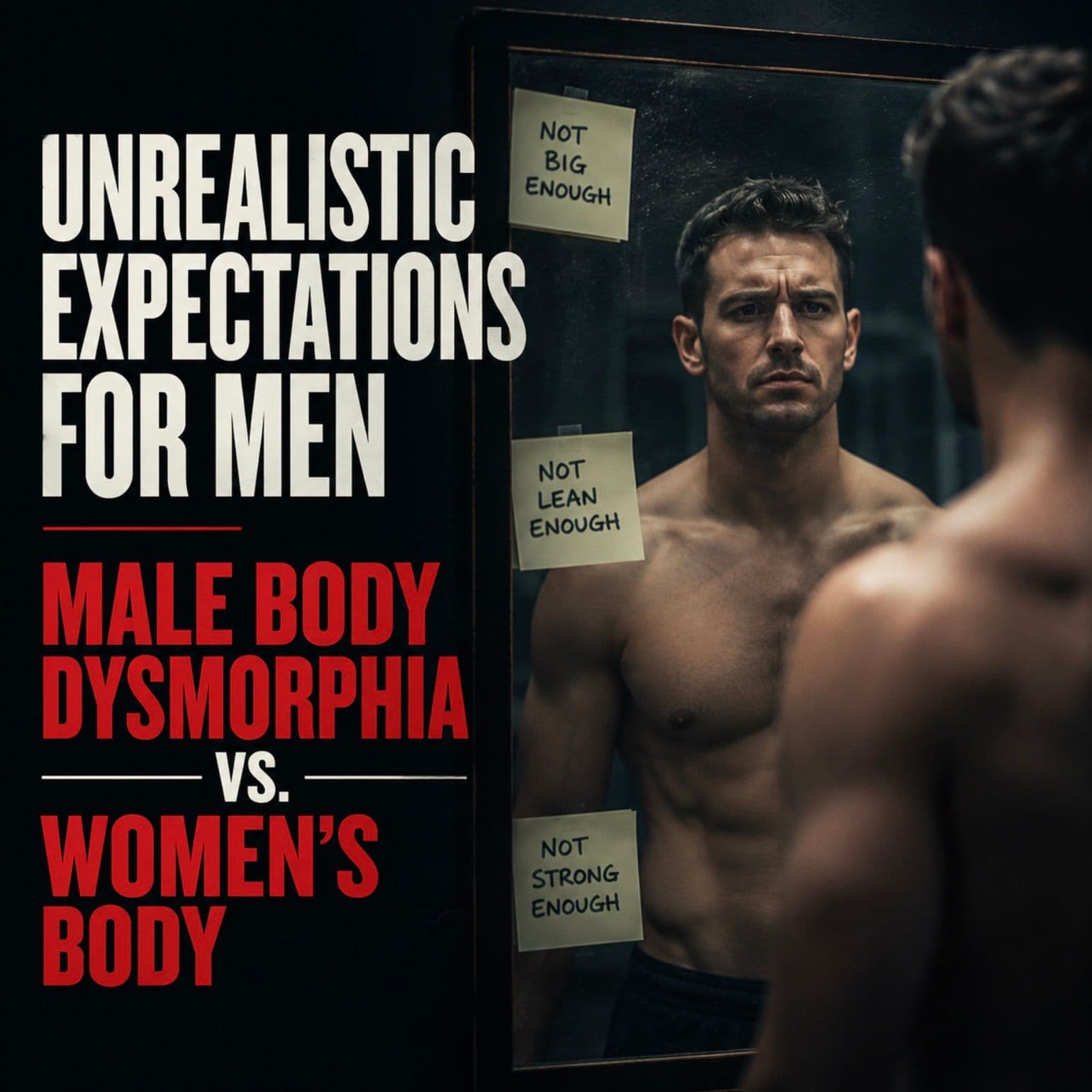
Male body dysmorphia commonly involves an intense focus on perceived physical flaws. For some men, that means worrying about hair loss, skin, height, weight, facial features, or genital appearance. For others, it takes the form of muscle dysmorphia: a persistent belief that they are too small, weak, or insufficiently muscular, regardless of how they actually look.
Body dysmorphic disorder is not vanity, laziness, or a lack of discipline. It is a legitimate mental health condition that can affect men and women. In men, however, it can be especially difficult to recognize because compulsive training, rigid dieting, supplement use, and constant physique tracking may be praised as dedication rather than identified as signs of distress.
What Is Male Body Dysmorphia?
“Body dysmorphia” is the commonly used term for body dysmorphic disorder, or BDD.
BDD is a mental health condition involving an excessive preoccupation with one or more perceived flaws in a person’s appearance. The flaw may be minor or completely unnoticeable to other people, but it feels significant and distressing to the person experiencing it.
The condition often includes repetitive thoughts or behaviors, such as:
- Repeatedly checking mirrors
- Avoiding mirrors completely
- Comparing your body to other people
- Asking others for reassurance
- Taking frequent progress photos
- Trying to conceal a perceived flaw
- Constantly measuring your weight, muscles, body fat, or proportions
- Avoiding social situations because of how you believe you look
The defining issue is not whether a person has a real physical imperfection. Everyone does. The concern becomes a disorder when the thoughts are consuming, difficult to control, and disruptive to everyday life. ommon Is Body Dysmorphic Disorder in Men?
Research estimates that body dysmorphic disorder affects approximately 2% of the adult population, although prevalence estimates vary between studies and populations. It affects both men and women and frequently begins during adolescence or early adulthood. be less likely to discuss appearance-related distress or seek professional help. Body concerns can also be overlooked when they appear to involve socially accepted behaviors such as lifting weights, tracking calories, using supplements, or following a strict training program.
That can allow the condition to progress before friends, family members, coaches, or healthcare professionals recognize what is happening.
What Is Muscle Dysmorphia?
Muscle dysmorphia is a form of body dysmorphic disorder in which a person becomes preoccupied with the belief that their body is too small or not muscular enough.
It is sometimes informally called “bigorexia” or “reverse anorexia.”
A man with muscle dysmorphia may already have a muscular or athletic body but still see himself as undersized, soft, weak, or physically inadequate. Adding muscle may provide temporary reassurance, but the satisfaction usually does not last. The target keeps moving.
Muscle dysmorphia is more commonly reported in boys and men, particularly among weightlifters, bodybuilders, and athletes whose training emphasizes appearance. It can lead to compulsive exercise, extreme dietary restrictions, social withdrawal, injuries, and the use of anabolic steroids or other appearance-enhancing drugs. of Male Body Dysmorphia
Body dissatisfaction exists on a spectrum. Disliking part of your appearance does not necessarily mean you have BDD.
Warning signs include:
Your appearance occupies a large part of your day
You may spend hours thinking about your muscles, stomach, hair, skin, height, face, or another feature. Even when you try to focus on work or relationships, your thoughts return to your appearance.
You never feel muscular or lean enough
You continue to feel physically inadequate despite measurable progress, compliments, or evidence that you are already fit.
Missing a workout causes extreme anxiety
A rest day, vacation, illness, or scheduling conflict feels unbearable because you believe your body will immediately shrink, soften, or deteriorate.
Your diet has become rigid and isolating
You avoid restaurants, celebrations, vacations, or family meals because they interfere with your eating plan.
You repeatedly check or avoid your appearance
Some men constantly inspect mirrors, photos, measurements, and gym lighting. Others avoid mirrors, photographs, changing rooms, intimacy, or situations where their body may be visible.
You compare yourself to nearly everyone
Social media feeds, actors, fitness influencers, athletes, and other men at the gym become constant reference points for evaluating your own body.
You conceal your body
You may wear oversized clothing, avoid taking off your shirt, decline invitations, or withdraw from sexual relationships because you are ashamed of how you believe you look.
You are considering increasingly risky methods
You feel pressured to add more supplements, extreme diets, anabolic steroids, research chemicals, or unprescribed hormones because normal progress no longer feels adequate.
The central question is not simply, “Do I want to look better?” It is, “How much control do these thoughts and behaviors have over my life?”
Why Are More Men Struggling With Body Image?
There is no single cause of body dysmorphic disorder. Genetics, personality traits, bullying, previous trauma, anxiety, perfectionism, cultural expectations, and repeated exposure to idealized bodies may all contribute.
Modern men are surrounded by physiques that are difficult for the average person to reproduce. Actors may prepare for shirtless scenes with personal trainers, controlled meals, dehydration, strategic lighting, temporary “pumps,” makeup, and digital editing. Fitness content may also involve filters, posing, selective angles, or undisclosed drug use.
A physique presented as normal may actually represent unusually favorable genetics, years of training, extensive resources, or pharmaceutical assistance.
Social media intensifies the comparison because a man is no longer comparing himself only with people in his community. He may be comparing himself with the leanest, largest, most genetically gifted, and most carefully photographed men in the world.
Over time, exceptional bodies can begin to look ordinary, while a healthy and realistic body begins to feel inadequate.
Male Body Dysmorphia vs. Women’s Body Positivity
Body image should not be treated as a competition between men and women.
Women have faced unrealistic appearance standards for generations, and body positivity developed partly as a response to discrimination, exclusion, and narrow beauty ideals. Recognizing those problems does not require ignoring the pressure placed on men.
Men can also experience shame related to weight, height, muscularity, hair loss, aging, sexual appearance, and perceived masculinity. Both men and women can develop body dysmorphic disorder, eating disorders, compulsive exercise patterns, or severe appearance anxiety.
The goal should not be to decide which gender has it worse. The goal should be to make it acceptable for anyone experiencing serious body-image distress to seek support.
Body acceptance also does not mean ignoring health. A person can work toward better fitness, nutrition, and metabolic health without believing that his value depends on having visible abdominal muscles or a particular body-fat percentage.
Is Body Dysmorphia the Same as Insecurity?
No. Occasional insecurity is common and usually changes with circumstances.
Body dysmorphic disorder is more persistent. It involves intrusive appearance-related thoughts and repetitive behaviors that cause significant emotional distress or interfere with daily functioning.
A man may recognize that his concern is excessive but still feel unable to stop it. Other men have limited insight and genuinely believe that the perceived flaw is as severe as it feels.
BDD may also occur alongside depression, anxiety, obsessive-compulsive symptoms, eating disorders, or substance use. That is why a professional evaluation can be more helpful than simply telling someone to be more confident.
Can Low Testosterone Affect Body Image?
Low testosterone and body dysmorphic disorder are different conditions, but some symptoms may overlap.
Men with clinically diagnosed hypogonadism may experience reduced energy, reduced muscle mass, increased body fat, lower libido, erectile difficulties, irritability, difficulty concentrating, or depressed mood. These physical and emotional changes can affect confidence and satisfaction with the body. being unhappy with your physique does not prove that you have low testosterone. Symptoms such as fatigue, reduced motivation, weight gain, and low mood can have many possible causes.
Clinical guidelines recommend diagnosing hypogonadism only when a man has relevant symptoms and consistently low testosterone levels confirmed through appropriate testing. Testosterone should not be prescribed solely because a man wants to become leaner, more muscular, or more confident. TRT Treat Male Body Dysmorphia?
Testosterone replacement therapy is not a treatment for body dysmorphic disorder.
For a man with confirmed testosterone deficiency, properly prescribed TRT may improve certain symptoms of hypogonadism and may support improvements in lean body mass, sexual function, energy, or general well-being.
Those changes do not automatically correct obsessive thinking or a distorted perception of the body.
A man can become stronger and more muscular while still believing he is not big enough. When that happens, changing the body may reinforce the cycle rather than resolve it.
Men experiencing both low testosterone and possible body dysmorphia may need support from two different types of professionals:
- A qualified medical provider to evaluate hormones and physical symptoms.
- A mental health professional familiar with BDD, eating disorders, compulsive exercise, or muscle dysmorphia.
Treating one condition should not mean overlooking the other.
The Risk of Chasing an Unreachable Physique
Muscle dysmorphia may encourage men to use anabolic steroids, unprescribed testosterone, or other appearance- and performance-enhancing drugs.
Research has found an association between anabolic steroid use, negative body image, and muscularity-focused psychopathology. Steroids may temporarily change body composition, but they do not reliably resolve the underlying belief that the body is inadequate. men, the cycle becomes increasingly dangerous:
- A larger physique begins to feel normal.
- The man becomes afraid of losing size.
- Dosages or drug combinations escalate.
- Health consequences become easier to rationalize.
- Stopping feels psychologically impossible.
Potential physical consequences of nonmedical anabolic steroid use include cardiovascular problems, liver or kidney damage, infertility, hormone suppression, sexual dysfunction, acne, hair loss, and psychiatric symptoms.
The fact that a substance changes your appearance does not mean it is treating the reason you feel dissatisfied.
How Is Body Dysmorphic Disorder Treated?
Body dysmorphic disorder usually does not disappear simply because someone receives compliments, reaches a goal weight, builds more muscle, or changes a physical feature.
Effective treatment may include cognitive behavioral therapy, often called CBT. This form of therapy can help a person recognize distorted thinking patterns, reduce repetitive checking or avoidance behaviors, and gradually face situations that trigger appearance-related anxiety.
Certain medications, particularly serotonin reuptake inhibitors, may also be considered by an appropriately licensed clinician. Treatment depends on symptom severity, other mental health conditions, medical history, and individual needs. erned about muscle dysmorphia may benefit from a professional who understands male body image and gym culture. Advice that simply tells a patient to stop exercising may feel unrealistic and can prevent honest communication.
A more effective approach may involve restoring flexibility and balance while addressing the thoughts driving the behavior.
Steps You Can Take Right Now
Professional support is important, but several practical steps can help you evaluate your relationship with your body.
Measure the effect on your life
For one week, track how much time you spend checking, comparing, measuring, photographing, concealing, or worrying about your appearance. The total may be more revealing than any single behavior.
Audit your social media feed
Mute or unfollow accounts that consistently make you feel inadequate, even if they call their content motivational.
Set performance-based goals
Consider tracking strength, cardiovascular fitness, sleep, mobility, blood pressure, or consistency instead of relying entirely on appearance.
Reintroduce flexibility
A healthy routine should allow room for rest days, travel, family meals, social events, and unexpected schedule changes.
Avoid self-prescribing hormones or steroids
Feeling too small or insufficiently lean is not a medical diagnosis. Hormone treatment should follow appropriate laboratory testing, a clinical evaluation, and continued monitoring.
Tell someone what is happening
Appearance concerns often grow stronger in secrecy. Speaking honestly with a partner, friend, provider, or therapist can interrupt the cycle.
When Should You Get Help?
Consider speaking with a healthcare or mental health professional when appearance-related thoughts:
- Consume an hour or more of your day
- Cause significant anxiety or depression
- Interfere with work, school, relationships, or intimacy
- Make you avoid social situations
- Lead to compulsive exercise or restrictive eating
- Push you toward unsafe supplements or drug use
- Continue despite reaching previous physique goals
- Make you feel hopeless or that life is not worth living
Body dysmorphic disorder can become more severe when left untreated. Seeking help is not an admission that your concerns are imaginary. It means the distress has become significant enough to deserve proper care. xperiencing thoughts of self-harm or suicide should seek immediate assistance. In the United States, call or text 988 to reach the Suicide & Crisis Lifeline. In an immediate emergency, contact local emergency services.
Frequently Asked Questions
Can men have body dysmorphic disorder?
Yes. Body dysmorphic disorder affects both men and women. Men may be especially likely to focus on muscularity, body size, hair, height, skin, or sexual appearance.
What is bigorexia?
Bigorexia is an informal name for muscle dysmorphia. It involves a persistent belief that the body is too small or insufficiently muscular, even when the person is visibly muscular.
Is going to the gym every day a sign of body dysmorphia?
Not necessarily. The frequency of exercise alone does not determine whether someone has a disorder. More important questions include whether exercise feels compulsory, causes injuries, replaces relationships and responsibilities, or produces severe anxiety when a workout is missed.
Can someone with body dysmorphia know that he looks muscular?
Yes. Some men intellectually understand that they are muscular but still feel too small. Others have limited insight and strongly believe that their body is inadequate.
Can TRT make body dysmorphia worse?
There is no simple answer. Clinically appropriate TRT may help symptoms in men with confirmed hypogonadism, but it does not treat BDD. Any treatment focused on changing appearance may become part of an unhealthy cycle when the underlying expectations and obsessive thoughts remain unaddressed.
Men who become increasingly preoccupied with size, leanness, dosage, or appearance after beginning treatment should discuss those changes honestly with their provider.
Is male body positivity the same as accepting poor health?
No. Body positivity and body acceptance do not require ignoring obesity, cardiovascular risk, diabetes, or other medical concerns. They mean separating a person’s worth from his appearance and pursuing health without shame, humiliation, or impossible standards.
The Bottom Line
Male body dysmorphia is more than feeling insecure about your appearance. It involves persistent, distressing thoughts and behaviors that can affect your mental health, relationships, physical health, and quality of life.
Muscle dysmorphia can be particularly difficult to recognize because the behaviors surrounding it may look like discipline from the outside. Training, improving your diet, and pursuing better health can all be positive. But no fitness goal should require you to sacrifice your relationships, safety, emotional well-being, or ability to enjoy your life.
Low testosterone can affect mood, energy, muscle mass, and body composition, but TRT is not a treatment for body dysmorphic disorder. Men experiencing symptoms of both conditions deserve a complete evaluation that considers physical health and mental health rather than assuming one explanation accounts for everything.
Medical disclaimer: This article is for educational purposes only and is not a substitute for diagnosis or treatment from a qualified healthcare or mental health professional.
Have a question? Ask us.
At AlphaMD, we're here to help. Feel free to ask us any question you would like about TRT, medical weightloss, ED, or other topics related to men's health. Or take a moment to browse through our past questions.
People are asking...
What are the perfect number?! Let's say I would like my total T to be around 1000.......
The perfect number has to do with your individual goals of therapy. Most men just want to feel better and get relief from their low T symptoms. For them ideal may mean a TT around 600. Some men desire... See Full Answer
Are there any mental health conditions that you wouldn't prescribe trt to?...
The providers you'd see through AlphaMD wouldn't say that, no. Typically anxiety, depression, self confidence issues, and body dysmorphia or body image issues can be a results of having low Testostero... See Full Answer
How prevalent is “moon face” in the guys you treat? And what can be done about it?...
Nearly zero men on standard therapeutic doses of TRT report this as an issue. This is more prevalent at higher doses, say something a bodybuilder might use from an UGL combined with steroids, than at ... See Full Answer
Get $30 off your first month’s order
Enter your email address now to receive $30 off your first month’s cost, other discounts, and additional information about TRT.
Legal Disclaimer
This website is a repository of publicly available information and is not intended to form a physician-patient relationship with any individual. The content of this website is for informational purposes only. The information presented on this website is not intended to take the place of your personal physician's advice and is not intended to diagnose, treat, cure, or prevent any disease. Discuss this information with your own physician or healthcare provider to determine what is right for you. All information is intended for your general knowledge only and is not a substitute for medical advice or treatment for specific medical conditions. The information contained herein is presented in summary form only and intended to provide broad consumer understanding and knowledge. The information should not be considered complete and should not be used in place of a visit, phone or telemedicine call, consultation or advice of your physician or other healthcare provider. Only a qualified physician in your state can determine if you qualify for and should undertake treatment.