
Intramuscular vs. Subcutaneous Testosterone Injections: Which TRT Method Is Right for You?
Published on:
Updated on:
People are asking...
What works better in your experience, subcutaneous injections or intramuscular injections. Are there pros and cons to each that should be considered?...
In practical terms subq takes longer but requires less knowledge/skill to perform & is typically less painful due to the size of the needle & location. For IM is requires a bit more knowledge, can hol... See Full Answer
Is there any real difference between SubQ and IM injections? Starting TRT in a few weeks and have a pretty strong phobia of needles...
For overall average testosterone throughout the week there is not much change. However subq is better at managing Estrogen symptoms because it absorbs slower (releases slower) than IM. Because of this... See Full Answer
What's the indication for Subcutaneous vs IM administration? Personal preference? Skill?...
In general Subq is better for TRT when given both options because the absorption is slower & leads to a more even level overall, so there are less spikes which might cause additional Estrogen transfer... See Full Answer
Have a question? Ask us.
At AlphaMD, we're here to help. Feel free to ask us any question you would like about TRT, medical weightloss, ED, or other topics related to men's health. Or take a moment to browse through our past questions.
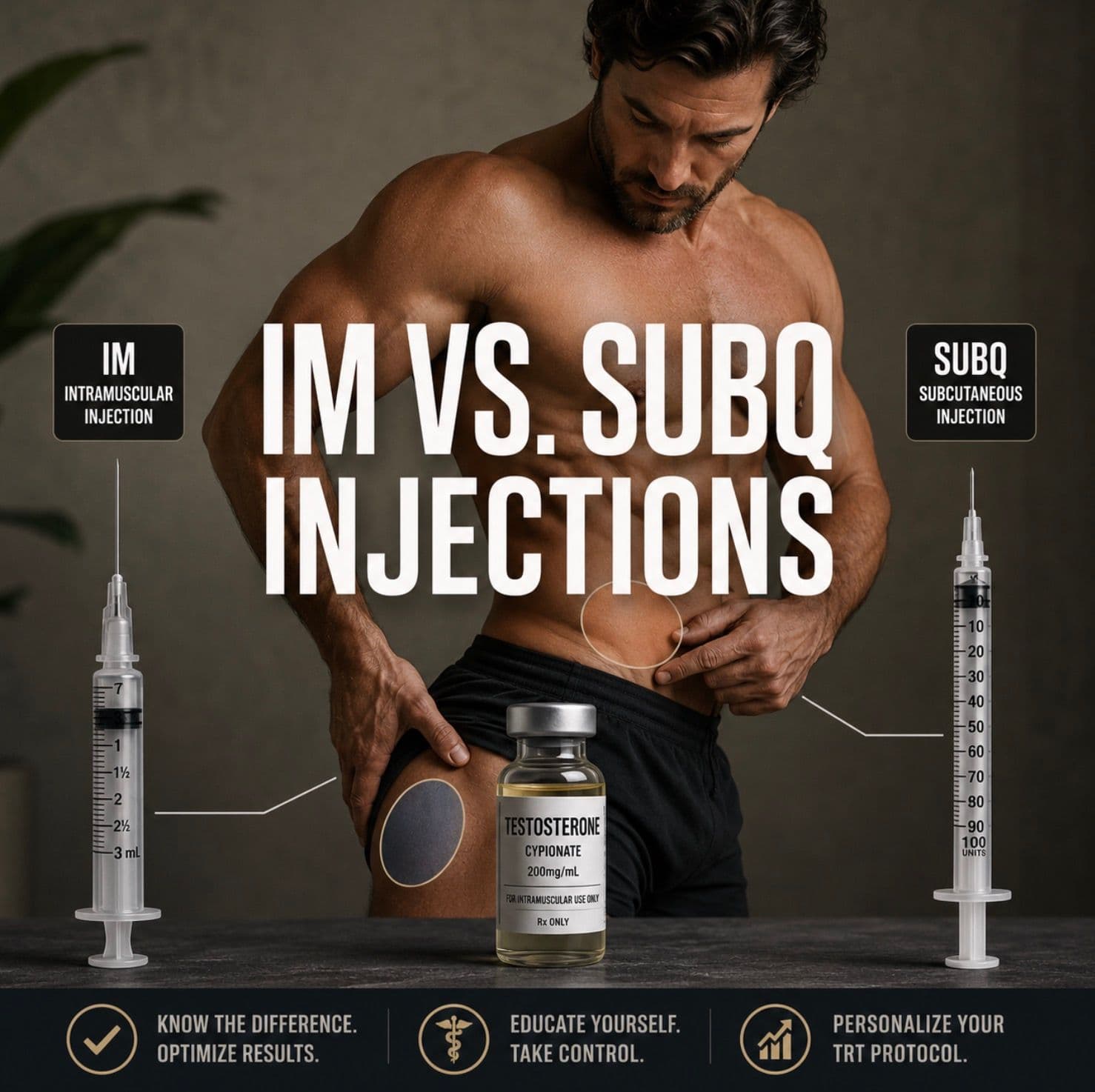
Short answer: Intramuscular testosterone injections go into the muscle, while subcutaneous testosterone injections go into the fatty tissue just under the skin. Both methods can be effective for testosterone replacement therapy when prescribed, taught, and monitored by a qualified clinician. The right choice often depends on your dose, injection comfort, absorption pattern, lab results, and how your body responds over time.
Testosterone replacement therapy, or TRT, is not just about the medication. How testosterone is delivered can affect comfort, consistency, and how easy it is to stick with your protocol.
For years, intramuscular injections were the standard approach. More recently, many clinicians have also used subcutaneous injections for appropriate patients because they can be easier to self-administer and may feel less intimidating.
Neither method is automatically “best” for everyone. The goal is to find the approach that fits your body, your labs, your comfort level, and your treatment plan.
What Is the Difference Between Intramuscular and Subcutaneous Testosterone Injections?
Short answer: Intramuscular injections deliver testosterone into muscle tissue, usually in the glute, thigh, or deltoid. Subcutaneous injections deliver testosterone into the fat layer under the skin, often in the abdomen, thigh, or flank. The biggest practical differences are injection depth, needle size, comfort, and how the medication may absorb.
An intramuscular injection, often called IM, means the medication is injected into muscle. Muscle has a strong blood supply, so medication placed there may absorb differently than medication placed in fatty tissue.
A subcutaneous injection, often called SubQ or SQ, means the medication is injected into the layer of fat beneath the skin. “Subcutaneous” simply means “under the skin.”
In TRT, the conversation usually comes down to a few practical questions:
- Which method is easier to perform consistently?
- Which method causes less soreness or irritation?
- Which method fits your prescribed dose and injection frequency?
- Which method keeps your symptoms and labs stable?
- Which method does your clinician recommend based on your history?
How Do Intramuscular Testosterone Injections Work?
Intramuscular testosterone injections place the medication deeper into muscle tissue. Common sites may include the upper outer glute, outer thigh, or shoulder area, depending on the medication, dose, and clinician instruction.
Some patients are comfortable with IM injections because they have been used for a long time and are familiar to many providers. IM injections may also be useful when a larger injection volume is needed.
That said, IM injections can feel more intimidating for some patients because they typically involve a longer needle and deeper injection. Some men report soreness, bruising, or anxiety around injecting into muscle.
Common IM considerations include:
- Deeper injection technique
- Longer needle length
- Possible post-injection soreness
- Need for careful site selection
- Greater importance of proper angle and depth
- Potential difficulty self-injecting certain areas
If a patient is inconsistent because they dread injections, that matters. A protocol that looks good on paper only works if the patient can follow it reliably.
How Do Subcutaneous Testosterone Injections Work?
Subcutaneous testosterone injections place the medication into the fatty layer beneath the skin. Common areas may include the abdomen, outer thigh, or flank area, depending on your clinician’s instructions.
Many patients find SubQ injections easier because they typically use a shorter, thinner needle and do not require reaching deep muscle tissue. For men who are nervous around needles, that difference can be meaningful.
SubQ injections are still medical injections. They require proper training, clean technique, site rotation, and clinician guidance.
Common SubQ considerations include:
- Shallower injection depth
- Smaller needle in many cases
- Often easier for self-administration
- May cause small temporary lumps or irritation
- May not be ideal for every dose volume
- Still requires monitoring through labs and symptoms
Some patients notice steadier day-to-day effects with SubQ injections, but individual response can vary.
How to Give a Subcutaneous Injection Safely
Short answer: A subcutaneous injection is usually given by placing a small needle into cleaned fatty tissue under the skin, injecting the medication slowly, and rotating sites to reduce irritation. You should only follow the exact technique, dose, needle size, and injection site instructions given by your clinician. Do not change your TRT injection method without medical guidance.
A general SubQ injection process may look like this, but your provider’s instructions should always come first:
- Wash your hands. Clean hands reduce the chance of contamination.
- Prepare your supplies. This may include medication, syringe, needle, alcohol swab, and sharps container.
- Choose the injection site. Common SubQ sites may include the abdomen, thigh, or flank, depending on clinician guidance.
- Clean the skin. Use an alcohol swab and let the area dry.
- Pinch the fatty tissue if instructed. This helps separate the fat layer from deeper tissue.
- Insert the needle at the angle your clinician taught you. Some patients are instructed to use a 45-degree angle, while others may use 90 degrees depending on needle length and body composition.
- Inject slowly. Pushing too quickly may increase pressure or irritation.
- Remove the needle and apply gentle pressure. Avoid aggressive rubbing unless your provider tells you otherwise.
- Dispose of the needle safely. Use an approved sharps container.
- Rotate sites next time. Reusing the exact same spot may increase irritation, lumps, or scar tissue.
This is not a substitute for hands-on instruction. If you feel unsure about injection technique, ask your clinician to walk you through it before trying it alone.
Is Subcutaneous Testosterone Better Than Intramuscular Testosterone?
Short answer: Subcutaneous testosterone is not automatically better than intramuscular testosterone, but it may be easier and more comfortable for some patients. IM injections may still be appropriate depending on dose, volume, provider preference, and patient response. Blood work and symptoms are what help clarify whether your method is working well.
This is where many men get stuck. They want a universal answer, but TRT does not work that way.
SubQ may be a good fit for someone who:
- Wants a smaller needle
- Has anxiety around deep muscle injections
- Prefers easier self-injection
- Is on a protocol that works well with smaller injection volumes
- Has clinician support for SubQ administration
IM may be a good fit for someone who:
- Tolerates muscle injections well
- Needs a larger injection volume
- Has been stable on IM for a long time
- Has clinician guidance to stay with IM
- Does not experience significant soreness or fluctuations
The best method is the one that produces stable labs, manageable side effects, consistent symptoms, and strong adherence.
How Do IM and SubQ Injections Compare?
Here is a practical way to think through the differences between intramuscular and subcutaneous testosterone injections.
If you feel a strong peak after injection, then fade before your next dose
This may mean your testosterone levels are rising and falling noticeably between doses.
Ask your provider: Would changing injection frequency or method help stabilize my levels?
If you dread injections or delay them
The injection method itself may be creating an adherence problem. A protocol only works if you can follow it consistently.
Ask your provider: Would SubQ injections be appropriate for my dose and medication?
If you get soreness after IM injections
The injection site, needle size, injection depth, or technique may need to be reviewed.
Ask your provider: Can we review my IM technique or consider another injection site?
If you get small lumps after SubQ injections
The site, medication volume, injection speed, or site rotation pattern may need adjustment.
Ask your provider: Should I change sites, inject more slowly, or split the dose?
If your energy, libido, or mood fluctuates during the week
Hormone levels may be rising and falling unevenly, or other markers may need review.
Ask your provider: Should we check total testosterone, free testosterone, estradiol, and hematocrit?
If your hematocrit rises
Hematocrit is the percentage of your blood made up of red blood cells. TRT can be associated with increases in hematocrit in some patients.
Ask your provider: Do we need to adjust my dose, injection frequency, or monitoring schedule?
If your estradiol-related symptoms change
Estradiol is a form of estrogen that men also need in appropriate amounts. Changes in estradiol can be associated with mood, libido, water retention, or sensitivity in some patients.
Ask your provider: Should estradiol be reviewed alongside my symptoms and testosterone levels?
Which Lab Markers Matter When Comparing Injection Methods?
Short answer: Your clinician may review total testosterone, free testosterone, estradiol, hematocrit, PSA, lipids, and sometimes SHBG to evaluate how your TRT protocol is working. These labs help connect how you feel with what is happening biologically. Symptoms alone do not tell the full story.
Here are the lab terms worth understanding:
- Total testosterone is the overall amount of testosterone measured in the blood.
- Free testosterone is the portion of testosterone that is not tightly bound to proteins and is more available for the body to use.
- SHBG, or sex hormone-binding globulin, is a protein that binds to testosterone and affects how much usable testosterone is available.
- Estradiol is a form of estrogen that men also need in appropriate amounts, but high or low levels may be associated with symptoms in some patients.
- Hematocrit is the percentage of your blood made up of red blood cells. TRT can be associated with increases in hematocrit in some patients.
- PSA, or prostate-specific antigen, is a prostate-related blood marker that clinicians may monitor in appropriate men.
- Lipids are cholesterol-related markers, including LDL, HDL, and triglycerides.
- Liver enzymes are blood markers that can help screen for liver stress or inflammation, though they are not specific to injection method.
Your injection method is only one part of the picture. Dose, frequency, body composition, metabolism, sleep, alcohol intake, medications, and overall health can all influence how you respond.
What Symptoms Can Suggest Your TRT Injection Method Needs Review?
Injection method may be worth discussing if you notice a repeated pattern like:
- Energy feels great for a few days, then drops
- Libido spikes and fades predictably
- Mood feels more irritable near the end of the dosing cycle
- Sleep quality changes after injection days
- Exercise recovery feels inconsistent
- Acne, oily skin, or water retention changes
- Injection-site soreness affects training or daily movement
- You avoid or delay injections because the process feels stressful
None of these automatically means your method is wrong. They are signals worth tracking.
A useful patient-style example:
A man injects once weekly into the muscle. For two days, his energy and libido feel high. By day five or six, he feels flat, irritable, and less motivated. That pattern may lead his clinician to review dose timing, injection frequency, testosterone levels, estradiol, hematocrit, and whether SubQ or more frequent dosing might be appropriate.
Another example:
A man switches to SubQ and likes the smaller needle, but he keeps using the same abdominal spot. He develops small tender lumps. That does not automatically mean SubQ is a bad fit. His clinician may review site rotation, injection speed, medication volume, and technique.
Can You Switch From IM to SubQ Testosterone?
Short answer: Some patients can switch from intramuscular to subcutaneous testosterone, but it should be done with clinician guidance. Your provider may review your dose, concentration, injection volume, frequency, symptoms, and follow-up labs before deciding whether the switch makes sense.
Do not change your injection method just because you saw a video or read a thread online. The medication may be the same, but the technique, absorption pattern, and monitoring plan may need adjustment.
Before switching, ask your clinician:
- Is my testosterone formulation appropriate for SubQ use?
- Would my current dose volume be comfortable under the skin?
- Should my injection frequency change?
- What site should I use?
- What needle size and angle should I use?
- When should follow-up blood work be checked?
- Which symptoms should I track after switching?
Changing methods should be a measured adjustment, not a guess.
Which Testosterone Injection Method Is Easier to Stick With?
For many men, the easiest method is the one they can perform consistently without stress.
Some patients prefer SubQ because it may feel simpler and less painful. Others prefer IM because they are used to it, tolerate it well, or feel stable on their current routine.
Consistency matters because skipped or delayed injections can create unnecessary ups and downs. If your injection method makes you procrastinate, avoid treatment, or feel anxious every week, that is worth bringing up.
Your clinician may be able to adjust:
- Injection site
- Needle size
- Injection frequency
- Medication volume
- Technique
- Route of administration
Small changes can make a protocol much easier to follow.
What Is the Bottom Line on IM vs. SubQ Testosterone Injections?
Intramuscular and subcutaneous testosterone injections can both have a place in TRT. IM injections place testosterone into muscle. SubQ injections place testosterone into fatty tissue under the skin.
SubQ injections may be easier and more comfortable for some patients, especially those who dislike longer needles or deep injections. IM injections may still be appropriate for certain patients, doses, or clinical preferences.
The best choice is not based on internet debates. It is based on your symptoms, labs, medical history, comfort level, and clinician-guided monitoring.
If you are unsure whether your current injection method is right for you, a licensed provider through AlphaMD can review your protocol, help you understand your lab markers, and discuss whether a different approach may make sense for your TRT plan.
Frequently Asked Questions
Is subcutaneous testosterone as effective as intramuscular testosterone?
Subcutaneous testosterone may be effective for appropriately selected patients when prescribed and monitored by a qualified clinician. Some studies have found SubQ testosterone to be well tolerated and capable of maintaining testosterone levels. That does not mean it is automatically best for everyone. Your dose, symptoms, lab results, and injection comfort all matter.
How do you give a subcutaneous testosterone injection?
A subcutaneous testosterone injection is typically given into cleaned fatty tissue under the skin, often in the abdomen, thigh, or flank. The needle is usually smaller than an intramuscular needle. Your clinician should teach you the correct site, angle, dose, needle size, injection speed, and site rotation before you self-inject.
Is SubQ testosterone less painful than IM testosterone?
Some patients find SubQ testosterone less painful because it usually uses a shorter, thinner needle and does not go deep into muscle. Others tolerate IM injections without much discomfort. Pain can depend on technique, site selection, needle size, injection speed, medication volume, and individual sensitivity.
Can I switch from intramuscular to subcutaneous testosterone?
You should not switch injection methods without medical guidance. Your clinician may need to review your medication type, dose volume, frequency, injection technique, symptoms, and follow-up labs. A supervised switch can help reduce the chance of technique problems, irritation, underdosing, overdosing, or unexpected changes in how you feel.
Where is the best place to inject testosterone subcutaneously?
Common SubQ injection sites may include the abdomen, outer thigh, or flank, but the best site depends on your body composition and your clinician’s instructions. Site rotation matters. Repeatedly injecting the exact same spot can increase the chance of irritation, tenderness, small lumps, or scar tissue.
What labs should be monitored while using testosterone injections?
Your clinician may monitor total testosterone, free testosterone, estradiol, hematocrit, PSA, lipids, and sometimes SHBG. Hematocrit is especially important because TRT can be associated with increased red blood cell concentration in some patients. Labs should be interpreted with symptoms, dose, timing, and overall health history.
Have a question? Ask us.
At AlphaMD, we're here to help. Feel free to ask us any question you would like about TRT, medical weightloss, ED, or other topics related to men's health. Or take a moment to browse through our past questions.
People are asking...
What works better in your experience, subcutaneous injections or intramuscular injections. Are there pros and cons to each that should be considered?...
In practical terms subq takes longer but requires less knowledge/skill to perform & is typically less painful due to the size of the needle & location. For IM is requires a bit more knowledge, can hol... See Full Answer
Is there any real difference between SubQ and IM injections? Starting TRT in a few weeks and have a pretty strong phobia of needles...
For overall average testosterone throughout the week there is not much change. However subq is better at managing Estrogen symptoms because it absorbs slower (releases slower) than IM. Because of this... See Full Answer
What's the indication for Subcutaneous vs IM administration? Personal preference? Skill?...
In general Subq is better for TRT when given both options because the absorption is slower & leads to a more even level overall, so there are less spikes which might cause additional Estrogen transfer... See Full Answer
Get $30 off your first month’s order
Enter your email address now to receive $30 off your first month’s cost, other discounts, and additional information about TRT.
Legal Disclaimer
This website is a repository of publicly available information and is not intended to form a physician-patient relationship with any individual. The content of this website is for informational purposes only. The information presented on this website is not intended to take the place of your personal physician's advice and is not intended to diagnose, treat, cure, or prevent any disease. Discuss this information with your own physician or healthcare provider to determine what is right for you. All information is intended for your general knowledge only and is not a substitute for medical advice or treatment for specific medical conditions. The information contained herein is presented in summary form only and intended to provide broad consumer understanding and knowledge. The information should not be considered complete and should not be used in place of a visit, phone or telemedicine call, consultation or advice of your physician or other healthcare provider. Only a qualified physician in your state can determine if you qualify for and should undertake treatment.