
The Vitamin K2 Secret: Why MK-4 Increases Testosterone (Even on TRT)
Published on:
Updated on:
People are asking...
Any experience of managing trt that is also supplemented by the individual with 4 Androstenediol. I use 2 squirts of Testogel daily but feel it doesn...
4 androstenediol does two things, it weakly attaches to the androgen receptor directly, and it also converts into other sex hormones. 4 androstenediol converts into estrogen and testosterone, at a rat... See Full Answer
Why does enclomiphene raise testosterone levels, but the testosterone doesn’t seem to be absorbed by the body, thus not relieving any symptoms of low ...
So, this may be a bit of a two part answer. A bit candid if you're okay with that. Enclomiphene is a pretty popular item these days because a lot of people love to feel like they've "figured out" som... See Full Answer
Is it possible for enclomiphene to “kickstart”Testosterone production? Example, 46yo male, 5’10 167lbs works out, eats good, sleep is pretty good, low...
Experienced providers will tell you they have never seen anything “kickstart” testosterone production. The analogy I have used in this case is to think of your testicles as a car engine which is not ... See Full Answer
Have a question? Ask us.
At AlphaMD, we're here to help. Feel free to ask us any question you would like about TRT, medical weightloss, ED, or other topics related to men's health. Or take a moment to browse through our past questions.
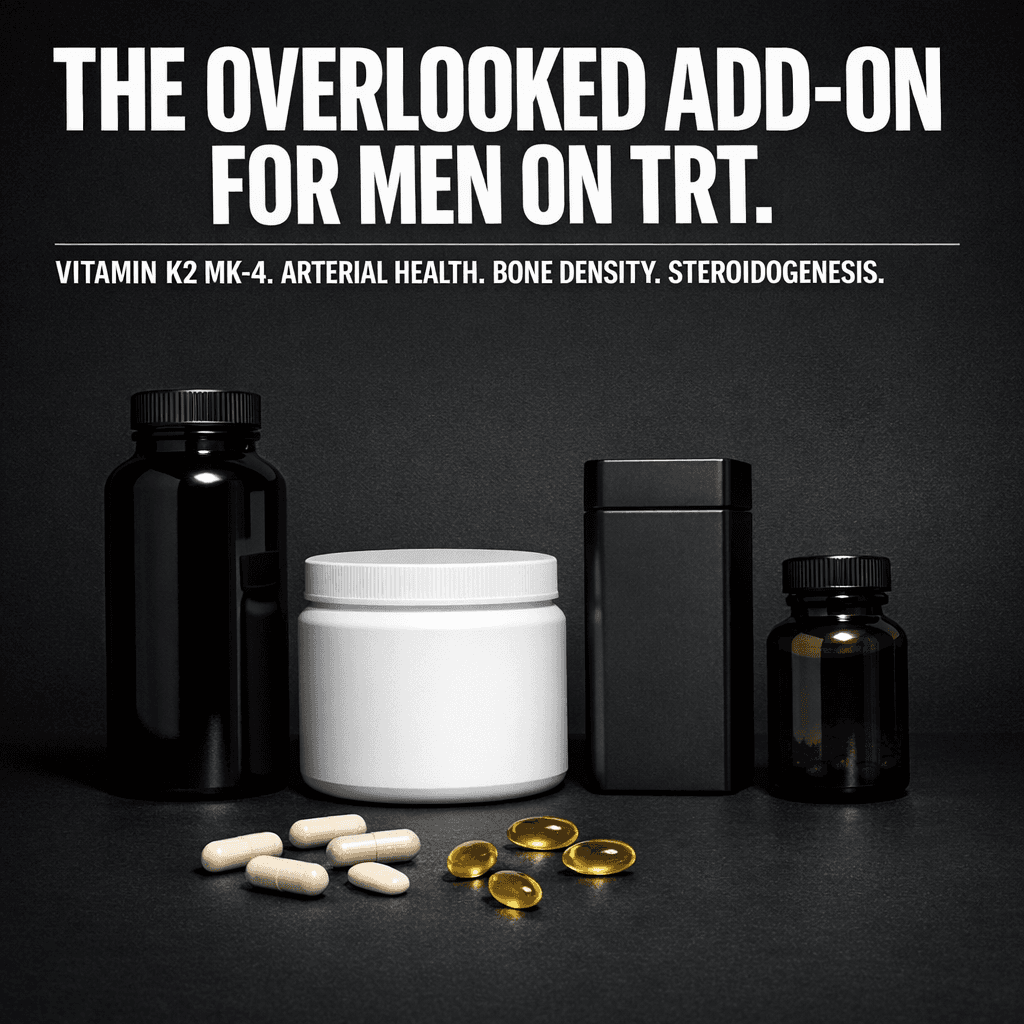
Most men on testosterone replacement therapy focus on their injections, their labs, and their sleep, and almost nobody thinks about vitamin K2. That oversight may be costing them more than they realize, especially when it comes to testicular function, bone health, and the full picture of hormonal optimization.
What Vitamin K2 Actually Is (And Why It Gets Confused)
Vitamin K is not a single compound. Most people know vitamin K1, found in leafy greens, which plays a critical role in blood clotting. Vitamin K2 is a separate family of molecules called menaquinones, and within that family, two forms get the most attention in research: MK-4 and MK-7.
MK-7 is the form found in fermented foods, most notably natto, a traditional Japanese fermented soybean dish that most Americans will never voluntarily eat twice. MK-7 has a longer half-life in the bloodstream, meaning it circulates for days after a single dose. This makes it easy to study and convenient to supplement.
MK-4 is different in ways that matter. It is not primarily obtained from food in large amounts. Instead, the body converts vitamin K1 into MK-4 through a unique enzymatic process that occurs in specific tissues, including the brain, arteries, and, critically, the testes. MK-4 has a shorter half-life but concentrates in tissues that MK-7 largely does not reach. That tissue-specific accumulation is exactly why researchers started paying closer attention to it in the context of male hormone physiology.
The Testes Are Not Passive Bystanders
To understand why MK-4 might matter for testosterone, a brief look at how testosterone is made is useful. Testosterone production in the testes is a multi-step biochemical process called steroidogenesis. It starts with cholesterol and moves through a series of enzymatic conversions inside Leydig cells, eventually producing testosterone.
This process requires more than just the right hormones telling the testes to work. It requires functional mitochondria (since early steps in steroidogenesis occur there), adequate cofactors, low oxidative stress, and a cellular environment that supports enzyme activity. LH, or luteinizing hormone from the pituitary, is the primary signal that tells Leydig cells to produce testosterone. But whether those cells respond well to that signal depends heavily on their internal health.
MK-4 has been identified as a ligand for a nuclear receptor involved in steroidogenesis regulation. In simpler terms, MK-4 appears to interact directly with cellular machinery inside the testes in ways that may support the production of testosterone. It is not a hormone itself. It is more like a facilitator of the environment in which hormone production happens.
What the Research Actually Shows
The most frequently cited study on this topic is a rodent study showing that rats supplemented with MK-4 had significantly higher testosterone levels than controls. The effect was dose-dependent and appeared to operate through increased expression of steroidogenic enzymes. That is a meaningful signal, but rodent physiology is not human physiology, and this distinction matters.
Human data is limited. One small study in older Japanese men found that those with higher vitamin K2 intake had higher testosterone levels, though this was observational, meaning it cannot prove causation. Other research has looked at vitamin K status and reproductive hormones in various populations with mixed results.
What researchers have not done yet is a large, well-controlled randomized clinical trial specifically examining MK-4 supplementation and testosterone levels in men. That study does not exist at the scale needed to make definitive claims. The mechanistic evidence is plausible. The animal data is intriguing. The human observational data is supportive but not conclusive. That honest summary is where the science currently stands, and any source telling you otherwise is overstating it.
Why This Matters Even More on TRT
Here is where the conversation becomes particularly relevant for men using testosterone replacement therapy.
When exogenous testosterone is introduced into the body, the hypothalamic-pituitary-gonadal axis responds by reducing its own output. LH levels drop, often significantly. Without LH signaling, the testes reduce their own testosterone production, and over time, testicular size and function can diminish. This is a well-understood consequence of TRT that is managed in different ways depending on a patient's goals and protocol.
For men who care about fertility, or who simply want to preserve testicular function during TRT, this suppression of intratesticular testosterone (the testosterone produced inside the testes, which is much higher in concentration than circulating testosterone) is a real concern. Even men with excellent serum testosterone levels on TRT can have very low intratesticular testosterone.
If MK-4 supports the cellular machinery of Leydig cells, it may help maintain some degree of testicular function even in the presence of suppressed LH. This is speculative, and no current clinical protocol is built around it, but the plausibility is grounded in what we know about how MK-4 interacts with steroidogenic tissue.
Beyond fertility and testicular function, there is another layer to consider. Men on TRT often expect their optimized hormone levels to translate directly into feeling well, building muscle, maintaining libido, and supporting energy. But these outcomes depend on far more than a testosterone number on a lab panel. Nutrient status, metabolic health, sleep, inflammation, and cellular function all contribute. MK-4 deficiency, if present, could be a quiet limiting factor in how well the body uses the hormonal environment it has been given.
K2's Role in the Bigger Picture of Men's Health
Testosterone is not the only reason men on TRT should pay attention to vitamin K2. Cardiovascular health is another major consideration.
Vitamin K2 activates a protein called matrix Gla protein (MGP), which inhibits arterial calcification. Without adequate K2, calcium can deposit in arterial walls rather than in bones, contributing to vascular stiffness and cardiovascular risk. This is relevant to TRT patients because long-term exogenous testosterone use has been the subject of ongoing cardiovascular research, and supporting arterial health through nutrition and supplementation is a reasonable component of long-term management.
Bone density is another area where K2 plays a documented role. K2 activates osteocalcin, a protein that directs calcium into bone matrix. Men with low testosterone often have compromised bone density, and while TRT helps address this, K2 supports the same outcome through a complementary mechanism. For men who start TRT with pre-existing bone health concerns, this overlap is worth noting.
Metabolic health is a third consideration. Some research suggests K2 may support insulin sensitivity and glucose metabolism, which are areas where men with low testosterone commonly struggle. These connections are not fully established, but the convergence of mechanisms across cardiovascular health, bone metabolism, and hormonal physiology gives K2 an unusually broad relevance to the TRT patient profile.
Getting More K2 Without Overcomplicating It
Dietary sources of MK-4 include animal products like egg yolks, liver, butter from grass-fed animals, and certain aged cheeses. These are not exotic foods, but they are foods that many men eating modern diets underconsum, particularly those who have spent years in low-fat eating patterns.
MK-7 is found in fermented foods, with natto being the richest source by far. Hard and soft cheeses, particularly European-style varieties, also contribute meaningful amounts.
For supplementation, the form matters. MK-4 supplements are available, though they are less common in mainstream retail than MK-7. Quality varies considerably across the supplement market. Looking for products that have third-party testing verification, that clearly state the form and source of K2, and that are free from unnecessary fillers is a reasonable starting point. Combination products offering both MK-4 and MK-7 exist and may offer broader tissue coverage given how differently the two forms distribute in the body.
One practical note on timing: vitamin K2 is fat-soluble, so taking it with a meal that contains dietary fat improves absorption meaningfully.
Who Should Be Careful
Vitamin K, in any form, can interact with anticoagulant medications, most notably warfarin (Coumadin). Men taking blood thinners should not add vitamin K2 supplementation without first consulting their physician, because it can counteract the medication's intended effect and create serious health risks.
Men with certain clotting disorders, those recovering from recent cardiovascular events, or those on complex medication regimens should discuss K2 with a clinician before supplementing. This is not a vitamin to introduce casually if your medical situation is complicated.
For otherwise healthy men who are simply curious about optimizing their physiology, the risk profile of K2 supplementation at reasonable amounts is generally considered low, but that conversation still belongs with a qualified provider who knows your full picture.
Where MK-4 Fits in an Honest Hormone Optimization Strategy
MK-4 is not a testosterone booster in the dramatic sense. It will not replace TRT, and it will not produce dramatic lab changes on its own based on current evidence. What the research suggests is more nuanced: that MK-4 may support the cellular and enzymatic environment in which testosterone production occurs, and that adequate vitamin K2 status is likely one of several nutritional factors that influence how well men respond to hormonal optimization efforts.
For men already on TRT, that framing is actually more useful than any exaggerated claim. TRT is a medical intervention that works best when the rest of physiology supports it. Nutrition, body composition, sleep, stress management, and targeted supplementation all matter. MK-4 appears to be one piece of that larger picture, with a plausible mechanism, some supportive early research, and a safety profile that makes it worth discussing with your provider.
If you are navigating TRT and want medical oversight that accounts for this kind of nuanced, whole-body thinking, AlphaMD works with men to build hormone optimization plans grounded in clinical evidence and individual health goals. The science around nutrients like MK-4 continues to develop, and staying informed is part of doing this well.
Have a question? Ask us.
At AlphaMD, we're here to help. Feel free to ask us any question you would like about TRT, medical weightloss, ED, or other topics related to men's health. Or take a moment to browse through our past questions.
People are asking...
Any experience of managing trt that is also supplemented by the individual with 4 Androstenediol. I use 2 squirts of Testogel daily but feel it doesn...
4 androstenediol does two things, it weakly attaches to the androgen receptor directly, and it also converts into other sex hormones. 4 androstenediol converts into estrogen and testosterone, at a rat... See Full Answer
Why does enclomiphene raise testosterone levels, but the testosterone doesn’t seem to be absorbed by the body, thus not relieving any symptoms of low ...
So, this may be a bit of a two part answer. A bit candid if you're okay with that. Enclomiphene is a pretty popular item these days because a lot of people love to feel like they've "figured out" som... See Full Answer
Is it possible for enclomiphene to “kickstart”Testosterone production? Example, 46yo male, 5’10 167lbs works out, eats good, sleep is pretty good, low...
Experienced providers will tell you they have never seen anything “kickstart” testosterone production. The analogy I have used in this case is to think of your testicles as a car engine which is not ... See Full Answer
Get $30 off your first month’s order
Enter your email address now to receive $30 off your first month’s cost, other discounts, and additional information about TRT.
Legal Disclaimer
This website is a repository of publicly available information and is not intended to form a physician-patient relationship with any individual. The content of this website is for informational purposes only. The information presented on this website is not intended to take the place of your personal physician's advice and is not intended to diagnose, treat, cure, or prevent any disease. Discuss this information with your own physician or healthcare provider to determine what is right for you. All information is intended for your general knowledge only and is not a substitute for medical advice or treatment for specific medical conditions. The information contained herein is presented in summary form only and intended to provide broad consumer understanding and knowledge. The information should not be considered complete and should not be used in place of a visit, phone or telemedicine call, consultation or advice of your physician or other healthcare provider. Only a qualified physician in your state can determine if you qualify for and should undertake treatment.