
The Military Is Finally Taking Low Testosterone Seriously. What About Veterans?
Published on:
Updated on:
People are asking...
Can you discuss the phenomena of veterans experiencing low T from PTSD? Is this a legitimate thing?...
So, PTSD in and of itself does not cause low testosterone. However, veterans are at risk of hypogonadism for many reasons that often coincide with PTSD. So, first is that many environmental exposures ... See Full Answer
I've been reading a lot about trt. I’m about to turn 36, had a general testosterone blood test done within the last year that came back normal. Iv swi...
If you've been having low Testosterone symptoms enough to research it, the likelihood is that you're probably a candidate. Do you remember what your Testosterone came back as? "Normal ranges" for Test... See Full Answer
Have been zeroing on some health issues and I recently got a Testosterone test of 301 ng/dl. As a very healthy male ( train 6x a week, track every cal...
Based on your symptoms, a licensed provider would likely consider you a candidate for TRT. A provider would want to talk with you to dive a bit deeper into them, but at a glance, yes.Men who are very ... See Full Answer
Have a question? Ask us.
At AlphaMD, we're here to help. Feel free to ask us any question you would like about TRT, medical weightloss, ED, or other topics related to men's health. Or take a moment to browse through our past questions.
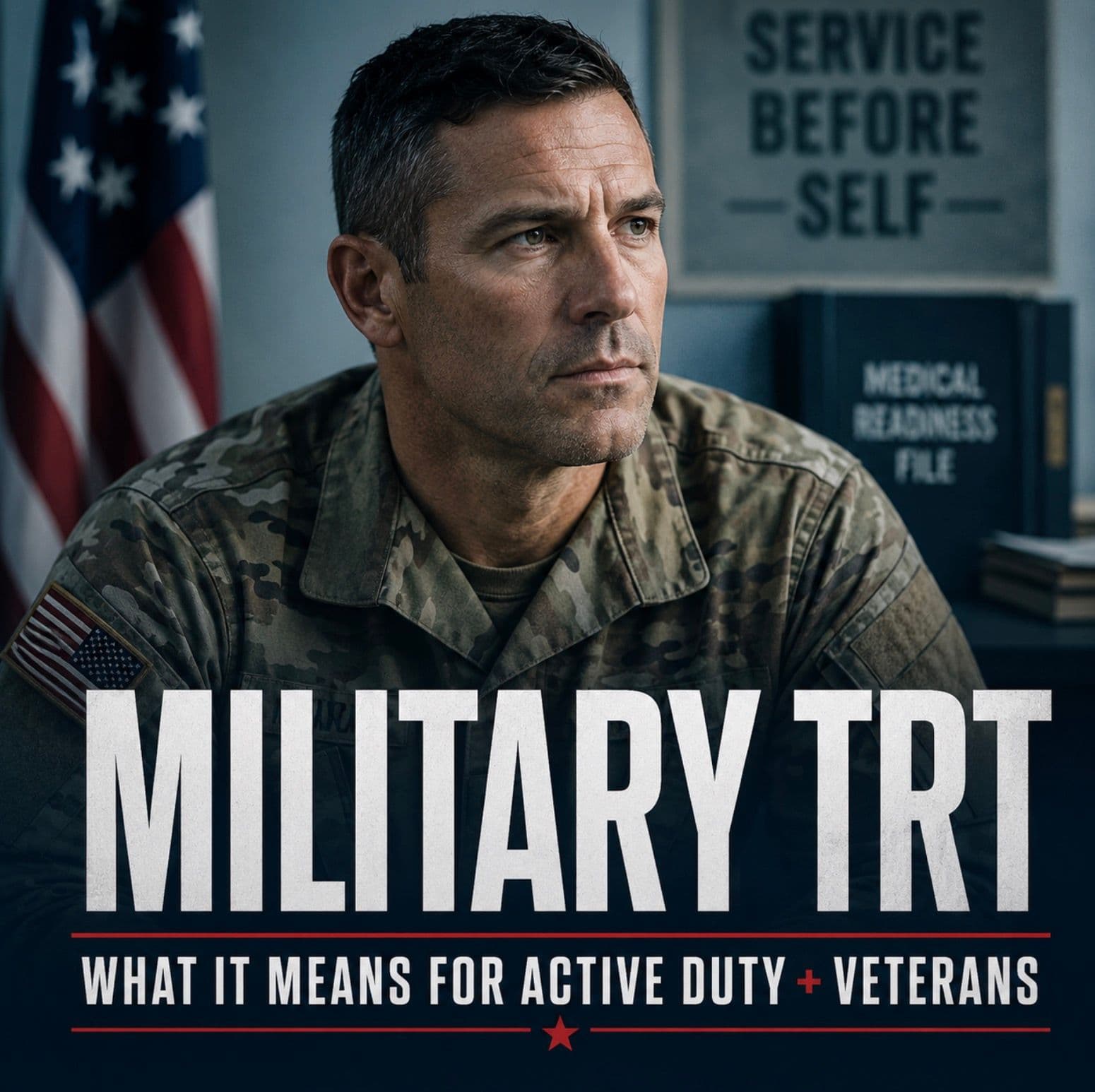
The U.S. military is preparing to make testosterone screening part of routine healthcare for service members aged 30 and older.
According to the original BBC report, Defense Secretary Pete Hegseth announced that eligible service members will be screened for testosterone deficiency during their annual health assessments. Military personnel younger than 30 will also be able to request testing.
Service members identified as having testosterone deficiency may be offered testosterone replacement therapy, or TRT, following a medical evaluation. Treatment will remain voluntary.
The announcement has attracted considerable attention, but it also raises a larger question:
Why has it taken this long for the military healthcare system to take testosterone deficiency seriously, and will veterans receive the same attention after their service ends?
Low Testosterone Is Not Just a Sexual Health Concern
Testosterone is often discussed only in relation to libido and sexual function. Clinically low testosterone, however, may affect multiple aspects of a man’s physical and mental well-being.
Symptoms associated with testosterone deficiency can include:
- Persistent fatigue
- Reduced muscle mass and strength
- Difficulty recovering from physical activity
- Increased body fat
- Low motivation
- Depressed mood
- Problems with concentration
- Reduced bone density
- Low libido
- Sexual dysfunction
These symptoms can substantially affect quality of life.
For active-duty service members, unresolved symptoms may also interfere with physical conditioning, recovery, alertness and overall readiness.
That does not mean every service member experiencing fatigue or declining performance needs TRT. Poor sleep, nutritional deficiencies, chronic stress, medication use, depression, thyroid disorders and other medical conditions can cause similar symptoms.
It does mean that hormone health deserves to be included in a complete clinical evaluation.
Military Service Can Put Hormone Health Under Pressure
Military personnel are routinely exposed to conditions that may affect the body’s hormonal systems.
These can include:
- Irregular or insufficient sleep
- Chronic psychological stress
- Extreme physical demands
- Calorie restriction
- Repeated deployments
- Traumatic injuries
- Chronic pain
- Certain medications
- Traumatic brain injuries
Traumatic brain injury may be especially relevant because an injury affecting the pituitary gland can disrupt the hormonal signals involved in testosterone production.
The symptoms of hormonal dysfunction may also overlap with post-traumatic stress, depression, sleep disorders and other conditions frequently experienced by active-duty personnel and veterans.
A service member experiencing fatigue, cognitive difficulties, reduced strength or low motivation could therefore have several contributing factors. Without appropriate testing, an underlying hormonal issue may go unrecognized.
Routine testosterone screening will not provide every answer, but it may help identify men who need a more thorough evaluation.
Screening Should Be the Beginning, Not the Diagnosis
The military’s decision should not create a system in which every man over 30 receives TRT after a single low laboratory result.
A testosterone deficiency diagnosis should consider:
- The individual’s symptoms
- More than one appropriately timed testosterone measurement
- Medical history
- Current medications
- Sleep quality
- Weight and metabolic health
- Fertility goals
- Possible pituitary or testicular conditions
- Previous head injuries
Testosterone levels naturally fluctuate and may temporarily decline because of inadequate sleep, acute illness, restrictive dieting, intense physical training or other health factors.
When an initial result is low, licensed medical providers should confirm the finding and investigate why it is low before recommending treatment.
TRT is not appropriate for every man, and treatment requires ongoing monitoring. However, concerns about inappropriate prescribing should not become a reason to dismiss men who have persistent symptoms and confirmed testosterone deficiency.
The goal should be responsible access, not automatic treatment or automatic denial.
Veterans Have Faced an Uneven System
The Department of Veterans Affairs does provide testosterone therapy for some qualifying veterans. However, access may depend on laboratory requirements, documented symptoms, underlying medical conditions and the clinical judgment of the individual healthcare team.
As a result, veterans can have very different experiences within the system.
Some may receive an appropriate evaluation and treatment plan. Others may encounter long delays, rigid laboratory interpretations or clinicians who focus on one test result without considering the veteran’s symptoms and complete medical history.
The problem is not simply that every veteran who requests testosterone should receive it.
The problem is inconsistency.
A responsible system must protect veterans from both undertreatment and inappropriate treatment. That means confirming a genuine deficiency, investigating possible causes, discussing fertility and potential risks, and monitoring treatment when it is prescribed.
Veterans should not have to repeatedly fight for a complete evaluation of symptoms that may be affecting their health, relationships and daily lives.
Care Should Not End When Military Service Does
The new screening initiative is focused primarily on active-duty personnel. But hormone-related health concerns do not disappear when someone retires or separates from the military.
For some veterans, these concerns may become more noticeable over time because of the combined effects of:
- Aging
- Chronic pain
- Sleep disruption
- Traumatic brain injury
- Metabolic disease
- Medication use
- Reduced physical activity
- Years of physical and psychological stress
If the government now recognizes testosterone health as potentially relevant to military readiness, it should also recognize its importance to veterans’ long-term health and quality of life.
Service members transitioning into civilian life should not suddenly face a different standard of care.
A better system would provide:
- Clear and consistent testing protocols
- Symptom-based clinical evaluations
- Appropriate confirmatory testing
- Investigation of service-related injuries
- Access to clinicians experienced in hormone health
- Treatment when medically appropriate
- Regular safety and effectiveness monitoring
- Better continuity between military and VA healthcare
The men who served should receive the same careful attention after leaving the military that they received while preparing for service.
AlphaMD Offers a Military and Veteran Discount
Access to appropriate care should not depend entirely on whether a service member or veteran can navigate a complicated government healthcare system.
AlphaMD offers active-duty military personnel and veterans a 20% discount on TRT plans and baseline medications available through the AlphaMD platform.
Eligibility must be verified using qualifying documentation, such as a Department of Defense identification card, a driver’s license with a military designation or a DD-214.
You can learn more about eligibility and how to apply through AlphaMD’s guide to the 20% military and veteran TRT discount.
Receiving a discount does not guarantee that TRT will be prescribed. Treatment decisions are made by independent, licensed medical providers following an individual evaluation, laboratory testing and a review of the patient’s medical history.
A Long-Overdue Change
The Pentagon’s announcement should not be interpreted as a declaration that every service member needs higher testosterone.
TRT is not a universal performance enhancer, and testosterone levels should not be treated as a measure of strength, toughness or military value.
The real significance of the policy is that hormone health is finally being recognized as a legitimate part of men’s healthcare.
For active-duty personnel, routine screening could help identify genuine medical concerns before they begin to further affect health, performance or quality of life.
For veterans, the announcement may feel bittersweet.
Many have spent years asking healthcare professionals to investigate persistent fatigue, loss of strength, sexual symptoms, mood changes and cognitive difficulties more thoroughly.
The government is now acknowledging that testosterone deficiency may matter when maintaining the health and readiness of an active fighting force.
It should matter just as much when caring for the people who have already served.
Have a question? Ask us.
At AlphaMD, we're here to help. Feel free to ask us any question you would like about TRT, medical weightloss, ED, or other topics related to men's health. Or take a moment to browse through our past questions.
People are asking...
Can you discuss the phenomena of veterans experiencing low T from PTSD? Is this a legitimate thing?...
So, PTSD in and of itself does not cause low testosterone. However, veterans are at risk of hypogonadism for many reasons that often coincide with PTSD. So, first is that many environmental exposures ... See Full Answer
I've been reading a lot about trt. I’m about to turn 36, had a general testosterone blood test done within the last year that came back normal. Iv swi...
If you've been having low Testosterone symptoms enough to research it, the likelihood is that you're probably a candidate. Do you remember what your Testosterone came back as? "Normal ranges" for Test... See Full Answer
Have been zeroing on some health issues and I recently got a Testosterone test of 301 ng/dl. As a very healthy male ( train 6x a week, track every cal...
Based on your symptoms, a licensed provider would likely consider you a candidate for TRT. A provider would want to talk with you to dive a bit deeper into them, but at a glance, yes.Men who are very ... See Full Answer
Get $30 off your first month’s order
Enter your email address now to receive $30 off your first month’s cost, other discounts, and additional information about TRT.
Legal Disclaimer
This website is a repository of publicly available information and is not intended to form a physician-patient relationship with any individual. The content of this website is for informational purposes only. The information presented on this website is not intended to take the place of your personal physician's advice and is not intended to diagnose, treat, cure, or prevent any disease. Discuss this information with your own physician or healthcare provider to determine what is right for you. All information is intended for your general knowledge only and is not a substitute for medical advice or treatment for specific medical conditions. The information contained herein is presented in summary form only and intended to provide broad consumer understanding and knowledge. The information should not be considered complete and should not be used in place of a visit, phone or telemedicine call, consultation or advice of your physician or other healthcare provider. Only a qualified physician in your state can determine if you qualify for and should undertake treatment.