
The HCG Dosing Mistake That's Wasting Your Money and Fertility
Published on:
Updated on:
People are asking...
How often do you see HCG doing nothing to preserve fertility? I had to completely quit all TRT for 6+ months to regain my fertility. I was on 250iu t...
Very rarely. Many times, men haven't done a semenalysis prior to starting TRT, so it's not always possible to be sure they were not already infertile prior to starting therapy. So without a baseline, ... See Full Answer
Can HCG cause itching/tingling nips and enlarged breasts? I was doing fine until (under doctors orders) I injected 500iu HCG. Woke up this morning wit...
No & yes. The HCG didn't do that, your Estrogen did. Adding HCG is going to increase your total Testosterone (which can trigger additional T -> E transfer) & it is also more prone to influence your Es... See Full Answer
Are there any viable alternatives to hCG when trying to maintain fertility on testosterone? If not, are there any being studied or developed? I've be...
There are some, like Enclomiphene or Clomid, but they are not as safe & effective as hCG is for the same purpose. That said, for many men like yourself who are impacted by cost & availability, provide... See Full Answer
Have a question? Ask us.
At AlphaMD, we're here to help. Feel free to ask us any question you would like about TRT, medical weightloss, ED, or other topics related to men's health. Or take a moment to browse through our past questions.
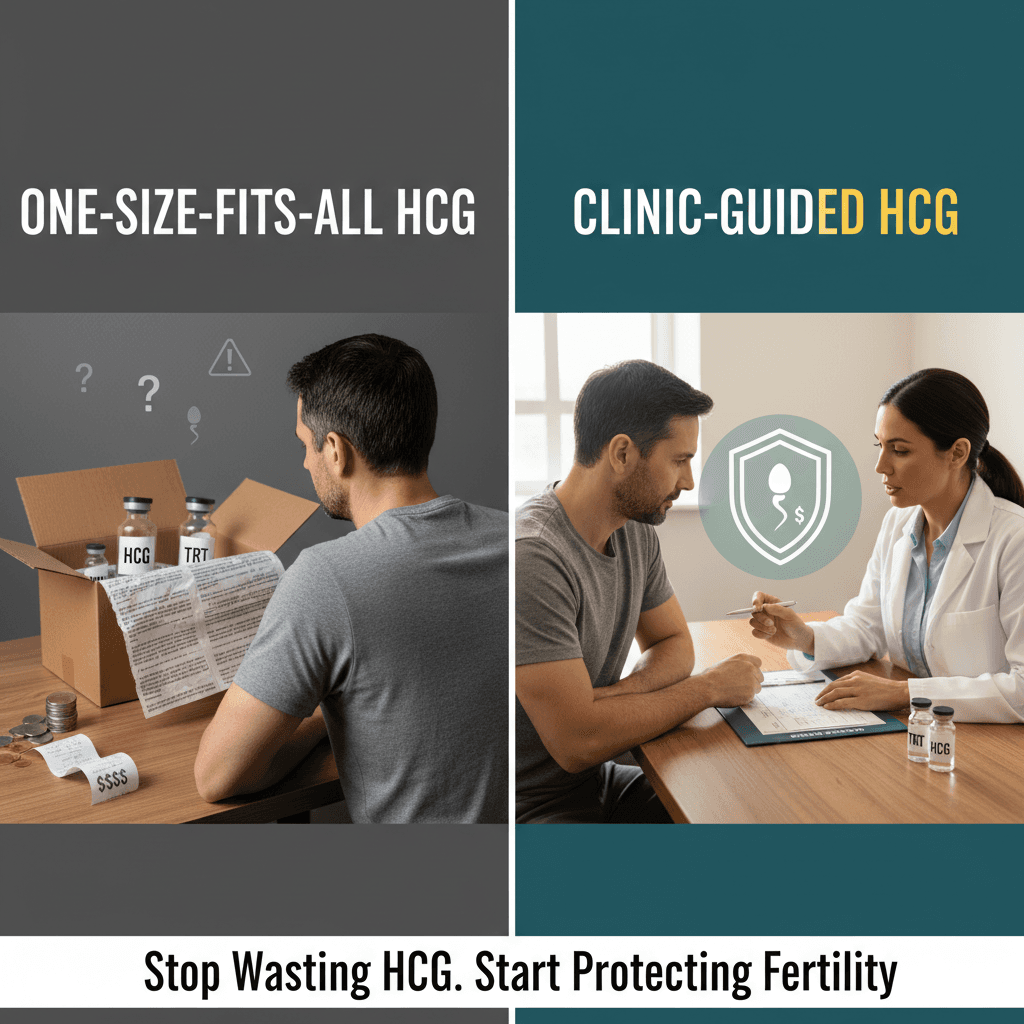
Most men on TRT using HCG think they're protecting their fertility, but a subtle dosing misunderstanding is quietly draining their bank accounts while doing little to preserve sperm production. The difference between using HCG strategically and just going through the motions can mean thousands of dollars wasted and fertility goals left unmet.
If you've started testosterone replacement therapy or you're considering it, you've probably heard about HCG as the fertility insurance policy. It gets added to protocols with the promise of keeping your testicles functioning, maintaining sperm production, and avoiding some of the downsides of shutting down your natural hormone production. The problem is that many men, and even some prescribers, approach HCG with a one-size-fits-all mentality that misses the entire point of why it's there in the first place.
The result? You're paying for a medication month after month that might not be dosed or timed in a way that actually supports your goals. Worse, improper HCG use can introduce side effects, complicate your hormone balance, and still leave you with compromised fertility when you actually need it.
Why HCG Became TRT's Fertility Safety Net
To understand the mistake, you need to understand what HCG actually does. Human chorionic gonadotropin is a hormone that mimics luteinizing hormone, or LH, which is one of the signals your pituitary gland normally sends to your testicles. LH tells the Leydig cells in your testes to produce testosterone locally and signals the supporting cells involved in sperm production.
When you start taking exogenous testosterone as part of TRT, your body detects that testosterone levels are adequate (or elevated) and stops producing LH and another signal called FSH. Without these signals, your testicles essentially go into standby mode. Testosterone production inside the testes drops, sperm production declines or stops, and testicular size often decreases.
HCG steps in as a substitute for that missing LH signal. By injecting HCG, you're telling your testes to keep working even though your pituitary has gone quiet. This can help maintain intratesticular testosterone, which is important for sperm production, and keeps the cellular machinery running so that fertility isn't completely shut down.
That's the theory. In practice, how you use HCG determines whether it actually accomplishes those goals or just adds cost and complexity to your protocol.
The Dosing Mistake That Costs You
The most common HCG mistake isn't about getting the dose slightly wrong. It's about using HCG for the wrong reasons or with the wrong strategy altogether.
Many men add HCG to their TRT protocol without a clear conversation about what they're trying to achieve. Some use it because they heard it prevents testicular atrophy and they don't like the idea of shrinkage. Others assume it's automatically protecting fertility. Some prescribers add it as a default part of every protocol without tailoring the approach to the individual.
The mistake is treating HCG as a checkbox item rather than a strategic tool tied to specific, measurable goals.
One version of this mistake is using HCG reactively instead of proactively. A man starts TRT without HCG, notices testicular shrinkage or worries about fertility months later, and then adds HCG hoping to reverse the changes. While HCG can sometimes help restore function, waiting until after suppression is well established makes the job harder. If fertility preservation was a goal from the start, HCG should have been part of the plan from day one, dosed and timed in a way that maintains testicular function continuously.
Another common version is dosing HCG too aggressively in an attempt to boost testosterone levels or chase symptom relief. Some men and prescribers use HCG as a way to push total testosterone higher, essentially using it as an extra testosterone source rather than a fertility preservation tool. The problem here is twofold. First, higher HCG exposure can increase estrogen conversion, leading to bloating, mood swings, or gynecomastia, which then requires additional medications to manage. Second, using HCG primarily for testosterone boost rather than testicular support means you're paying for an expensive medication to do a job that adjusting your actual TRT dose would accomplish more efficiently.
Then there's the inconsistency trap. Some men use HCG sporadically, taking it for a few weeks, stopping when they feel fine, restarting when they worry about fertility, and generally treating it as optional. This on-again, off-again approach fails to provide the consistent signaling needed to maintain spermatogenesis. Sperm production is a process that takes months, and intermittent HCG use can leave you with the costs and inconvenience of the medication without the protective benefits.
Finally, there's overreliance on HCG without considering the bigger picture. HCG can help maintain some testicular function, but it doesn't replicate the full hormonal environment needed for optimal fertility. If your TRT protocol is otherwise poorly designed, if your estrogen is chronically too high or too low, if you're using other medications that impact fertility, or if you have underlying health issues affecting sperm quality, HCG alone won't save you. Throwing more HCG at the problem without addressing these factors is like pouring water into a leaky bucket.
Why This Mistake Drains Your Wallet
HCG is not a cheap medication, especially compared to testosterone itself. Depending on your source and whether you're going through insurance, traditional pharmacies, or compounding pharmacies, the monthly cost can add up quickly. If you're using HCG in a way that doesn't align with your actual goals, every dollar spent is waste.
Consider the man who adds HCG to his protocol because he heard it's good to have, but he has no immediate plans for fertility and hasn't had a serious conversation with his prescriber about what success looks like. He's paying every month for a medication that might not be dosed or monitored in a way that would actually preserve his fertility if he decided to conceive a year or two down the line.
Or the man using HCG at higher levels to try to feel better, when the real issue is that his base TRT dose needs adjustment or his estrogen management is off. He's masking the underlying problem with an expensive add-on, potentially creating new side effects, and still not achieving stable symptom relief.
Then there are the downstream costs. Overuse of HCG can drive estrogen higher, leading to prescriptions for aromatase inhibitors or other medications to manage side effects. Lab work becomes more complicated and more frequent to chase the moving target. You end up in a cycle of adding medications to manage the effects of other medications, all because the foundational strategy wasn't clear.
The Fertility Consequences You Don't See
Beyond the financial waste, improper HCG use can directly undermine the fertility it's supposed to protect. Excessive HCG can desensitize Leydig cells over time, reducing their responsiveness to the signal. It can also push estrogen high enough to negatively impact sperm parameters. Estrogen is necessary for male fertility, but too much can impair sperm production and function.
Inconsistent HCG use creates a roller coaster for your testicles. They get a signal to wake up, start ramping up activity, then the signal disappears and they go dormant again. This constant fluctuation isn't conducive to the stable, long-term environment that spermatogenesis requires.
Even more concerning is the false sense of security. Many men assume that because they're taking HCG, their fertility is protected. They don't get semen analysis done, they don't have ongoing conversations with their prescriber about fertility monitoring, and they discover the problem only when they're actively trying to conceive and nothing is happening. At that point, coming off TRT or switching to a fertility-focused protocol is more disruptive, time-consuming, and uncertain.
What A Smarter HCG Strategy Looks Like
Getting HCG right starts with clarity about your goals. Before you add HCG to a TRT protocol, you and your prescriber should have an explicit conversation about what you're trying to achieve. Are you actively trying to preserve fertility because you plan to have children in the near future? Are you hoping to maintain testicular size for personal or psychological reasons? Are you trying to keep the option of fertility open as a possibility down the road, even if it's not an immediate priority?
Your goals shape the entire approach. If active fertility preservation is the aim, HCG should be part of the protocol from the beginning, dosed in a way that provides consistent testicular stimulation without excessive estrogen conversion. Fertility monitoring through semen analysis becomes part of the plan, not an afterthought. If fertility is a more distant or uncertain goal, the conversation might involve a more moderate approach, with clear expectations about what HCG can and can't guarantee.
Dosing strategy should match your goals, not just follow a generic protocol. Some men do well with more frequent, smaller amounts of HCG, which can provide steady stimulation with less estrogen spike. Others might use less frequent dosing if the goal is primarily maintaining testicular size rather than maximizing fertility. The key is intentionality, not guesswork.
Monitoring is essential. You can't know if your HCG strategy is working without data. That means periodic semen analysis if fertility is a goal, along with hormone panels that look at how HCG is affecting your estrogen and overall balance. Adjustments should be based on results, not assumptions.
Just as important is recognizing when HCG might not be the right tool. For men with no fertility goals, no concern about testicular size, and no other specific reason to maintain intratesticular testosterone, HCG may not be necessary at all. That's a conversation worth having honestly, rather than adding it by default because it's trendy or seems like extra insurance.
Having The Right Conversation With Your Clinician
The difference between wasting money on HCG and using it effectively comes down to communication. You need a prescriber who asks about your fertility goals upfront, who explains what HCG can and can't do, and who's willing to tailor the protocol to your individual situation.
Red flags include prescribers who add HCG to every protocol without discussion, who can't explain the rationale for the dosing strategy, or who dismiss questions about fertility monitoring. Green flags include clinicians who ask detailed questions about your family planning timeline, who recommend baseline and follow-up semen analysis, and who adjust your protocol based on your response and goals rather than sticking rigidly to a template.
You should feel comfortable asking questions like: Why are we using HCG in my protocol? What specific outcome are we trying to achieve? How will we know if it's working? What are the risks of the approach we're taking? What would change if my goals were different?
If your current provider can't or won't engage with these questions, that's valuable information. TRT and fertility management are nuanced, and cookie-cutter approaches often lead to the exact mistake we've been discussing: spending money on a medication that isn't serving your actual needs.
Getting HCG Right Is About Strategy, Not Habit
The men who get the most value from HCG are the ones who understand why it's in their protocol and can articulate what success looks like. They're not just taking it because it came in the box or because a forum said it's essential. They're using it as part of a coherent plan that aligns medication, monitoring, and goals.
This kind of clarity protects both your fertility and your wallet. You avoid paying for medications you don't need. You reduce the risk of side effects from poorly thought out dosing. You have realistic expectations and a roadmap for adjusting course if things aren't working. Most importantly, if fertility is truly a priority, you're giving yourself the best chance of preserving it while benefiting from TRT.
Understanding HCG's role in your hormone health isn't about memorizing doses or becoming your own doctor. It's about being an informed participant in your care, asking the right questions, and working with a clinician who treats your individual goals as the foundation of your protocol.
Services like AlphaMD specialize in this kind of individualized, education-focused approach to men's hormone health. Through the platform, licensed providers emphasize clear communication about medications like HCG, tailor evidence-based protocols to your specific situation, and monitor your progress so your treatment actually aligns with your fertility and health goals. Whether you connect with a provider through AlphaMD or elsewhere, the principle remains the same: HCG is a powerful tool when used strategically, but a waste of money and a missed opportunity when it's just part of a generic routine.
The HCG dosing mistake that's costing you isn't about getting the numbers slightly wrong. It's about using the medication without a clear purpose, without proper monitoring, and without honest conversation about what you're trying to achieve. Fixing that mistake doesn't require you to become a hormone expert. It requires finding a clinician who will partner with you to build a protocol that serves your goals, not just a standard template. That's how you protect your fertility and stop throwing money at a strategy that was never designed for you in the first place.
Have a question? Ask us.
At AlphaMD, we're here to help. Feel free to ask us any question you would like about TRT, medical weightloss, ED, or other topics related to men's health. Or take a moment to browse through our past questions.
People are asking...
How often do you see HCG doing nothing to preserve fertility? I had to completely quit all TRT for 6+ months to regain my fertility. I was on 250iu t...
Very rarely. Many times, men haven't done a semenalysis prior to starting TRT, so it's not always possible to be sure they were not already infertile prior to starting therapy. So without a baseline, ... See Full Answer
Can HCG cause itching/tingling nips and enlarged breasts? I was doing fine until (under doctors orders) I injected 500iu HCG. Woke up this morning wit...
No & yes. The HCG didn't do that, your Estrogen did. Adding HCG is going to increase your total Testosterone (which can trigger additional T -> E transfer) & it is also more prone to influence your Es... See Full Answer
Are there any viable alternatives to hCG when trying to maintain fertility on testosterone? If not, are there any being studied or developed? I've be...
There are some, like Enclomiphene or Clomid, but they are not as safe & effective as hCG is for the same purpose. That said, for many men like yourself who are impacted by cost & availability, provide... See Full Answer
Get $30 off your first month’s order
Enter your email address now to receive $30 off your first month’s cost, other discounts, and additional information about TRT.
Legal Disclaimer
This website is a repository of publicly available information and is not intended to form a physician-patient relationship with any individual. The content of this website is for informational purposes only. The information presented on this website is not intended to take the place of your personal physician's advice and is not intended to diagnose, treat, cure, or prevent any disease. Discuss this information with your own physician or healthcare provider to determine what is right for you. All information is intended for your general knowledge only and is not a substitute for medical advice or treatment for specific medical conditions. The information contained herein is presented in summary form only and intended to provide broad consumer understanding and knowledge. The information should not be considered complete and should not be used in place of a visit, phone or telemedicine call, consultation or advice of your physician or other healthcare provider. Only a qualified physician in your state can determine if you qualify for and should undertake treatment.