
The 'Happiness Hormone' TRT Blocks (And How to Restore It)
Published on:
Updated on:
People are asking...
How do you recommend coming off TRT if you have been on for many years?...
A combination of Clomid/Enclomiphene & HCG is usually ideal. It would be fine to start those up while still on TRT for a few weeks if it's all planned, then stop Testosterone completely. Testosterone ... See Full Answer
Aside from high/low E2, what else are the primary reasons a person on TRT would have poor mood and low energy?...
Hormonally speaking, it could relate to the neurosteroids pregnenolone and DHEA-S. These act directly on the brain and are associated with mood and cognition. When on exogenous testosterone, these hor... See Full Answer
Is there research on recovery if anyone wants to stop or has to stop due to medical reasons? Can they actually recover their natural production? Does ...
You can read the research here . Basically, after stopping TRT, natural testosterone production returns to its previous levels within 3 months after the last injection. Sperm production took longer, ... See Full Answer
Have a question? Ask us.
At AlphaMD, we're here to help. Feel free to ask us any question you would like about TRT, medical weightloss, ED, or other topics related to men's health. Or take a moment to browse through our past questions.
Your testosterone levels are dialed in, strength is up, energy is solid. But something's off. Sleep isn't as deep as it used to be. You're more irritable than you expected. That calm, grounded feeling you thought TRT would bring? Nowhere to be found.
Here's what most guys don't realize: when you start testosterone replacement therapy, you're not just boosting one hormone. You're shifting an entire cascade of neurochemicals, and one of the most important ones takes a hit. It's called allopregnanolone, and it might be the missing piece in your protocol.
What the Hell Is Allopregnanolone?
Think of allopregnanolone as your brain's natural chill pill. It's a neurosteroid, a compound your body makes from progesterone that acts directly on your brain's GABA receptors. These are the same receptors that anti-anxiety meds and alcohol target, which tells you everything you need to know about what this stuff does.
When allopregnanolone levels are healthy, you feel:
- Calm and mentally stable
- Better sleep quality, especially deep sleep
- Reduced anxiety and racing thoughts
- Improved stress resilience
- That grounded, "in control" feeling
It's not euphoria. It's something better: baseline calm. The kind of mental state where you can handle stress without your nervous system lighting up like a Christmas tree.
Why TRT Tanks Your Allo Levels
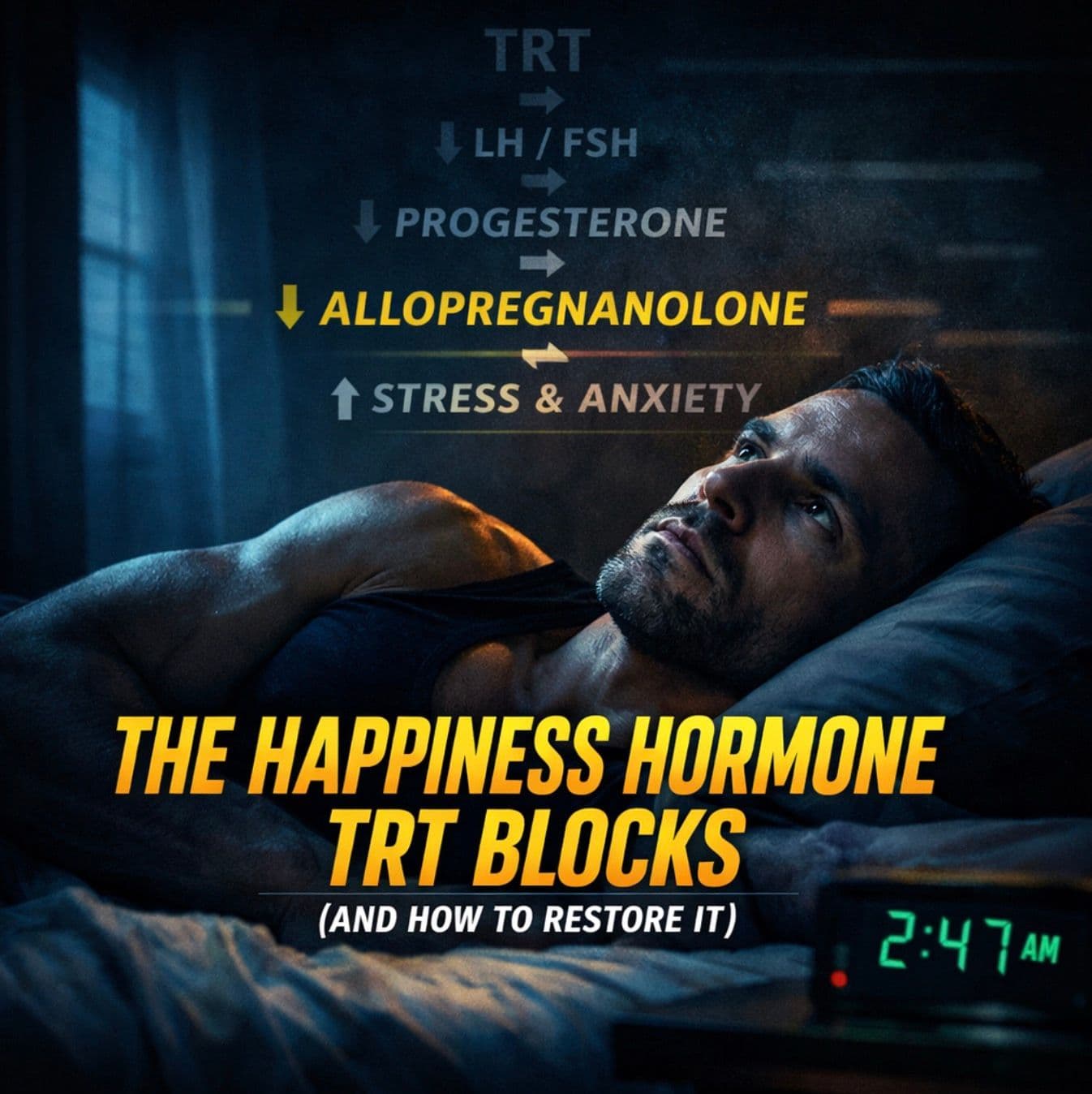
Here's the problem. Your body makes allopregnanolone from progesterone. And when you're on TRT, your natural testosterone production shuts down through negative feedback to the pituitary. But testosterone isn't the only thing that gets suppressed. Your LH and FSH drop, which means your testicles stop producing pregnenolone and progesterone too.
No progesterone? No allopregnanolone.
This is why some guys feel amazing the first few weeks on TRT, then notice their mood flatten out or their anxiety creep up. The initial testosterone boost gives you energy and confidence, but as your natural progesterone production drops off, you lose that neurological buffer against stress.
Some guys get lucky and don't notice much. Others feel like they're running on high octane fuel with no shock absorbers. Everything feels sharper, more intense, more reactive. You might snap at your wife over small stuff. You might lie in bed with your mind racing even though your body is exhausted.
Sound familiar?
The Progesterone Paradox Most Doctors Miss
Here's where it gets interesting. If you Google "progesterone for men," you'll find a lot of conflicting information. Some sources say it's a "female hormone" that will tank your testosterone. Some say it's crucial for male health. Who's right?
Both, sort of.
High-dose progesterone (like 50-100mg or more) can suppress testosterone by increasing prolactin and competing at androgen receptors. That's real. But we're not talking about high doses. We're talking about microdosing: 5-10mg of oral progesterone, typically taken at night.
At this range, you're not flooding your system. You're restoring a natural metabolic pathway that TRT shut down. You're giving your brain the raw material to make allopregnanolone again without meaningfully impacting your testosterone levels or your masculinization from TRT.
The Microdosing Protocol
The sweet spot for most guys is 5-10mg of oral progesterone taken before bed. Some protocols:
Conservative approach: Start with 5mg for two weeks. If sleep and mood improve without any negative effects, you can stay there or try 7.5-10mg.
Standard approach: 10mg nightly. This tends to be the most common dose that provides benefits without downsides.
Timing matters: Take it 30-60 minutes before bed. Allopregnanolone has sedating properties, and you want that working for you while you sleep, not while you're trying to focus during the day.
You'll need a prescription, and you want bioidentical micronized progesterone (Prometrium is the brand name, but generic works fine). Not synthetic progestins like medroxyprogesterone. Those are chemically different and won't convert to allopregnanolone the same way.
What to Expect
This isn't a light switch. Most guys notice subtle improvements in the first week, particularly with sleep quality and how easily they fall asleep. The mental clarity and stress resilience build over 2-4 weeks as your brain's allopregnanolone levels normalize.
You're looking for:
- Falling asleep faster and waking up less during the night
- Better dream recall (REM sleep improvement)
- Less mental chatter and rumination
- Feeling more patient and less reactive
- That "everything's okay" baseline mood
What you're NOT looking for is sedation, grogginess, or feeling emotionally blunted. If you experience those, your dose is too high.
What About Your Testosterone?
This is the question that stops most guys from trying this. Understandable. You're on TRT specifically to optimize testosterone. The last thing you want is something that works against that.
The reality: at microdoses, progesterone doesn't significantly impact testosterone levels. If you're on a stable TRT protocol with good levels, 5-10mg of progesterone isn't going to crash your T or make you lose your gains.
Some guys even report better results from their TRT when they add low-dose progesterone, likely because the improved sleep quality and reduced cortisol (from better stress response) actually support better recovery and muscle growth.
That said, everyone's biochemistry is different. If you're concerned, add it for 4-6 weeks, then get bloodwork. Check your total testosterone, free testosterone, and if you want to be thorough, your progesterone levels to confirm you're in a reasonable range (most guys should be around 0.5-2 ng/mL on this protocol).
FAQs
Can I just use pregnenolone instead?
Some guys do, usually around 25-50mg. Pregnenolone converts to progesterone, which then converts to allopregnanolone. The advantage is pregnenolone also supports other pathways. The disadvantage is the conversion isn't always efficient, and you might not get enough downstream allopregnanolone. Direct progesterone tends to be more reliable.
Will this make me emotional or moody?
At microdoses? No. The "emotional" reputation of progesterone comes from the high doses women use for hormone replacement or birth control. You're using 1/10th of that or less. Most guys feel more stable, not more emotional.
Do I need to cycle it?
No. Unlike some supplements where receptors downregulate, GABA-A receptors (where allopregnanolone works) don't desensitize to physiological levels. You can run this indefinitely.
What if I'm using HCG on my TRT protocol?
HCG preserves some testicular function, which means you might be producing some progesterone naturally. You might still benefit from low-dose progesterone, but your needs might be lower. Start at 5mg and assess from there.
Why Your Clinic Might Not Know About This
Most TRT clinics focus on one thing: getting your testosterone levels optimized. And to be fair, that's the main event. But the best protocols recognize that hormones don't operate in isolation. When you manipulate one, you affect others.
Progressive TRT providers are starting to incorporate allopregnanolone support into their protocols, either through low-dose progesterone or pregnenolone supplementation. With AlphaMD, the provider overseeing your care looks at the complete picture - not just your testosterone number, but how you actually feel and function day-to-day.
Because here's the thing: optimal testosterone with crashed allopregnanolone doesn't feel optimal. You might have the labs of a 25-year-old, but if you're anxious, wired, and sleeping poorly, what's the point?
Getting your neurosteroids dialed in alongside your testosterone is how you actually achieve what you came to TRT for in the first place: feeling like yourself again, just better.
Have a question? Ask us.
At AlphaMD, we're here to help. Feel free to ask us any question you would like about TRT, medical weightloss, ED, or other topics related to men's health. Or take a moment to browse through our past questions.
People are asking...
How do you recommend coming off TRT if you have been on for many years?...
A combination of Clomid/Enclomiphene & HCG is usually ideal. It would be fine to start those up while still on TRT for a few weeks if it's all planned, then stop Testosterone completely. Testosterone ... See Full Answer
Aside from high/low E2, what else are the primary reasons a person on TRT would have poor mood and low energy?...
Hormonally speaking, it could relate to the neurosteroids pregnenolone and DHEA-S. These act directly on the brain and are associated with mood and cognition. When on exogenous testosterone, these hor... See Full Answer
Is there research on recovery if anyone wants to stop or has to stop due to medical reasons? Can they actually recover their natural production? Does ...
You can read the research here . Basically, after stopping TRT, natural testosterone production returns to its previous levels within 3 months after the last injection. Sperm production took longer, ... See Full Answer
Get $30 off your first month’s order
Enter your email address now to receive $30 off your first month’s cost, other discounts, and additional information about TRT.
Legal Disclaimer
This website is a repository of publicly available information and is not intended to form a physician-patient relationship with any individual. The content of this website is for informational purposes only. The information presented on this website is not intended to take the place of your personal physician's advice and is not intended to diagnose, treat, cure, or prevent any disease. Discuss this information with your own physician or healthcare provider to determine what is right for you. All information is intended for your general knowledge only and is not a substitute for medical advice or treatment for specific medical conditions. The information contained herein is presented in summary form only and intended to provide broad consumer understanding and knowledge. The information should not be considered complete and should not be used in place of a visit, phone or telemedicine call, consultation or advice of your physician or other healthcare provider. Only a qualified physician in your state can determine if you qualify for and should undertake treatment.