
The Case for Omega-3s on TRT Is Stronger Than You Think — But Most Men Are Under-Dosing Them
Published on:
Updated on:
People are asking...
My e2 was a little elevated and the doc suggested doing .25 after every injection (EOD, so it’s a little less than 1mg/wk) to knock it down a bit but ...
We live in a world where there are still very few good long term studies on men’s health. In the case of AI’s there are exactly zero studies on AI use in men in TRT. All of the “data” are based off o... See Full Answer
Why do TRT clinics just throw 200mg out to start...
They really shouldn't, but because many take the approach of uniform care over individual planning, they pick a dose that will *certainly* give results which is good for marketing, even if it will alm... See Full Answer
I struggle with high estrogen on TRT. Even with a 200mg/1mg test cyp/anastrozole compound injection done sub-q. EOD .2ml injections and total test ar...
So based on your dose you would be receiving about 0.6mg of anastrozole each week. While that dose is typically adequate for most, there are some men who need up to 1mg/wk. It sounds like you are prob... See Full Answer
Have a question? Ask us.
At AlphaMD, we're here to help. Feel free to ask us any question you would like about TRT, medical weightloss, ED, or other topics related to men's health. Or take a moment to browse through our past questions.
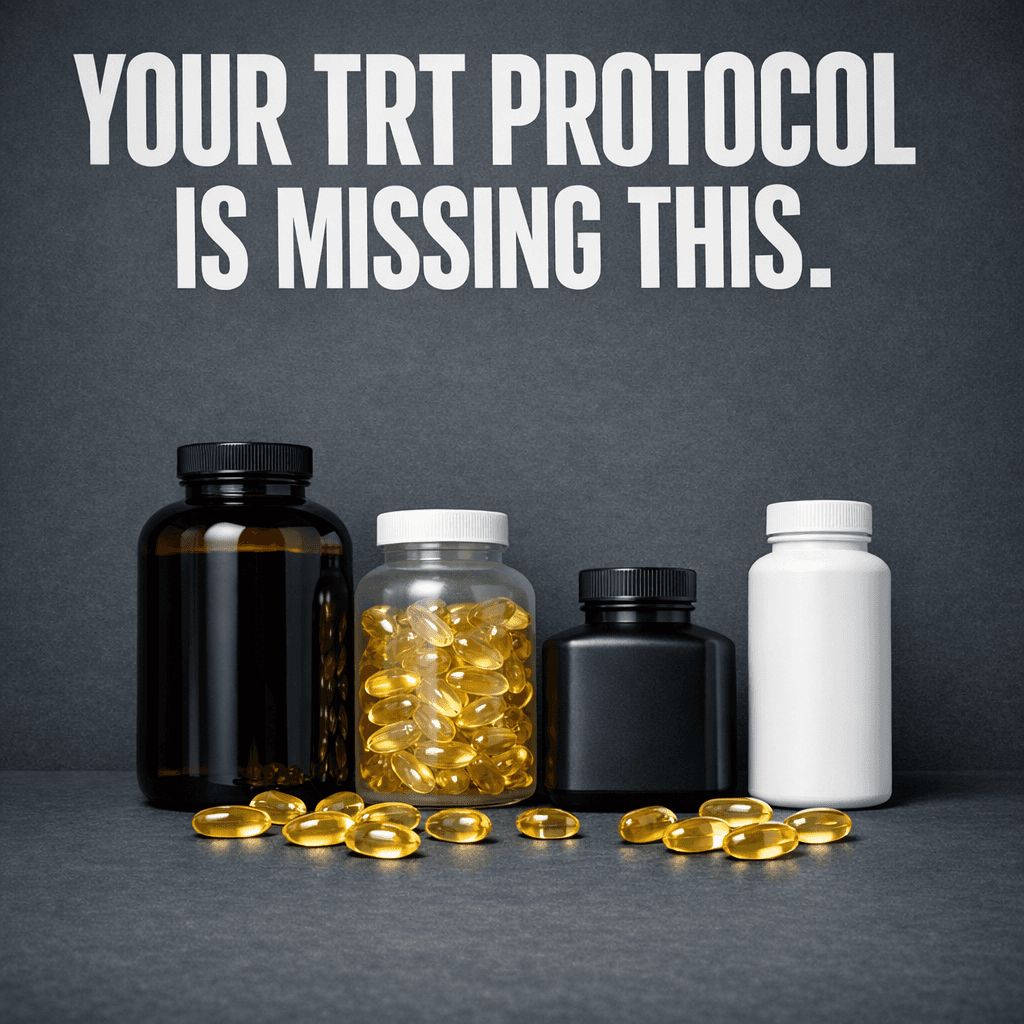
Most men on testosterone replacement therapy spend real time thinking about their protocol, their labs, and their training. Very few spend the same energy thinking about omega-3s, and that gap is quietly working against them.
Omega-3s are a category of dietary fat, with the two most relevant forms being EPA and DHA. Your body cannot produce these on its own in meaningful amounts, so you depend entirely on what you eat or supplement. TRT, for those unfamiliar, is a medically supervised treatment that restores testosterone to a healthy range in men whose levels have dropped below what their body needs to function well. The two subjects intersect more than most men realize.
Why TRT Changes What Your Body Needs From Nutrition
Testosterone replacement is not just a hormone tweak. It shifts your physiology in ways that have downstream effects on your cardiovascular system, your muscles, your metabolism, and your inflammatory response. When your testosterone rises toward an optimal range, you often train harder, recover more aggressively, and push your cardiovascular system with more intensity. That increased demand creates a context where the anti-inflammatory and cardiometabolic properties of EPA and DHA become more relevant, not less.
Men on TRT are also more likely to be actively engaged in optimizing their health, which means they are paying closer attention to risk factors, biomarkers, and long-term outcomes. Omega-3s are one of the few over-the-counter nutrients with a meaningful body of research behind their cardiovascular and metabolic effects. Ignoring them while carefully managing your protocol makes little practical sense.
The Under-Dosing Problem Is More Common Than Most Men Assume
Here is where the gap gets interesting. Many men who take fish oil are not actually getting a meaningful amount of EPA and DHA. They think they are covered because they bought a bottle of fish oil capsules and take one every morning. But there is a significant difference between the total amount of fish oil in a capsule and the actual EPA and DHA content inside it.
A product label can say "fish oil" in large type and list a serving size that sounds substantial, but when you look more carefully at the nutrition facts, the actual combined EPA and DHA content may be much lower than you expect. This is especially common with budget products, big-box store house brands, and heavily discounted options. The rest of the capsule is made up of other fats that do not carry the same benefits.
Beyond label confusion, inconsistency is its own problem. Fish oil capsules that taste fishy or cause digestive discomfort often end up forgotten in a cabinet. Men take them for two weeks after a doctor mentions it, then life gets busy. That kind of on-and-off pattern does not allow the gradual tissue accumulation that makes omega-3s meaningful over time. Their effects are not acute, they are cumulative.
What the Research Connects to TRT-Relevant Goals
The research on EPA and DHA is not a single study or a fringe finding. It spans decades, covers diverse populations, and points consistently toward several areas that matter specifically to men managing their health on TRT.
Cardiometabolic health is the most studied area. Elevated triglycerides are a concern for many men, and omega-3 fatty acids have a well-documented relationship with triglyceride levels. This is not a minor footnote for men on TRT, because testosterone therapy can influence lipid panels in ways that make cardiovascular monitoring particularly important. Supporting your cardiometabolic profile through nutrition is a reasonable companion strategy, not a replacement for medical oversight.
Inflammation and recovery are also worth understanding. Intense training generates inflammation as a normal part of the adaptation process, but chronic, unresolved inflammation is a different story. EPA and DHA are precursors to compounds the body uses to modulate and resolve inflammation. Men who train seriously and recover hard have a practical reason to ensure their EPA and DHA intake is consistent.
Joint comfort and connective tissue health matter more as training intensity increases. Many men on TRT push their volume and their loads harder than they did before treatment. Joints, tendons, and connective tissue take more stress, and the general support that omega-3s provide to inflammatory pathways can translate into day-to-day comfort for some men, particularly with prolonged or high-frequency training.
Mood, mental sharpness, and stress resilience are areas where DHA in particular plays a structural role. DHA is a primary component of brain cell membranes. The research on omega-3s and mood regulation, cognitive function, and stress response is nuanced and ongoing, but the overall direction is supportive. For men who feel that TRT helps their mental clarity and emotional stability, optimizing DHA intake is a reasonable additional step.
Sexual health connects to this picture indirectly but meaningfully. Cardiovascular health is one of the foundations of erectile function and sexual vitality. Anything that supports vascular flexibility, blood flow, and endothelial health has a downstream relationship with sexual performance. Omega-3s are not a treatment for sexual dysfunction, but their cardiovascular contributions make them relevant to the broader picture.
Sleep quality is a secondary benefit worth mentioning. Some research suggests omega-3s may positively influence sleep architecture in certain individuals. Sleep is one of the most important variables in hormonal health, recovery, and cognitive performance, so any support in that direction has compounding value for men on TRT.
Quality Is Not a Marketing Concept, It Is a Chemistry Problem
Fish oil oxidizes. When fats go rancid, they do not just lose potency, they may actually introduce compounds that work against your goals. A capsule that smells strongly fishy when you bite into it, or a bottle that has been sitting in a warm storage room for months, is likely past its useful life.
The form of omega-3 also matters at a basic level. Fish oil products come in different molecular forms, primarily triglyceride form and ethyl ester form. Triglyceride form is closer to how omega-3s naturally appear in fish and is generally better absorbed, particularly when taken with a fat-containing meal. Ethyl ester form is cheaper to produce and more common in lower-cost supplements, though some research suggests absorption can be more variable.
For men who prefer a plant-based or fish-free option, algae oil is worth knowing about. EPA and DHA originally come from marine algae, which fish consume and concentrate in their tissue. Algae-derived omega-3s skip the fish entirely and go directly to the source. They are also well-suited for men with fish allergies or those who want a more sustainable supply chain.
Third-party testing is not a luxury, it is a basic quality filter. Supplements are not regulated the way pharmaceuticals are, which means the label does not always match the contents. Independent certification from organizations that test for purity, potency, and oxidation levels gives you actual evidence that what you are taking is what the label says it is.
Storage matters more than most people think. Keeping fish oil in a warm cabinet above the stove is a reliable way to accelerate oxidation. Refrigerating an open bottle is a simple habit that meaningfully extends freshness.
Reading the Label Without Getting Fooled
The most important habit when evaluating an omega-3 product is looking past the front-panel marketing to the actual supplement facts. The relevant number is the combined EPA plus DHA content per serving, not the total fish oil weight. Those two numbers can be dramatically different on the same product.
Also check the serving size. Some products appear to have higher EPA and DHA content per serving, but the serving is multiple capsules rather than one. If you are only taking one capsule because that is what most products suggest, you may be getting a fraction of what the label's full serving delivers.
Food-first thinking is always worth considering. Fatty fish like salmon, mackerel, sardines, and anchovies provide EPA and DHA in a natural matrix alongside other nutrients, and regular consumption is a meaningful contribution to your intake. For many men, a combination of dietary sources and a quality supplement used consistently is more practical than relying on either alone.
A Note on Safety and Who Should Pause Before Starting
Omega-3s are broadly well-tolerated, but they are not completely without considerations. Men who take blood thinners or anticoagulant medications, or who have bleeding disorders, should talk with a clinician before adding omega-3 supplements, particularly at higher intakes. The same applies to anyone with a fish or shellfish allergy, anyone with upcoming surgery, and anyone managing a condition that involves their lipid metabolism or cardiovascular system directly.
Omega-3s are not a treatment for any condition, and their benefits vary from person to person. Some men notice meaningful changes over time, others less so. Treating them as a thoughtful addition to an overall health strategy, rather than as a cure or a quick fix, is the right frame.
Putting It Together Inside a Smarter TRT Strategy
TRT gives your body a better hormonal environment to work from. What you do with that environment, how you train, how you recover, how you eat, and how consistently you support your cardiovascular and metabolic health, determines how much of that potential you actually realize.
Omega-3s are not glamorous. They do not produce the fast, noticeable changes that men associate with starting TRT. But they work quietly in the background, session after session, month after month, on the cardiometabolic markers, the inflammatory pathways, the brain chemistry, and the joint resilience that make the TRT experience more sustainable and more complete.
The problem is that most men taking them are either using low-quality products, not reading labels carefully enough to understand what they are actually getting, or taking them so inconsistently that cumulative benefit never has a chance to develop.
Platforms like AlphaMD, which focus on men's health and support providers who manage TRT, are well-positioned to help patients think through exactly these kinds of supportive habits. Managing a TRT protocol well is not just about monitoring labs and adjusting doses. It also means building the surrounding habits, nutritional strategies, and supplementation practices that let the therapy do its best work. Omega-3s, chosen well and taken consistently, belong in that picture.
Have a question? Ask us.
At AlphaMD, we're here to help. Feel free to ask us any question you would like about TRT, medical weightloss, ED, or other topics related to men's health. Or take a moment to browse through our past questions.
People are asking...
My e2 was a little elevated and the doc suggested doing .25 after every injection (EOD, so it’s a little less than 1mg/wk) to knock it down a bit but ...
We live in a world where there are still very few good long term studies on men’s health. In the case of AI’s there are exactly zero studies on AI use in men in TRT. All of the “data” are based off o... See Full Answer
Why do TRT clinics just throw 200mg out to start...
They really shouldn't, but because many take the approach of uniform care over individual planning, they pick a dose that will *certainly* give results which is good for marketing, even if it will alm... See Full Answer
I struggle with high estrogen on TRT. Even with a 200mg/1mg test cyp/anastrozole compound injection done sub-q. EOD .2ml injections and total test ar...
So based on your dose you would be receiving about 0.6mg of anastrozole each week. While that dose is typically adequate for most, there are some men who need up to 1mg/wk. It sounds like you are prob... See Full Answer
Get $30 off your first month’s order
Enter your email address now to receive $30 off your first month’s cost, other discounts, and additional information about TRT.
Legal Disclaimer
This website is a repository of publicly available information and is not intended to form a physician-patient relationship with any individual. The content of this website is for informational purposes only. The information presented on this website is not intended to take the place of your personal physician's advice and is not intended to diagnose, treat, cure, or prevent any disease. Discuss this information with your own physician or healthcare provider to determine what is right for you. All information is intended for your general knowledge only and is not a substitute for medical advice or treatment for specific medical conditions. The information contained herein is presented in summary form only and intended to provide broad consumer understanding and knowledge. The information should not be considered complete and should not be used in place of a visit, phone or telemedicine call, consultation or advice of your physician or other healthcare provider. Only a qualified physician in your state can determine if you qualify for and should undertake treatment.