
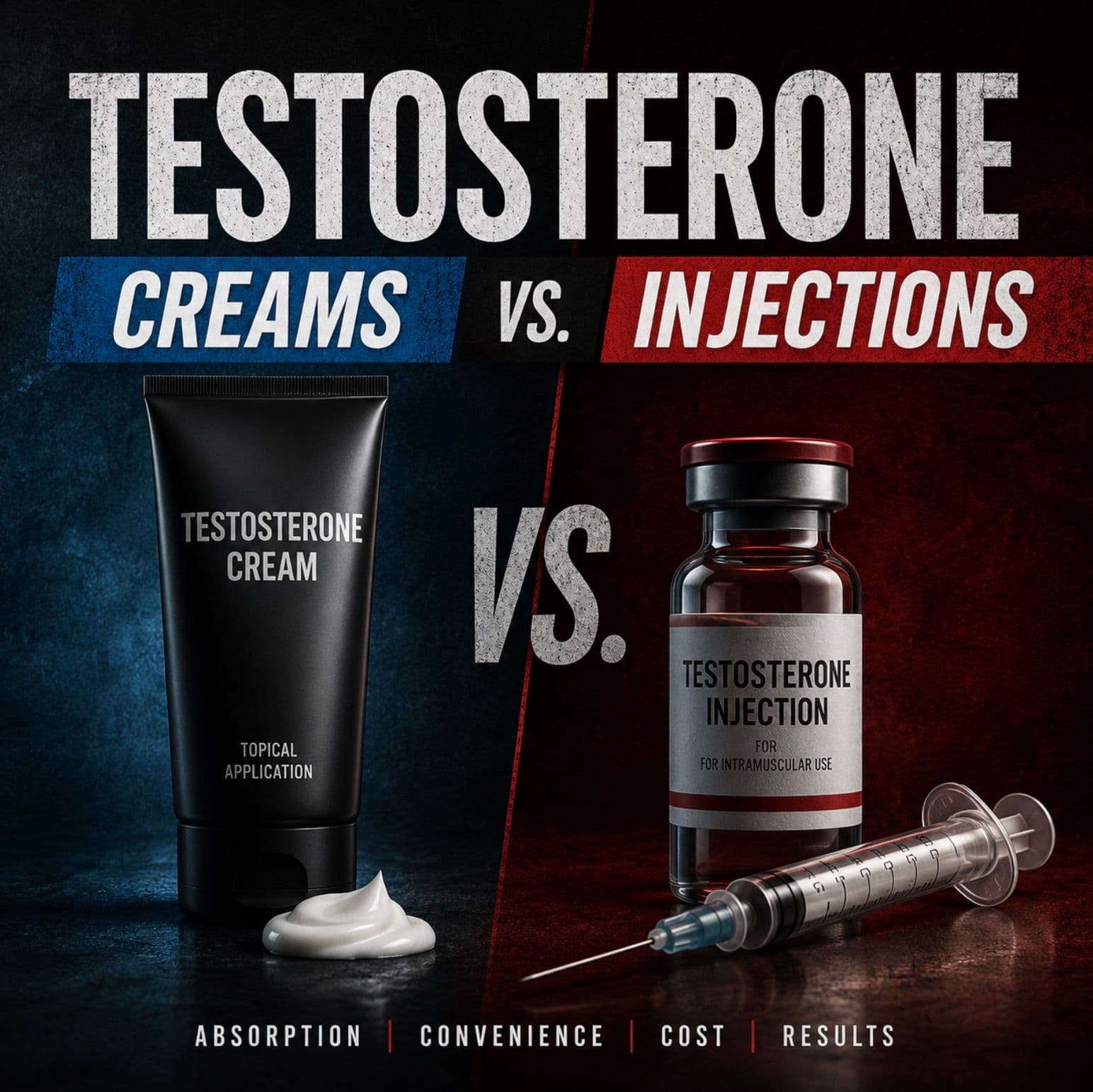
Testosterone Creams vs Injections: Comparing Testosterone Replacement Therapy Methods
Published on:
Updated on:
People are asking...
How does testosterone cream compare to injections? Are side effects less likely with the cream? Can you reach the same test levels with the cream (eve...
Both forms have pros and cons, and both are excellent options. The creams have the convenience of no needles, but at the cost of needing daily applications. Also, you can transfer the medications to o... See Full Answer
What do you think of gels, creams, pellets, patches, natesto and other methods of testosterone administration other than injection? Seems to be mixed...
In general, they are less effective than injections. The reason for the mixed opinions is generally because for some people, just a small change is enough of a boost for them and they'd rather not hav... See Full Answer
My current level has rebounded to 550. In December, it was 400 and I'm assuming at the end of the marathon season it was 200 or less. I might just lo...
For Testosterone, injections are much better than creams and gels. They are more consistent, potent, accurate, take less time investment, and generally cost way less. For a lot of people the idea of i... See Full Answer
Have a question? Ask us.
At AlphaMD, we're here to help. Feel free to ask us any question you would like about TRT, medical weightloss, ED, or other topics related to men's health. Or take a moment to browse through our past questions.
Testosterone injections and topical testosterone can both raise testosterone levels in men with clinically diagnosed hypogonadism. Neither method is automatically best for every patient.
Injections generally provide more predictable dosing, require less frequent administration, and eliminate the risk of transferring testosterone through skin contact. Topical testosterone avoids needles and may produce relatively steady daily hormone exposure, but it must be applied consistently and its absorption can vary between patients.
The right option depends on your laboratory results, symptoms, lifestyle, treatment preferences, response to therapy, and clinician’s recommendations.
Testosterone Cream vs Injections: The Quick Answer
For many men, testosterone injections are the more practical and reliable form of testosterone replacement therapy because they:
- Deliver a measured dose directly into the body
- Are typically administered only once or several times per week
- Are not affected by differences in skin absorption
- Cannot be transferred to a partner or child through skin contact
- Are often more affordable than topical formulations
Topical testosterone may be a better option for men who strongly prefer to avoid needles and are comfortable following a daily application routine.
Both approaches require a prescription, an appropriate diagnosis, follow-up laboratory testing, and ongoing medical supervision.
What Is Testosterone Replacement Therapy?
Testosterone replacement therapy is a medical treatment used for men whose bodies do not produce sufficient testosterone because of an underlying medical condition.
A low testosterone result alone is not always enough to establish a diagnosis. Clinicians generally evaluate:
- Symptoms consistent with testosterone deficiency
- More than one properly timed testosterone measurement
- Possible causes of the low result
- Relevant medical history and medications
- Fertility goals
- Baseline health markers
The American Urological Association recommends using both symptoms and laboratory findings when evaluating testosterone deficiency rather than diagnosing the condition from symptoms alone.
TRT is intended to restore testosterone to an appropriate physiological range. It is not simply a bodybuilding treatment, general anti-aging medication, or guaranteed solution for fatigue, weight gain, erectile dysfunction, or low mood.
What Is Topical Testosterone?
Topical testosterone is applied to the skin, usually once per day. Testosterone passes through the skin and enters the bloodstream gradually.
FDA-approved topical testosterone products in the United States primarily include gels and solutions. What patients casually call “testosterone cream” may sometimes be a customized product prepared by a compounding pharmacy.
That distinction matters.
FDA-approved testosterone products have undergone review for their approved uses, manufacturing quality, dosing, and labeling. Compounded medications are not FDA-approved, meaning the FDA does not independently verify their safety, effectiveness, or quality before they are marketed.
A compounded product may still be prescribed when a clinician determines that a commercially available medication does not meet a patient’s specific medical needs. However, compounded cream should not automatically be assumed to work exactly like an FDA-approved gel.
What Are Testosterone Injections?
Injectable testosterone is administered into muscle or the fatty tissue beneath the skin, depending on the prescribed medication and injection method.
Common injectable forms include testosterone cypionate and testosterone enanthate. These medications contain testosterone attached to an ester that slows its release after injection.
A clinician may divide the prescribed weekly amount into smaller, more frequent doses. This can help reduce the difference between peak and trough testosterone levels for some patients.
Injection frequency should be individualized. Patients should not change their dose or schedule without consulting their prescribing clinician.
Are Testosterone Injections More Effective Than Cream?
Both topical and injectable testosterone can produce therapeutic testosterone levels when they are prescribed appropriately and used correctly.
The more accurate distinction is predictability, not whether one method is universally capable of working.
Injections offer predictable dose delivery
With an injection, a known amount of medication enters the body. The resulting blood level can still vary based on the dose, injection frequency, timing of laboratory testing, metabolism, and other individual factors.
However, injections do not depend on the skin absorbing the medication.
Topical absorption varies more between patients
Topical testosterone must cross the skin before reaching the bloodstream. Absorption may differ based on:
- The specific product and concentration
- Application site
- Skin characteristics
- Application technique
- Whether the medication is allowed to dry properly
- Washing, swimming, or sweating after application
- Consistency of daily use
Some men achieve excellent testosterone levels with topical treatment. Others absorb too little medication or have difficulty maintaining consistent results.
Therefore, injections may be easier to adjust and monitor when topical absorption is unreliable.
Do Testosterone Injections Cause More Hormone Fluctuation?
They can, but this depends heavily on the dosing schedule.
A large injection given at a long interval may produce a higher peak after administration followed by a lower level before the next dose. Smaller injections given more frequently may reduce these fluctuations.
Topical gels provide testosterone through the skin after each daily application. FDA-approved gel formulations are designed to provide ongoing transdermal delivery rather than a single instantaneous surge.
Neither method produces perfectly flat testosterone levels. Even natural testosterone production changes throughout the day.
The clinical goal is not to eliminate every fluctuation. It is to maintain an appropriate treatment response while controlling symptoms and avoiding excessive testosterone exposure.
Testosterone Cream or Gel: Potential Advantages
Topical testosterone may be attractive for several reasons.
No injections
The clearest advantage is the absence of needles. This can make treatment more acceptable for patients with significant needle anxiety.
Daily administration
Some patients prefer a daily routine over remembering injections on particular days.
Relatively gradual exposure
Daily topical application can provide ongoing testosterone exposure without the injection-related peak associated with some longer dosing intervals.
Easy discontinuation
Because topical testosterone is applied daily, treatment can generally be stopped without waiting for a long-acting injectable formulation to gradually clear.
Testosterone Cream or Gel: Potential Disadvantages
It must be applied every day
Missing applications can reduce testosterone exposure. The routine may become inconvenient during travel, exercise, irregular work schedules, or rushed mornings.
Absorption can be inconsistent
A prescribed dose does not guarantee that every patient will absorb the same amount. Follow-up blood testing is necessary to determine whether the treatment is producing an appropriate level.
Skin irritation may occur
Some users develop redness, itching, dryness, or irritation at the application site.
It can transfer to other people
Testosterone remaining on treated skin can expose another person through direct contact.
FDA labeling for testosterone gel includes a warning about secondary exposure, particularly in children. Patients must follow product-specific instructions, which may include:
- Washing their hands after application
- Allowing the product to dry
- Covering the application site with clothing
- Washing the site before anticipated skin-to-skin contact
- Preventing children and partners from touching unwashed application areas
This issue can be especially important for men living with young children or pregnant partners.
Product instructions vary
Different topical products can have different concentrations, approved application sites, washing restrictions, and dosing instructions. They are not necessarily interchangeable.
Testosterone Injections: Potential Advantages
More predictable administration
An injection delivers the prescribed quantity without relying on skin absorption.
Less frequent dosing
Depending on the medication and treatment plan, injections may be administered once or several times per week rather than every day.
No transfer risk
Once testosterone has been injected, it cannot be transferred to another person by touching the patient’s skin.
Dose flexibility
A clinician can adjust both the amount administered and the frequency of injections based on symptoms, laboratory results, side effects, and individual response.
Often lower cost
Generic injectable testosterone is frequently less expensive than branded topical testosterone, although actual cost depends on insurance, pharmacy pricing, supplies, and the patient’s treatment program.
Testosterone Injections: Potential Disadvantages
Needles and injection discomfort
Some patients experience anxiety, bruising, soreness, bleeding, or irritation. Proper technique and suitable equipment can make injections more manageable.
Peaks and troughs
Levels may vary considerably when injections are given in larger amounts at longer intervals. Dose size and frequency can often be adjusted when clinically appropriate.
Injection-site complications
Although uncommon with proper technique, injections can cause swelling, inflammation, infection, or reactions to an ingredient in the medication.
Supplies and storage
Patients administering testosterone at home need the correct syringes, needles, sharps disposal method, and medication-storage routine.
Do Creams Have Fewer Side Effects Than Injections?
Not necessarily.
Many important TRT risks are related to testosterone exposure itself rather than the delivery method. These can include:
- Increased hematocrit or red blood cell concentration
- Acne or oily skin
- Fluid retention
- Breast tenderness
- Reduced sperm production
- Testicular shrinkage
- Changes in blood pressure
- Worsening of untreated sleep apnea in susceptible patients
- Changes in urinary or prostate-related symptoms
The likelihood of a particular effect may vary with the formulation, dose, testosterone level, health history, and individual response.
Topical treatment adds the possibility of skin irritation and secondary exposure. Injections add the possibility of injection-site reactions and more noticeable peaks and troughs with some dosing schedules.
The FDA announced class-wide labeling changes in 2025 after reviewing cardiovascular and blood-pressure evidence. The agency removed language about an increased risk of major adverse cardiovascular outcomes from the boxed warning while requiring or strengthening warnings that testosterone products may increase blood pressure.
That does not mean TRT is risk-free. Blood pressure and other relevant health markers should still be monitored throughout treatment.
Does Topical Testosterone Increase DHT More Than Injections?
Testosterone can be converted into dihydrotestosterone, or DHT, by the enzyme 5-alpha-reductase.
Because this enzyme is present in the skin, topical testosterone can produce proportionally higher DHT levels in some patients than injectable testosterone. This does not mean every topical user will experience DHT-related problems, nor does it prove that topical treatment is better for libido or sexual function.
Potential DHT-sensitive effects may include:
- Acne
- Increased body hair
- Accelerated scalp hair loss in genetically susceptible men
- Changes in prostate-related symptoms
DHT testing is not automatically required for every TRT patient. A clinician may consider it when symptoms, side effects, or treatment response justify further evaluation.
Can You Reach the Same Testosterone Level With Cream and Injections?
Potentially, yes.
Some men can reach an appropriate testosterone level with either method. The challenge is that topical absorption varies more from person to person.
A high concentration printed on a cream label does not tell you how much testosterone ultimately enters the bloodstream. Laboratory testing is needed to determine whether the prescribed treatment is working.
The purpose of TRT is also not to chase the highest possible laboratory number. Treatment should be adjusted according to:
- Symptom response
- Testosterone measurements
- Timing of the blood draw
- Side effects
- Hematocrit and other safety markers
- The patient’s overall health
How Are Labs Timed for Creams and Injections?
The timing of a testosterone blood test can affect the result.
For injectable testosterone, the appropriate testing point depends on the medication, dosing frequency, and what the clinician is trying to evaluate. A measurement taken soon after an injection may look substantially different from one taken shortly before the next dose.
For topical testosterone, clinicians generally standardize how long after the daily application the blood sample is collected. Care must also be taken to avoid contaminating the blood-draw site with topical testosterone.
Patients should follow their clinician’s exact instructions rather than selecting an arbitrary testing time.
Which TRT Method Is More Convenient?
For most men, injections require less frequent attention.
A patient may complete a small number of injections each week, while topical testosterone must usually be applied every day. The topical user also needs to consider drying time, clothing, bathing, exercise, travel, and skin contact with others.
However, convenience is personal. Someone who is strongly opposed to needles may find a daily application easier than self-injection.
The most convenient treatment is the one a patient can use correctly and consistently.
Who May Prefer Topical Testosterone?
Topical testosterone may be suitable for a patient who:
- Has significant needle anxiety
- Prefers daily treatment
- Can maintain a reliable application routine
- Has no difficulty preventing secondary exposure
- Absorbs the medication adequately
- Does not develop troublesome skin irritation
- Has access to a suitable and affordable product
Who May Prefer Testosterone Injections?
Injections may be preferable for a patient who:
- Wants a less frequent treatment schedule
- Has not absorbed topical testosterone reliably
- Lives with children and wants to eliminate transfer risk
- Wants more precise control over the administered dose
- Is comfortable learning proper injection technique
- Finds injectable therapy more affordable
- Develops skin irritation from topical medication
These are general considerations, not prescribing rules. A licensed clinician should evaluate the complete medical picture.
Do Testosterone Cream and Injections Affect Fertility?
Yes. Both can suppress the hormonal signals that support sperm production.
External testosterone tells the brain and pituitary gland that sufficient testosterone is already present. This can reduce luteinizing hormone and follicle-stimulating hormone, lower testosterone production inside the testes, and decrease sperm production.
Changing from injections to cream does not eliminate this effect.
Men who currently want children or may want children in the future should discuss fertility before beginning TRT. Depending on the circumstances, a clinician may discuss semen testing, sperm preservation, or treatment approaches intended to support fertility.
What Monitoring Is Required During TRT?
Monitoring should be based on the patient’s age, health history, symptoms, formulation, and treatment response. It may include:
- Total testosterone
- Free testosterone when clinically appropriate
- Complete blood count and hematocrit
- Blood pressure
- Prostate-specific antigen when indicated
- Lipid or metabolic markers
- Treatment response and side effects
- Fertility considerations
- Screening for sleep-related breathing problems
A patient should also report symptoms such as significant swelling, persistent headaches, worsening shortness of breath, severe urinary changes, or unexpected reactions to the medication.
Testosterone Cream vs Injections: Which Is Better?
For many men, testosterone injections provide the best combination of predictable delivery, dose flexibility, convenience, and cost. They are particularly useful when topical absorption is inconsistent or when medication transfer is a concern.
Topical testosterone remains a legitimate option for appropriately selected patients. It can raise testosterone effectively and avoids needles, but it requires daily adherence and careful precautions around skin contact.
The best method is not determined by marketing claims or by the highest testosterone number. It is the formulation that safely produces an appropriate clinical response and that the patient can use consistently under medical supervision.
Frequently Asked Questions
Are testosterone injections stronger than cream?
Not inherently. The formulations use different doses because they enter the bloodstream differently. A cream or gel dose cannot be compared directly with an injection dose milligram for milligram.
Injections often feel “stronger” because the administered amount is known and does not depend on skin absorption.
Does testosterone cream work as well as injections?
It can work well for patients who absorb it adequately and apply it consistently. Other patients may struggle to reach or maintain appropriate levels with topical treatment.
Are testosterone injections safer than cream?
Neither method is universally safer. They share many testosterone-related risks. Topical treatment adds skin irritation and transfer concerns, while injections add needle-related and injection-site risks.
How often is testosterone cream applied?
Most topical testosterone products are applied once daily, but patients must follow the instructions for their specific prescribed product.
How often are testosterone injections given?
Frequency varies by formulation and treatment plan. Some clinicians divide short-acting injectable testosterone into one or more doses per week to manage hormone fluctuations.
Can I switch from cream to injections?
A clinician can transition a patient from one formulation to another, but the doses are not directly interchangeable. The new regimen should be prescribed and followed by appropriately timed laboratory testing.
Can I apply testosterone cream to the scrotum?
Only use a testosterone product on sites specifically directed by the prescribing clinician and the product instructions. Many FDA-approved gels must not be applied to the genitals. Some compounded preparations may have different instructions, but patients should never change the application site on their own.
Is compounded testosterone cream FDA-approved?
No. Compounded drugs are not FDA-approved. The FDA does not verify their safety, effectiveness, or quality before they are marketed. A clinician may still prescribe a compounded product when there is a specific medical reason that an approved product does not meet the patient’s needs.
The Bottom Line
Testosterone injections and topical testosterone can both be effective treatments for medically diagnosed testosterone deficiency.
Injections generally offer more predictable administration, less frequent dosing, lower transfer risk, and often a lower cost. Topical testosterone offers a needle-free option but requires consistent daily application, careful skin-contact precautions, and sufficient individual absorption.
Treatment should be selected with a licensed clinician and adjusted according to symptoms, properly timed laboratory testing, side effects, fertility goals, and overall health.
Sources
- American Urological Association: Testosterone Deficiency Guideline
- FDA: Testosterone Information
- FDA: Class-Wide Testosterone Labeling Changes
- FDA: Compounding and the FDA Questions and Answers
- Mayo Clinic: Male Hypogonadism Diagnosis and Treatment
This article is for general educational purposes and is not a substitute for individualized medical advice. Only a qualified healthcare professional can diagnose testosterone deficiency and determine whether testosterone therapy is appropriate.
Have a question? Ask us.
At AlphaMD, we're here to help. Feel free to ask us any question you would like about TRT, medical weightloss, ED, or other topics related to men's health. Or take a moment to browse through our past questions.
People are asking...
How does testosterone cream compare to injections? Are side effects less likely with the cream? Can you reach the same test levels with the cream (eve...
Both forms have pros and cons, and both are excellent options. The creams have the convenience of no needles, but at the cost of needing daily applications. Also, you can transfer the medications to o... See Full Answer
What do you think of gels, creams, pellets, patches, natesto and other methods of testosterone administration other than injection? Seems to be mixed...
In general, they are less effective than injections. The reason for the mixed opinions is generally because for some people, just a small change is enough of a boost for them and they'd rather not hav... See Full Answer
My current level has rebounded to 550. In December, it was 400 and I'm assuming at the end of the marathon season it was 200 or less. I might just lo...
For Testosterone, injections are much better than creams and gels. They are more consistent, potent, accurate, take less time investment, and generally cost way less. For a lot of people the idea of i... See Full Answer
Get $30 off your first month’s order
Enter your email address now to receive $30 off your first month’s cost, other discounts, and additional information about TRT.
Legal Disclaimer
This website is a repository of publicly available information and is not intended to form a physician-patient relationship with any individual. The content of this website is for informational purposes only. The information presented on this website is not intended to take the place of your personal physician's advice and is not intended to diagnose, treat, cure, or prevent any disease. Discuss this information with your own physician or healthcare provider to determine what is right for you. All information is intended for your general knowledge only and is not a substitute for medical advice or treatment for specific medical conditions. The information contained herein is presented in summary form only and intended to provide broad consumer understanding and knowledge. The information should not be considered complete and should not be used in place of a visit, phone or telemedicine call, consultation or advice of your physician or other healthcare provider. Only a qualified physician in your state can determine if you qualify for and should undertake treatment.