
Shilajit for Testosterone: What $50/Jar Supplements Won't Tell You
Published on:
Updated on:
People are asking...
How do you feel about oral trt that some competitors have begun to offer?...
It is intriguing. Oral testosterone is likely the future of TRT, though there are not many studies yet on the true efficacy of them. Currently, all safe forms of oral testosterone are on patent (Jaten... See Full Answer
What exactly is included at your $129/month price point? I checked your website but didn’t find specifics. Thanks....
Provider consultations, lab test reviews, most doses of Testosterone, if prescribed (higher doses may carry a slight increase to cover the added medication cost), any AI the provider prescribes, injec... See Full Answer
Hi, I am a 41 year old female, in peri menopause interested in TRT. Recent labs taken 2 weeks ago: Free testosterone 0.5 pg/ml and Testosterone NG/dl ...
Lab results and symptoms like yours are exactly what a licensed provider would consider when evaluating whether TRT is appropriate. It is rare to find medical providers that are comfortable with presc... See Full Answer
Have a question? Ask us.
At AlphaMD, we're here to help. Feel free to ask us any question you would like about TRT, medical weightloss, ED, or other topics related to men's health. Or take a moment to browse through our past questions.
You've probably seen the Instagram ads: a jar of black resin promising to restore the testosterone levels of your younger self, naturally and without needles. But if shilajit were really that powerful, why isn't your doctor prescribing it?
Shilajit has become one of the most hyped supplements in the men's health space, marketed as an ancient solution to modern problems like low energy, declining libido, and suboptimal testosterone. The pitch is seductive because it combines exotic origins, traditional wisdom, and just enough scientific language to sound legitimate. But between the marketing claims and the actual evidence sits a gap wide enough to drive a supplement truck through.
Understanding what shilajit might actually do, what it definitely won't do, and where it fits in the broader conversation about men's health requires looking past the glossy branding and into the messy reality of supplement science.
The Himalayan Tar That Became a Testosterone Trend
Shilajit is a sticky, tar-like substance that oozes from rocks in mountain ranges, primarily the Himalayas. It forms over centuries as plant matter decomposes and becomes compressed by layers of rock. Traditional Ayurvedic medicine has used it for thousands of years as a rejuvenator and adaptogen, prescribed for everything from inflammation to sexual dysfunction.
The substance is incredibly complex chemically, containing fulvic acid, humic acid, minerals, and dozens of other organic compounds. This complexity is part of what makes shilajit appealing to marketers and frustrating to researchers. When something contains that many active components, you can theoretically attribute almost any effect to it while making it nearly impossible to identify which specific compound does what.
Modern supplement companies have repackaged this ancient remedy for the biohacking generation. The same substance that Himalayan healers dispensed in tiny amounts now comes in sleek jars with labels featuring muscular torsos and promises about peak performance. The price tags have climbed accordingly, with premium brands charging upwards of fifty dollars for a month's supply.
What the Slick Marketing Actually Promises
Walk through the claims made by high-end shilajit supplements and you'll find a consistent formula. They promise to naturally boost testosterone production, increase energy and stamina, enhance libido and sexual performance, improve recovery from exercise, and support overall vitality. Some go further, suggesting benefits for cognitive function, detoxification, and longevity.
The language is carefully calibrated. Most avoid making direct medical claims that would attract regulatory attention, instead using phrases like "supports healthy testosterone levels" or "promotes male vitality." They lean heavily on the traditional use argument, the "used for thousands of years" appeal that sidesteps the question of whether those traditional uses were based on actual effectiveness or cultural beliefs.
Testimonials feature prominently. Men report feeling more energetic, experiencing stronger workouts, noticing improved mood, and enjoying better bedroom performance. These stories are powerful and relatable, but they're also scientifically meaningless. Human perception is incredibly susceptible to placebo effects, expectation bias, and the natural fluctuations in how we feel day to day.
The most expensive brands add layers of credibility through third-party testing certifications, detailed sourcing stories about high-altitude harvesting, and complex purification processes. All of this creates an impression of premium quality and scientific rigor that may or may not translate to actual therapeutic benefits.
What Human Studies Actually Show About Testosterone
When you move past marketing materials and look at published human research on shilajit and testosterone, the picture becomes much less dramatic. There are studies, but they're limited in number, often small in size, and sometimes methodologically questionable.
The most frequently cited study examined men with low testosterone who took purified shilajit for several months. The researchers reported modest increases in total and free testosterone compared to placebo. Sounds promising, right? But the study had fewer than a hundred participants, was conducted by researchers with potential conflicts of interest, and hasn't been replicated by independent teams using the same formulation.
Another study looked at healthy volunteers and found some improvements in testosterone levels, but the increases were relatively small and the clinical significance remains unclear. A bump in testosterone that shows up on a lab test doesn't necessarily translate to noticeable changes in energy, muscle mass, or sexual function.
The research also suffers from a fundamental problem: most studies don't use standardized shilajit preparations. One study might use a specific purified extract, another might use raw resin, and a third might use a different proprietary formulation. This makes it nearly impossible to draw broad conclusions about "shilajit" as a category.
Importantly, none of the human studies show testosterone increases comparable to what you'd see with actual hormone replacement therapy. The effects, when present, are subtle and may not be clinically meaningful for someone experiencing genuine symptoms of low testosterone.
The Contamination Problem No One Wants to Discuss
Because shilajit is a naturally occurring substance scraped from rocks, it comes with significant contamination risks that are rarely mentioned in marketing materials. Raw shilajit can contain heavy metals like lead, mercury, and arsenic. It can harbor fungal toxins, harmful microorganisms, and free radicals.
Reputable manufacturers claim to purify their shilajit to remove these contaminants, and third-party testing can verify this to some degree. But the supplement industry is notoriously inconsistent in quality control. Independent analyses have repeatedly found supplements that don't contain what their labels claim, include unlisted ingredients, or harbor contaminants.
For shilajit specifically, there's an additional challenge: the lack of standardization means there's no clear benchmark for what constitutes quality shilajit. Unlike pharmaceutical drugs with precise active ingredient requirements, shilajit products can vary wildly in their chemical composition even when sourced from the same region. The jar you buy this month might be chemically different from the jar you buy next month from the same brand.
This variability makes it difficult to know whether you're getting an effective dose of active compounds, a subtherapeutic amount, or potentially contaminated material. The expensive price tag doesn't guarantee purity or potency.
When Subtle Support Meets Serious Hormone Deficiency
The disconnect between shilajit marketing and medical reality becomes most apparent when comparing it to medically supervised testosterone replacement. If you have genuinely low testosterone causing significant symptoms, the difference is night and day.
Properly administered testosterone therapy, supervised by a physician who monitors your blood work and adjusts treatment accordingly, produces reliable and substantial increases in testosterone levels. Men with clinical hypotenuse typically experience noticeable improvements in energy, mood, libido, muscle mass, and quality of life.
Shilajit, even in the most optimistic interpretation of the available research, might produce small increases in testosterone in some people some of the time. For someone with borderline levels or age-related decline, that might contribute marginally to overall wellness. For someone with clinically significant testosterone deficiency, it's bringing a supplement to a hormone fight.
This doesn't mean shilajit has no place in men's health, but it does mean expectations need to be calibrated appropriately. If you're exhausted, struggling with low libido, losing muscle mass despite training, and experiencing mood changes, a jar of shilajit is not an appropriate substitute for medical evaluation and potential treatment.
The Lifestyle Factors That Actually Move the Needle
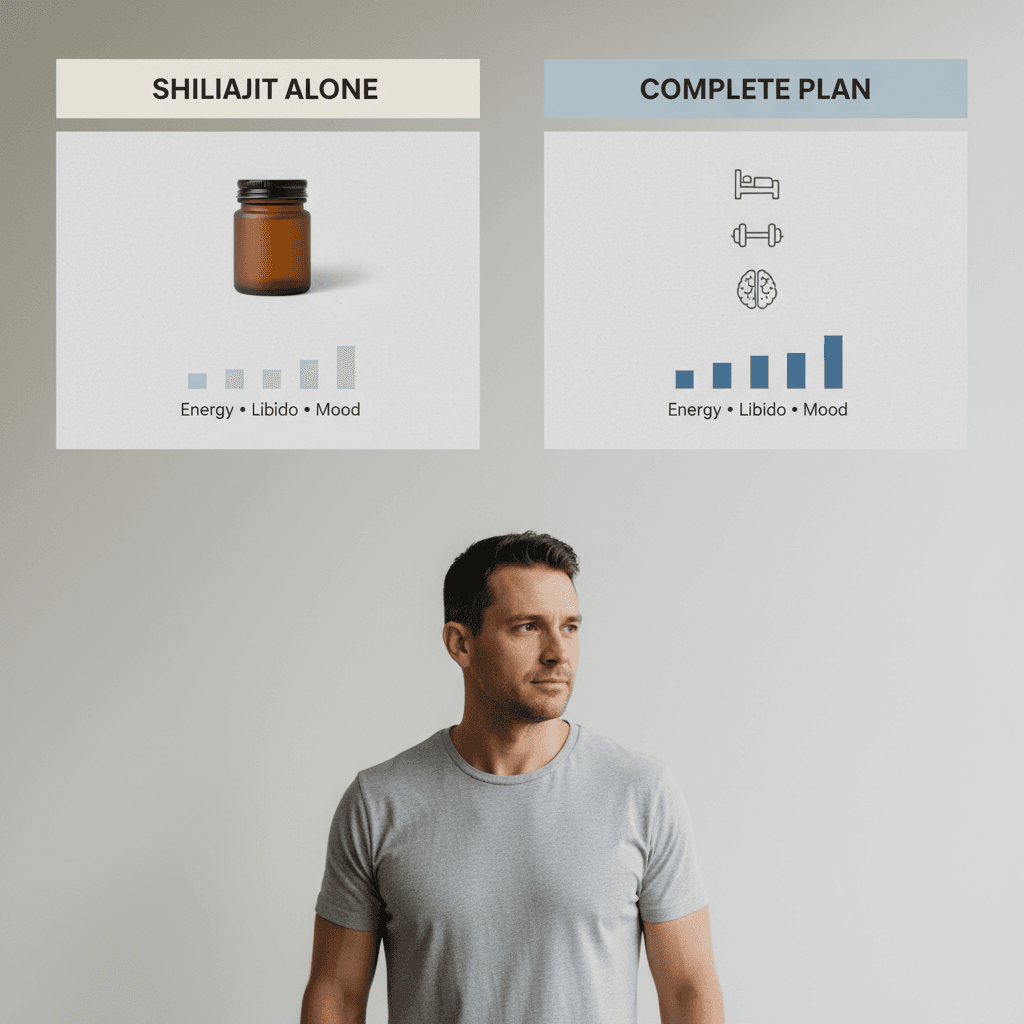
One of the most misleading aspects of shilajit marketing is the implication that you can supplement your way out of testosterone problems while ignoring the fundamentals. The reality is that lifestyle factors often have a much larger impact on testosterone levels than any supplement.
Sleep deprivation crushes testosterone production. Men who consistently sleep fewer hours than they need can see their testosterone levels drop significantly. Chronic stress elevates cortisol, which interferes with testosterone production and function. Excess body fat, particularly visceral fat around the midsection, converts testosterone to estrogen and creates a hormonal environment that further suppresses testosterone production.
Alcohol consumption, especially heavy drinking, directly impairs testosterone production in the testes. Lack of resistance training means missing out on one of the most reliable natural testosterone boosters. Nutritional deficiencies in zinc, magnesium, and vitamin D can limit testosterone production.
For many men concerned about their testosterone levels, addressing these fundamental factors would likely produce more meaningful improvements than any supplement, shilajit included. The problem is that fixing sleep, managing stress, losing excess weight, cutting back on drinking, and committing to consistent strength training requires sustained effort and lifestyle change. Taking a supplement feels easier and more immediate.
Shilajit might play a small supporting role in an overall men's health strategy, but it can't compensate for poor sleep, chronic stress, sedentary behavior, or excess alcohol consumption. Framing it as a primary intervention rather than a minor adjunct sets up unrealistic expectations.
Why the Ancient Wisdom Argument Deserves Skepticism
Supplement marketers love to invoke traditional use as evidence of effectiveness. Shilajit has been used in Ayurvedic medicine for thousands of years, therefore it must work, right? This argument sounds compelling but collapses under scrutiny.
Traditional medicine systems developed without the benefit of controlled trials, blinded comparisons, or biochemical analysis. Remedies were based on observation, theory, and cultural transmission, which sometimes identified genuinely effective treatments but also perpetuated ineffective or even harmful practices. Bloodletting was traditional medicine. Mercury was traditional medicine. Longevity of use doesn't equal proven efficacy.
Moreover, traditional Ayurvedic use of shilajit was typically in small amounts, combined with other herbs and minerals, prescribed by practitioners who considered individual constitution and context. Modern supplement use involves standardized doses of isolated or purified shilajit, taken by people with completely different diets, lifestyles, and health conditions. The two scenarios aren't comparable.
Respecting traditional knowledge doesn't mean accepting it uncritically or assuming it translates directly to modern applications. It means studying these substances rigorously to determine if and how they might be beneficial. For shilajit, that rigorous study is still incomplete.
What You're Actually Buying for Fifty Dollars
When you purchase a premium jar of shilajit, what are you getting for your money? Chemically, you're getting a complex mixture of organic compounds and minerals that varies based on source, processing, and manufacturer. Therapeutically, you're getting something with theoretical promise, limited human evidence, and a lot of question marks.
You're also buying into the hope that a natural substance can solve complicated health issues without the side effects, medical supervision, or commitment required by conventional treatment. That hope is valuable from a marketing perspective but potentially counterproductive from a health perspective if it delays appropriate medical care.
The supplement industry is built on blurring the line between possibility and probability, between "this might help in theory" and "this will definitely work for you." Shilajit sits squarely in that blurry space. It's not complete snake oil, there are compounds in it that show some biological activity, and the limited human research suggests possible modest benefits. But it's also far from the transformative testosterone solution that marketing implies.
For fifty dollars a month, you could invest in a gym membership, a sleep tracker, sessions with a therapist to address stress, or co-pays for medical visits to actually evaluate your hormone levels. Those investments would likely produce more reliable returns for your testosterone and overall health.
Navigating the Gap Between Optimization and Medicine
The shilajit phenomenon reflects a broader tension in men's health between the desire for optimization and the need for actual medical treatment when problems arise. There's nothing wrong with wanting to feel your best, maintain vitality as you age, and explore evidence-based strategies for health improvement. Problems emerge when optimization tactics are substituted for medical evaluation and treatment of genuine deficiencies or conditions.
If you're curious about shilajit and want to try it as part of a comprehensive approach to health that includes proper sleep, stress management, good nutrition, and regular exercise, you're probably not going to harm yourself with a quality product from a reputable manufacturer. But if you're experiencing symptoms that significantly impact your quality of life, fatigue that doesn't improve with rest, persistent low libido, difficulty maintaining muscle mass, mood changes, you need more than a supplement.
Real testosterone deficiency requires proper diagnosis through blood work and clinical evaluation, not guesswork based on symptoms or internet research. It requires treatment that's monitored and adjusted by a healthcare provider who can track your response and watch for potential side effects. It requires understanding the broader context of your health, not just focusing on a single hormone level.
Companies like AlphaMD have emerged to bridge the gap between traditional healthcare barriers and men's need for accessible, evidence-based hormone therapy. Through these platforms, licensed providers deliver medical evaluation, lab testing, consultation, and supervised treatment for men with actual testosterone deficiency, all with the convenience of an online experience. It's not about optimization hype or miracle supplements, but about getting appropriate care when you genuinely need it.
Shilajit might have a place in the supplement cabinet of someone interested in traditional medicine and willing to accept uncertainty about benefits. It doesn't have a place as a substitute for medical care when medical care is what's actually needed. Knowing the difference between those two scenarios is more valuable than any jar of Himalayan resin.
Have a question? Ask us.
At AlphaMD, we're here to help. Feel free to ask us any question you would like about TRT, medical weightloss, ED, or other topics related to men's health. Or take a moment to browse through our past questions.
People are asking...
How do you feel about oral trt that some competitors have begun to offer?...
It is intriguing. Oral testosterone is likely the future of TRT, though there are not many studies yet on the true efficacy of them. Currently, all safe forms of oral testosterone are on patent (Jaten... See Full Answer
What exactly is included at your $129/month price point? I checked your website but didn’t find specifics. Thanks....
Provider consultations, lab test reviews, most doses of Testosterone, if prescribed (higher doses may carry a slight increase to cover the added medication cost), any AI the provider prescribes, injec... See Full Answer
Hi, I am a 41 year old female, in peri menopause interested in TRT. Recent labs taken 2 weeks ago: Free testosterone 0.5 pg/ml and Testosterone NG/dl ...
Lab results and symptoms like yours are exactly what a licensed provider would consider when evaluating whether TRT is appropriate. It is rare to find medical providers that are comfortable with presc... See Full Answer
Get $30 off your first month’s order
Enter your email address now to receive $30 off your first month’s cost, other discounts, and additional information about TRT.
Legal Disclaimer
This website is a repository of publicly available information and is not intended to form a physician-patient relationship with any individual. The content of this website is for informational purposes only. The information presented on this website is not intended to take the place of your personal physician's advice and is not intended to diagnose, treat, cure, or prevent any disease. Discuss this information with your own physician or healthcare provider to determine what is right for you. All information is intended for your general knowledge only and is not a substitute for medical advice or treatment for specific medical conditions. The information contained herein is presented in summary form only and intended to provide broad consumer understanding and knowledge. The information should not be considered complete and should not be used in place of a visit, phone or telemedicine call, consultation or advice of your physician or other healthcare provider. Only a qualified physician in your state can determine if you qualify for and should undertake treatment.