
Post-Holiday Reset: Getting Back on Track After Two Weeks of Chaos
Published on:
Updated on:
People are asking...
Question about the “honeymoon phase”. So I started 6 weeks ago on my protocol and felt great the first 4… energetic and kicking ass in the gym and on ...
Yes, it is very common. And your theory as to why it happens is the one providers most often point to, though there is no way of knowing exactly why it happens. The good news is that it resolves in ti... See Full Answer
Generally speaking does 2x or 3x per week help with acne symptoms too? Most on here say so, I'm going to start my regimen in a couple weeks and will ...
Absolutely, you should see an improvement with twice a week over once a week by a large amount, as the spike you would have had would be huge. You should also notice a more even feeling of benefits an... See Full Answer
When you change your dose, how long does it take to reverse the side effects?...
Typically your E2 levels will stabilize around 2-3 weeks after any change in dose.... See Full Answer
Have a question? Ask us.
At AlphaMD, we're here to help. Feel free to ask us any question you would like about TRT, medical weightloss, ED, or other topics related to men's health. Or take a moment to browse through our past questions.
You woke up this morning feeling like you got hit by a truck, and it's not just the hangover talking. Two weeks of late nights, heavy meals, skipped workouts, and more alcohol than you care to admit have left you bloated, sluggish, and wondering where your energy went.
If that sounds familiar, you're not alone. The post-holiday crash is real, and it happens to almost everyone who indulges during the festive season. Your body doesn't reset like a computer after a night of sleep. When you stack days of disrupted routines, excess calories, alcohol, poor sleep quality, and missed training sessions, your physiology shifts in measurable ways. Insulin sensitivity drops, inflammation creeps up, stress hormones stay elevated, and your testosterone production can take a temporary hit. Add in the psychological weight of losing your routine, and it's no surprise that getting back on track feels harder than it should.
The good news? Your body wants to bounce back. With a focused, realistic approach over the next few weeks, you can restore your energy, clear the brain fog, and get back to feeling like yourself again. This isn't about punishing yourself with crash diets or brutal workouts. It's about understanding what happened, why you feel the way you do, and what actually works to get back on track.
Why the Holiday Hangover Hits Different After 30
When you were younger, you could bounce back from a weekend of partying like nothing happened. A few days of clean eating and some decent sleep, and you were good to go. But somewhere around your thirties, that resilience starts to fade. Two weeks of chaos now leaves you feeling wrecked for longer, and it's not just in your head.
As men age, recovery capacity naturally declines. Your hormone production becomes more sensitive to lifestyle disruptions. Testosterone levels, which peak in your twenties, become more vulnerable to stress, poor sleep, and excess body fat. When you combine sleep deprivation with alcohol and inflammatory foods, you create the perfect storm for cortisol to stay elevated while testosterone dips. This hormonal shift directly impacts your energy, mood, motivation, and even your ability to build or maintain muscle.
Your metabolic flexibility also changes with age. Insulin sensitivity decreases, meaning your body doesn't handle carbohydrates and sugar as efficiently as it once did. After two weeks of holiday eating, your cells become even more resistant to insulin, making you feel sluggish and promoting fat storage, especially around your midsection. That bloated, thick feeling isn't just water weight. It's a combination of inflammation, digestive stress, and genuine fat gain that happened faster than you expected.
The routine disruption amplifies everything. When your sleep schedule gets thrown off, your circadian rhythm takes time to recalibrate. Poor sleep quality means less deep sleep, which is when your body produces the majority of its testosterone and does most of its physical recovery. Miss out on that for two weeks straight, and you're operating on a significant deficit.
What Two Weeks of Disruption Actually Does to Your Body
Understanding the specific ways your body responds to holiday chaos helps you target your reset more effectively. This isn't about guilt or shame. It's about recognizing patterns so you can address them.
Alcohol, even in moderate amounts over consecutive days, disrupts multiple systems. It fragments your sleep architecture, preventing you from getting adequate REM and deep sleep stages. It increases estrogen relative to testosterone, contributes to dehydration, stresses your liver, and promotes inflammation throughout your body. That inflammation doesn't just make you feel puffy. It affects your brain, your joints, your gut, and your cardiovascular system.
Processed foods, excess sugar, and large portions create their own cascade of issues. Your gut microbiome shifts toward less favorable bacterial populations. Blood sugar spikes and crashes become more extreme. Your body ramps up inflammatory markers as it tries to process the constant influx of calories and low-quality nutrients. Over time, this leads to increased oxidative stress and cellular damage that takes energy to repair.
Missed workouts matter more than you might think. Regular resistance training is one of the most powerful tools for maintaining healthy testosterone levels, insulin sensitivity, and metabolic rate. When you stop training for two weeks, you don't just lose strength. You lose the acute hormonal benefits that each workout provides, including temporary testosterone boosts and improved insulin signaling. Your muscles become less efficient at using glucose, and your metabolic rate drops slightly, making it easier to gain fat and harder to feel energized.
Stress accumulates differently during the holidays. You might feel relaxed on the surface, but irregular schedules, social obligations, travel, and disrupted routines keep your nervous system in a state of low-grade activation. Cortisol stays elevated, which directly suppresses testosterone production and promotes fat storage, particularly visceral fat around your organs.
The Reset Framework That Actually Works
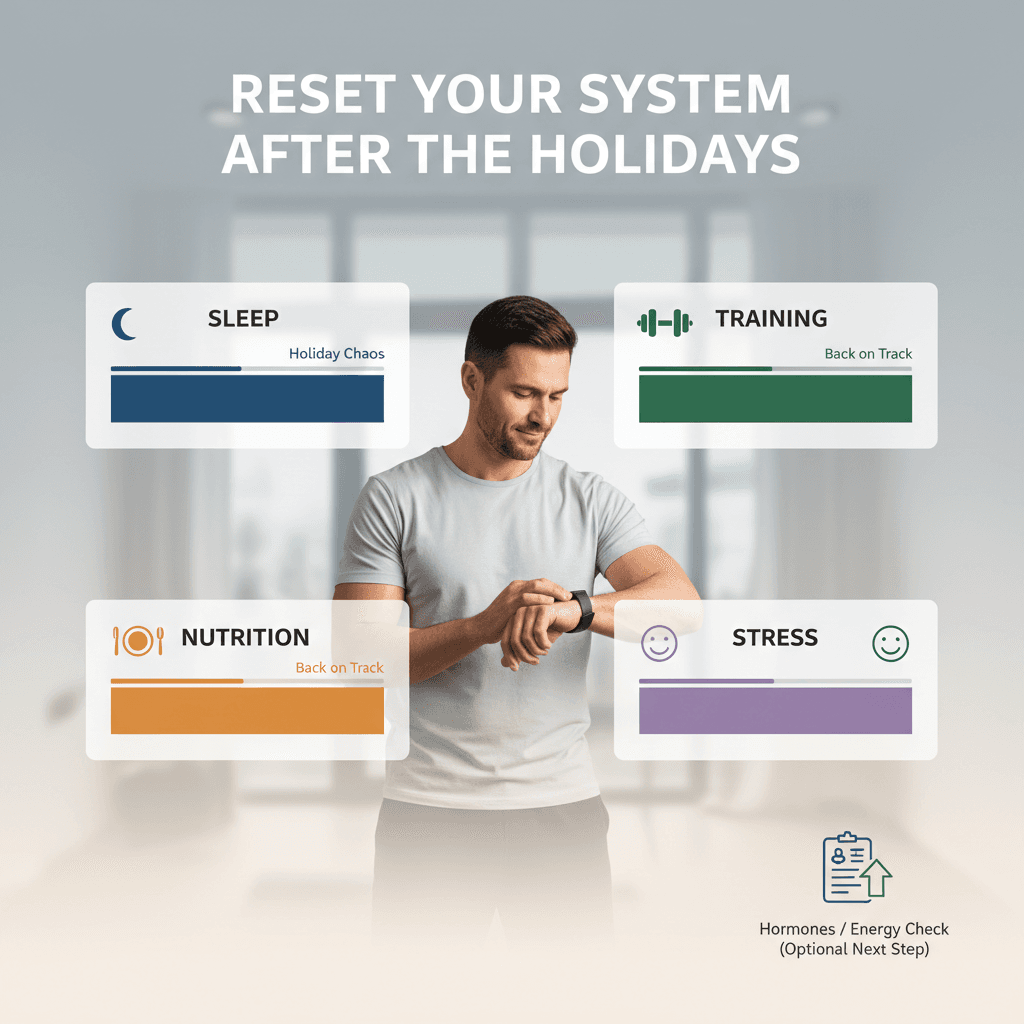
Forget about detoxes, cleanses, or extreme restriction. Your body doesn't need to be punished. It needs support to get back to baseline. The most effective reset focuses on four foundational pillars: sleep, movement, nutrition, and stress management. Done consistently for two to four weeks, these actions will restore most of what you lost during the holidays.
Start with sleep because it's the foundation for everything else. Your first priority is establishing a consistent wake time, even on weekends. Your body runs on a circadian clock, and that clock is set primarily by light exposure and wake time consistency. Go to bed within the same 30-minute window each night, and wake up at the same time each morning. This alone will improve sleep quality within days.
Create a wind-down routine that starts about an hour before bed. Dim the lights in your home, reduce screen time, and consider activities that genuinely relax your nervous system, whether that's reading, stretching, or simply sitting quietly. Keep your bedroom cool, dark, and reserved for sleep. If alcohol has been part of your nightly routine, start cutting back now. Even a single drink can fragment your sleep quality enough to prevent proper recovery.
Movement doesn't mean destroying yourself in the gym. In fact, if you try to jump back into your old routine at full intensity, you'll likely feel worse and increase injury risk. Start with something achievable. Three to four resistance training sessions per week, focusing on compound movements like squats, presses, and pulls, will reactivate your muscles and kickstart the hormonal benefits of training. Keep sessions to 45 to 60 minutes, prioritize form over ego, and give yourself permission to scale back weight or volume for the first week.
Daily walking is underrated but essential. Aim for 7,000 to 10,000 steps per day, spread throughout the day rather than crammed into one session. Walking improves insulin sensitivity, reduces stress, aids digestion, and helps regulate your circadian rhythm when done outdoors in natural light. It's the easiest high-value habit you can add immediately.
Eating Like an Adult Again
Nutrition during your reset should focus on three things: adequate protein, minimizing inflammatory foods, and stabilizing blood sugar. You don't need to count every calorie or follow a restrictive diet. You just need to get back to eating like someone who cares about how they feel.
Protein should be the anchor of every meal. Target roughly one gram per pound of body weight if you're active and trying to maintain or build muscle. High protein intake supports satiety, preserves lean mass, stabilizes blood sugar, and requires more energy to digest than carbohydrates or fat. Think eggs, lean meats, fish, Greek yogurt, and protein shakes if you need convenience.
Cut back dramatically on added sugar and processed carbohydrates. Your insulin sensitivity is already compromised, and continuing to spike blood sugar will keep you feeling tired and hungry. Focus on fiber-rich carbohydrates like vegetables, fruits, and whole grains in moderate amounts. Fiber slows digestion, feeds beneficial gut bacteria, and helps you feel full without overeating.
Hydration matters more than most people realize. Dehydration affects everything from cognitive function to workout performance to appetite regulation. Drink water consistently throughout the day, and consider front-loading your intake in the morning. If you've been drinking heavily, your electrolyte balance may also be off, so don't be afraid to add a pinch of salt to your water or eat mineral-rich foods.
Alcohol should be minimized or eliminated during your reset period. This is one of the fastest ways to see improvement in sleep quality, energy levels, body composition, and mood. If complete abstinence feels unrealistic, limit yourself to one or two drinks per week maximum, and avoid drinking close to bedtime.
Getting Your Head Right Without Going Extreme
The mental side of the reset is just as important as the physical side. Perfectionism and all-or-nothing thinking will sabotage your progress faster than any cheat meal.
Accept that the first few days will feel uncomfortable. You might be hungrier than usual as your blood sugar stabilizes. You might feel irritable as your body adjusts to less alcohol and sugar. You might be sore from reintroducing workouts. These are normal responses, not signs that something is wrong. Push through the first 72 hours, and things will start to smooth out.
Track how you feel over weeks, not days. Your weight might fluctuate. Your energy might be inconsistent at first. Your sleep might take a week or two to truly improve. Judge your progress by the trend, not by individual data points. Notice when your morning energy returns. Pay attention to when your appetite becomes more stable. Celebrate when you start sleeping through the night again or when your lifts start feeling strong.
Avoid comparing your reset to anyone else's. Your buddy might drop ten pounds in a week, while you lose three. That doesn't mean you're doing something wrong. Bodies respond differently based on age, training history, genetics, stress levels, and hormone status. Focus on your own trajectory.
Build in flexibility without using it as an excuse. If you have a work dinner or social event, participate without guilt. One meal won't derail your reset. Just get back on track with your next meal and your next workout. Consistency over time beats perfection every time.
When the Reset Isn't Enough
For most men, two to four weeks of dialed-in lifestyle habits will restore energy, mood, and motivation. But some men do everything right and still feel off. The workouts are consistent, the sleep is solid, the nutrition is clean, but something still feels missing. Morning energy never fully returns. Libido stays low. The mental sharpness doesn't come back. Workouts feel harder than they should.
This is when it's worth considering whether hormone health, particularly testosterone, might be playing a role. Testosterone naturally declines with age, typically starting in your thirties and continuing throughout your life. For some men, that decline is steeper or happens earlier. Chronic stress, previous lifestyle habits, medications, underlying health conditions, and genetics all influence your hormone levels.
Low testosterone presents in ways that overlap significantly with the post-holiday crash: fatigue, low motivation, reduced muscle mass, increased body fat, brain fog, and diminished sex drive. The difference is that these symptoms persist even after you've corrected your lifestyle. If you've given yourself a solid month of good habits and still feel like you're operating at 70 percent, it's time to talk to a clinician.
Hormone evaluation involves more than just a single blood test. A knowledgeable provider will assess your symptoms, medical history, lifestyle factors, and comprehensive lab work to understand your hormone profile. This includes testosterone, but also related markers that affect how you feel and function. Treatment, when appropriate, is highly individualized and should always be paired with continued attention to sleep, nutrition, training, and stress management.
This is where companies like AlphaMD come into play. AlphaMD is an online men's health platform built around a comprehensive approach to hormone health. Rather than a prescription-first mindset, care through AlphaMD pairs lifestyle optimization with personalized attention from licensed providers. The provider overseeing your care understands that testosterone replacement therapy isn't a magic bullet. It works best when integrated into a broader health strategy that includes everything you're already doing: training hard, eating well, sleeping consistently, and managing stress.
If you've been wondering whether low testosterone might be holding you back, or if you're already on TRT and want more personalized guidance, working with a provider who understands both the medical and lifestyle sides of men's health makes a significant difference. Hormone optimization isn't about chasing numbers. It's about helping you feel and perform at your best.
Moving Forward
The post-holiday reset isn't a punishment. It's a recalibration. You enjoyed yourself, you indulged, and now you're getting back to the habits that make you feel strong, energized, and in control. Give yourself two to four weeks of consistent effort, and you'll be surprised how much better you feel.
Prioritize sleep, get back to training, clean up your nutrition, and manage your stress. Track your progress by how you feel, not just by what the scale says. Be patient with the process, and don't let perfectionism derail you.
And if you do everything right but still feel like something is missing, don't ignore it. Hormone health is a real factor in how you feel and perform, and getting it checked is a smart move, not a weakness. Whether you're dealing with temporary post-holiday fatigue or something more persistent, the path forward is the same: take action, stay consistent, and give your body what it needs to thrive.
Have a question? Ask us.
At AlphaMD, we're here to help. Feel free to ask us any question you would like about TRT, medical weightloss, ED, or other topics related to men's health. Or take a moment to browse through our past questions.
People are asking...
Question about the “honeymoon phase”. So I started 6 weeks ago on my protocol and felt great the first 4… energetic and kicking ass in the gym and on ...
Yes, it is very common. And your theory as to why it happens is the one providers most often point to, though there is no way of knowing exactly why it happens. The good news is that it resolves in ti... See Full Answer
Generally speaking does 2x or 3x per week help with acne symptoms too? Most on here say so, I'm going to start my regimen in a couple weeks and will ...
Absolutely, you should see an improvement with twice a week over once a week by a large amount, as the spike you would have had would be huge. You should also notice a more even feeling of benefits an... See Full Answer
When you change your dose, how long does it take to reverse the side effects?...
Typically your E2 levels will stabilize around 2-3 weeks after any change in dose.... See Full Answer
Get $30 off your first month’s order
Enter your email address now to receive $30 off your first month’s cost, other discounts, and additional information about TRT.
Legal Disclaimer
This website is a repository of publicly available information and is not intended to form a physician-patient relationship with any individual. The content of this website is for informational purposes only. The information presented on this website is not intended to take the place of your personal physician's advice and is not intended to diagnose, treat, cure, or prevent any disease. Discuss this information with your own physician or healthcare provider to determine what is right for you. All information is intended for your general knowledge only and is not a substitute for medical advice or treatment for specific medical conditions. The information contained herein is presented in summary form only and intended to provide broad consumer understanding and knowledge. The information should not be considered complete and should not be used in place of a visit, phone or telemedicine call, consultation or advice of your physician or other healthcare provider. Only a qualified physician in your state can determine if you qualify for and should undertake treatment.