
Anavar + TRT: The Clinical Dose for Lean Mass That Doesn't Trash Your Lipids
Published on:
Updated on:
People are asking...
Currently on 125mg per week. Levels 1050 test estrogen in range etc. all blood work good for over 1.5 years. Currently no sides. But light facial acn...
As far as additional medications to supplement your TRT to advance your physique; your primary options (legally speaking) of anabolic/androgenic steroid (AAS) agents would be nandrolone or oxandrolone... See Full Answer
Do you guys prescribe other anabolics other then Testosterone?...
Where it's appropriate, yes. There other other legal anabolic like Oxandrolone & Nandrolone. We certainly prescribe them significantly less than standard Testosterone. In general, if there's an issue ... See Full Answer
How often do doctors prescribe something like oxandrolone or nandrolone in addition to a regular testosterone protocol for TRT? Some people claim that...
I feel like Oxandrolone & Nandrolone in TRT need their own videos to talk about them, so we'll do that this week, then share it here when done.There's a fair number of AAS on the table with TRT since ... See Full Answer
Have a question? Ask us.
At AlphaMD, we're here to help. Feel free to ask us any question you would like about TRT, medical weightloss, ED, or other topics related to men's health. Or take a moment to browse through our past questions.
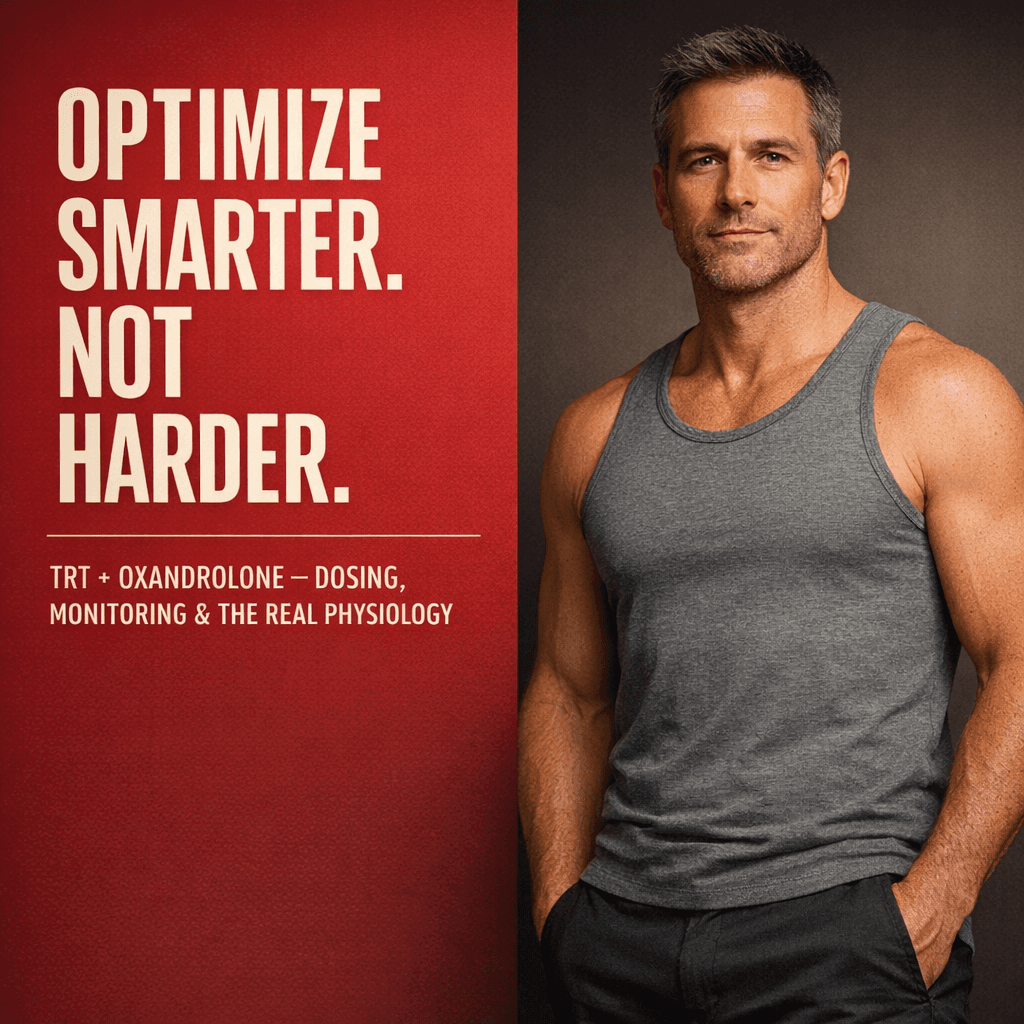
Most men on testosterone replacement therapy feel better, stronger, and leaner than they did before - and then they hit a plateau and start wondering what else is possible. That question, asked honestly and without hype, is exactly where the conversation about oxandrolone and TRT begins.
Why TRT Alone Leaves Some Men Wanting More
Testosterone replacement therapy has one primary clinical job: restore physiological testosterone levels in men whose bodies are no longer producing enough on their own. When it works well, the results are meaningful. Energy returns, mood stabilizes, muscle tissue responds better to training, and body fat, especially visceral fat, tends to shift in a favorable direction.
But TRT is not a performance drug. It is a restoration tool. For many men, getting back to normal is genuinely transformative. For others, particularly those who train seriously or who are pursuing specific body composition goals, normal is not the finish line. They have restored the baseline and now want to build on it.
This is not vanity for its own sake. Lean muscle mass is metabolically protective. It improves insulin sensitivity, supports bone density, and contributes to long-term functional independence. So when a man on TRT asks whether there is a clinically reasonable way to support further lean mass development, it is a legitimate question that deserves a serious, medically grounded answer.
What Oxandrolone Actually Is
Oxandrolone is a synthetic anabolic-androgenic steroid derived from dihydrotestosterone. It has been used in clinical medicine for decades, with applications in muscle wasting conditions, recovery from severe burns, and management of certain metabolic disorders. It is a Schedule III controlled substance in the United States, available only by prescription, and it is not interchangeable with over-the-counter supplements regardless of how some products are marketed.
What draws attention to oxandrolone in the context of TRT and physique goals is its relatively favorable profile for lean tissue gains with comparatively low water retention. Unlike some other anabolic compounds, it does not convert to estrogen through aromatization, which means the characteristic bloating and fluid retention associated with testosterone itself tends not to be a feature. Gains, when they occur, tend to reflect actual changes in lean tissue and strength rather than temporary fluid shifts.
It is critical to correct a common mischaracterization here. Oxandrolone is frequently described as a "mild" steroid, and that word does real harm. Mild compared to what, and in which direction? It may be milder in terms of androgenic side effects like body hair or voice changes, but its impact on cardiovascular risk markers, particularly lipids, is not mild at all. The oral route of administration and its DHT-derived structure carry specific metabolic consequences that deserve full attention before any decision is made.
The Meaning of "Clinical Dose" in This Context
When clinicians and informed patients use the phrase "clinical dose," they are describing something conceptually distinct from the escalating amounts common in competitive bodybuilding culture. A clinical approach means the lowest exposure that achieves a defined therapeutic goal, used for a defined period, with active monitoring throughout.
The contrast matters. Bodybuilding culture tends to push dose upward over time, stack compounds, and extend cycles in pursuit of marginal additional gains. A clinical framework does the opposite. It asks what the minimum effective intervention looks like, keeps the duration bounded and time-limited, and treats any sign of adverse effect as a reason to reassess rather than push through.
Goal-setting is part of this. A clinician-guided approach to oxandrolone as an adjunct to TRT would involve clear, realistic goals, a plan for monitoring key health markers, and a pre-defined endpoint. The objective is meaningful benefit with the smallest necessary physiological exposure. That is not a compromise. It is the point.
The Lipid Problem: Why This Conversation Cannot Skip Cardiology
Androgens, as a class, have complex and often unfavorable effects on lipid metabolism. Testosterone itself can modestly reduce HDL cholesterol, which is the particle associated with cardiovascular protection. But oral, DHT-derived androgens like oxandrolone have a more pronounced effect on the lipid panel, and this is where the "doesn't trash your lipids" part of any serious conversation becomes genuinely difficult.
HDL suppression is the most consistently documented concern. HDL is not merely a number; it reflects reverse cholesterol transport, the process by which cholesterol is cleared from arterial walls and returned to the liver. When HDL falls significantly, that process becomes less efficient, and cardiovascular risk rises regardless of how the person looks in the mirror.
LDL and ApoB are equally important. ApoB is a protein that wraps around atherogenic particles, and it is increasingly recognized as a more direct measure of cardiovascular risk than LDL alone. A man who looks lean, who has added muscle and reduced visible body fat, can simultaneously be accumulating arterial risk that does not show up in any mirror. That disconnect between appearance and cardiometabolic health is one of the most important things to understand before adding any anabolic compound to a TRT regimen.
Lipoprotein(a), or Lp(a), is another marker worth discussing with a clinician. Lp(a) is largely genetically determined, but it is independently associated with cardiovascular and clotting risk. Its relevance in the context of androgen use is an active area of discussion, and any comprehensive pre-treatment evaluation should include awareness of a patient's Lp(a) status.
The clinical goal, if oxandrolone is used at all, is to keep lipid disruption within a range that a clinician considers acceptable relative to the therapeutic benefit, and to intervene quickly if that balance tips.
What Monitoring Actually Looks Like
Serious clinician oversight in this context is not a formality. It is the mechanism that separates informed, medically supervised use from something far riskier.
A full lipid panel is the starting point and a recurring checkpoint throughout any course of treatment. This means not just total cholesterol but HDL, LDL, triglycerides, and ideally ApoB as a more precise atherogenic risk marker. Liver enzymes matter because oxandrolone is an oral compound processed hepatically, and any signal of liver strain warrants immediate reassessment. Blood pressure requires regular tracking, as both testosterone and anabolic compounds can influence vascular tone.
Hematocrit and hemoglobin are especially relevant for men already on TRT. Testosterone stimulates red blood cell production, and adding another anabolic agent can push this further. Elevated hematocrit thickens blood and raises clotting risk. Glucose and insulin markers matter because anabolic compounds can influence insulin sensitivity in both directions, and men with existing metabolic concerns need that tracked closely.
Beyond labs, patient-reported effects carry diagnostic weight. Sleep quality changes, mood shifts, libido changes, skin and hair changes, and cardiovascular symptoms like palpitations or unusual shortness of breath are all part of the clinical picture and should be reported to the prescribing clinician promptly.
Mitigation Is Real, But It Has Limits
There are evidence-supported lifestyle strategies that can help preserve lipid health during androgen use. These are not substitutes for monitoring, and they are not guarantees, but they are meaningful contributors to risk management.
Dietary patterns that emphasize fiber, particularly soluble fiber from vegetables, legumes, and whole grains, support LDL clearance and overall cardiometabolic health. Reducing alcohol is important because alcohol impairs liver function and can worsen lipid metabolism, particularly when an oral compound is also being processed hepatically. Sleep quality directly influences lipid metabolism, cortisol regulation, and insulin sensitivity, making it a legitimate clinical variable rather than a soft lifestyle recommendation.
Exercise programming, especially aerobic conditioning combined with resistance training, has well-documented benefits for HDL and overall cardiovascular risk. The irony is that men using anabolic compounds while neglecting cardiovascular training may be partially undermining the very risk management they need most.
Some men should not use oxandrolone at all. Significant pre-existing dyslipidemia, uncontrolled hypertension, active liver disease, a personal or family history of early cardiovascular disease, or certain clotting disorders are conditions that a clinician may consider disqualifying. This is not a negotiable list. It is the clinician's job to evaluate these factors individually and make a recommendation accordingly.
Side Effects Beyond the Lipid Panel
Lipids get the most attention in this conversation for good reason, but they are not the only consideration.
Hair loss is a meaningful concern for men with androgenetic alopecia predisposition. DHT-derived compounds can accelerate this process, and oxandrolone is no exception. Acne and skin oiliness are reported by some users. Mood changes, including increased irritability or emotional dysregulation, can occur and are worth monitoring both personally and through clinical follow-up.
Fertility is a significant consideration for men who may want biological children. Exogenous androgens suppress the body's own hormonal signals to the testes, reducing sperm production. This effect is dose and duration-dependent and may not be fully reversible in all cases. Any man with fertility considerations should discuss this explicitly with a clinician before proceeding.
Drug interactions are another practical concern. Oxandrolone can affect the metabolism of other medications, including anticoagulants, which creates clinically significant interaction risks that must be reviewed by a pharmacologically informed prescriber.
Realistic Expectations for Lean Mass
Clinical gains from a conservative, time-limited oxandrolone course in the context of TRT are real but measured. Men who respond well and train consistently typically report improved strength, better recovery between sessions, and meaningful changes in lean-to-fat ratio. These are not dramatic, rapid transformations. They are incremental improvements that compound over time when combined with serious training and nutrition.
What oxandrolone does not do is substitute for those fundamentals. A man with inconsistent training and poor nutritional habits will not be rescued by any pharmacological addition to his TRT protocol. The compound works with the physiology, not around it.
Expectations also need to account for individual variation. Genetics, age, training history, baseline body composition, and overall health status all influence how a person responds. There is no guaranteed outcome, and any clinician promising dramatic results from a specific protocol is overstating the evidence.
Keeping the Long View in Focus
If the goal is genuine lean mass development without compromising cardiometabolic health, the strategy is not complicated to describe, even if it requires discipline to execute. Conservative exposure, tight monitoring, a defined endpoint, and a commitment to the lifestyle factors that protect lipid and liver health are the framework. Anything that departs significantly from that framework moves the risk-benefit calculation in the wrong direction.
For men on TRT who are considering this path, the starting point is a comprehensive evaluation with a clinician who understands men's hormonal health in depth, not a rushed conversation that skips the cardiovascular and metabolic details. Clinics like AlphaMD are built around exactly that kind of individualized, monitoring-focused approach to hormone optimization, where the emphasis is on long-term health rather than short-term results at any cost. That orientation, careful evaluation, ongoing lab work, and honest risk communication, is what separates responsible hormone medicine from something more reckless.
Have a question? Ask us.
At AlphaMD, we're here to help. Feel free to ask us any question you would like about TRT, medical weightloss, ED, or other topics related to men's health. Or take a moment to browse through our past questions.
People are asking...
Currently on 125mg per week. Levels 1050 test estrogen in range etc. all blood work good for over 1.5 years. Currently no sides. But light facial acn...
As far as additional medications to supplement your TRT to advance your physique; your primary options (legally speaking) of anabolic/androgenic steroid (AAS) agents would be nandrolone or oxandrolone... See Full Answer
Do you guys prescribe other anabolics other then Testosterone?...
Where it's appropriate, yes. There other other legal anabolic like Oxandrolone & Nandrolone. We certainly prescribe them significantly less than standard Testosterone. In general, if there's an issue ... See Full Answer
How often do doctors prescribe something like oxandrolone or nandrolone in addition to a regular testosterone protocol for TRT? Some people claim that...
I feel like Oxandrolone & Nandrolone in TRT need their own videos to talk about them, so we'll do that this week, then share it here when done.There's a fair number of AAS on the table with TRT since ... See Full Answer
Get $30 off your first month’s order
Enter your email address now to receive $30 off your first month’s cost, other discounts, and additional information about TRT.
Legal Disclaimer
This website is a repository of publicly available information and is not intended to form a physician-patient relationship with any individual. The content of this website is for informational purposes only. The information presented on this website is not intended to take the place of your personal physician's advice and is not intended to diagnose, treat, cure, or prevent any disease. Discuss this information with your own physician or healthcare provider to determine what is right for you. All information is intended for your general knowledge only and is not a substitute for medical advice or treatment for specific medical conditions. The information contained herein is presented in summary form only and intended to provide broad consumer understanding and knowledge. The information should not be considered complete and should not be used in place of a visit, phone or telemedicine call, consultation or advice of your physician or other healthcare provider. Only a qualified physician in your state can determine if you qualify for and should undertake treatment.