
Lost 41 Pounds on Retatrutide While Building Muscle—How This Changes TRT Body Recomp
Published on:
Updated on:
People are asking...
Would a person that has low test and takes trt build more or less muscle than an average person that doesn’t take anything?...
They would generally build the same amount of muscle, assuming that "average person" was not also a low Testosterone individual. This is because the primary goal of TRT is to get you back to where you... See Full Answer
I’m on top of macros and lifting heavy. History of losing body fat and keeping it off. Disciplined. Etc. I have rocked pretty large deficits for mo...
Yes. While on TRT, you are more likely to preserve muscle while in a caloric deficit. In fact, it is still potentially possible to gain some muscle in a slight caloric deficit if your testosterone rem... See Full Answer
I’m on top of macros and lifting heavy. History of losing body fat and keeping it off. Disciplined. Etc. I have rocked pretty large deficits for mo...
Yes. While on TRT, you are more likely to preserve muscle while in a caloric deficit. In fact, it is still potentially possible to gain some muscle in a slight caloric deficit if your testosterone rem... See Full Answer
Have a question? Ask us.
At AlphaMD, we're here to help. Feel free to ask us any question you would like about TRT, medical weightloss, ED, or other topics related to men's health. Or take a moment to browse through our past questions.
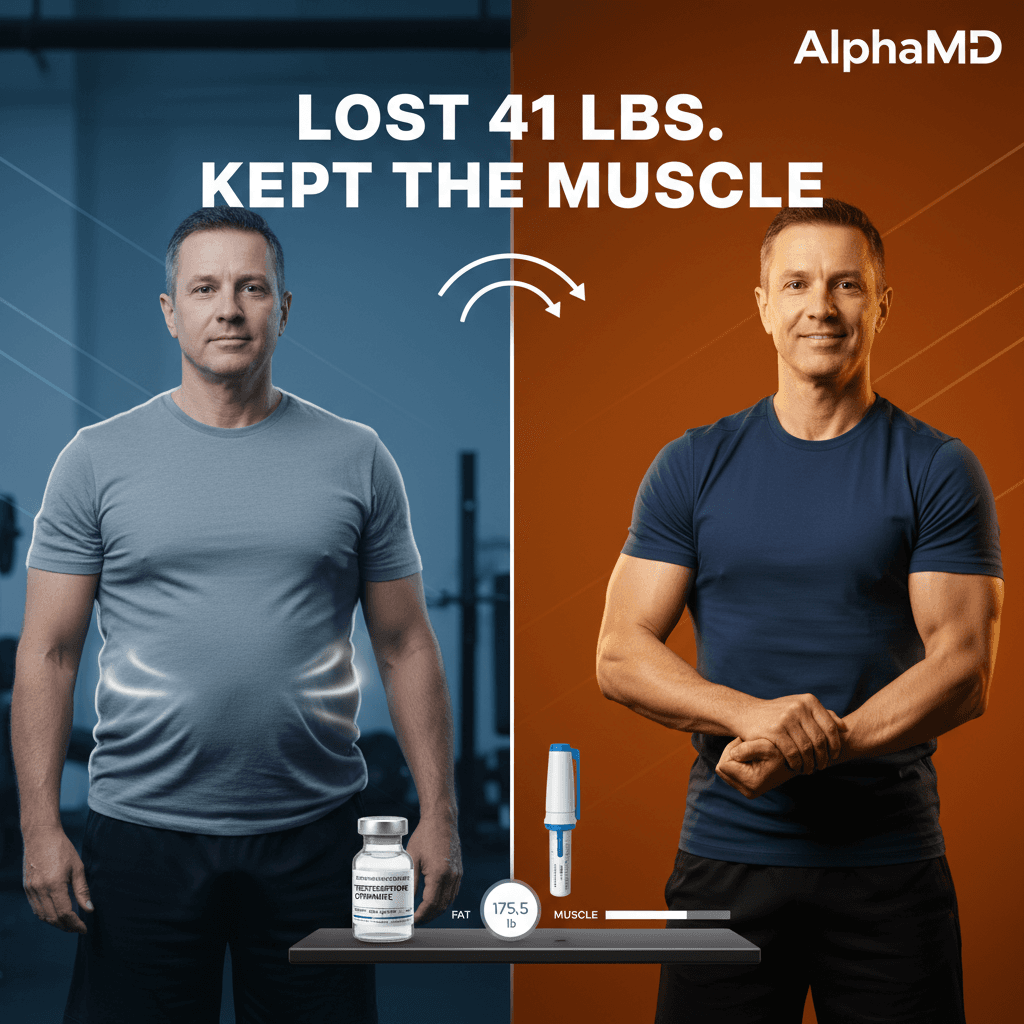
Losing 41 pounds while building muscle sounds like the kind of transformation that would take a year of perfect adherence to diet and training, or maybe something only possible with unsustainable calorie restriction. But when you combine Retatrutide with testosterone replacement therapy (TRT) and a structured resistance training program, the rules of body recomposition shift dramatically.
This isn't just about dropping weight. It's about rewriting the traditional TRT playbook, where men were told to either bulk slowly and accept fat gain, or cut carefully and risk losing hard-earned muscle. The emergence of powerful weight-loss medications like Retatrutide is changing what's achievable, and more importantly, how quickly you can get there without sacrificing lean tissue.
From Plateaued TRT Cut to 41 Pounds Gone
Most men on TRT hit a frustrating wall. They've optimized their testosterone levels, dialed in their training, and cleaned up their diet. Yet the stubborn fat around the midsection refuses to budge. The scale might drop a few pounds, but progress stalls. Energy dips. Hunger becomes relentless. The body fights back.
Traditional approaches to fat loss on TRT typically involve moderate calorie deficits sustained over many months. The goal is always to preserve muscle while slowly chipping away at body fat. This works, but it's painfully slow, and adherence becomes the limiting factor. Most men can white-knuckle a strict diet for a few weeks, maybe a couple months. But six months of feeling hungry and underperforming in the gym? That's where most recomposition efforts fall apart.
Retatrutide changes this equation entirely. As a triple agonist medication that targets GLP-1, GIP, and glucagon receptors, it creates a metabolic environment that makes significant fat loss not only possible but sustainable. Men report losing substantial amounts of body fat, like 41 pounds or more, while maintaining or even gaining muscle mass when the approach is structured correctly.
The difference isn't magic. It's biology. Retatrutide works through multiple pathways to reduce appetite, improve insulin sensitivity, increase energy expenditure, and potentially preserve lean tissue during caloric restriction. When you're not constantly battling hunger signals and your body is metabolically primed to use fat for fuel, the entire experience of fat loss transforms.
What Retatrutide Does That Diet Alone Cannot
Understanding how Retatrutide functions helps explain why the results differ so dramatically from traditional dieting. This medication doesn't just make you less hungry, though appetite suppression is certainly part of the picture. It fundamentally alters how your body manages energy, stores fat, and responds to food intake.
GLP-1 receptor agonism slows gastric emptying and increases satiety signals to the brain. You feel fuller faster and stay satisfied longer. GIP receptor activity improves insulin sensitivity and may have protective effects on lean body mass. Glucagon receptor stimulation increases energy expenditure and promotes fat oxidation. Together, these mechanisms create a metabolic shift that allows for aggressive fat loss without the metabolic adaptation and muscle catabolism that typically accompanies rapid weight reduction.
When men attempt to lose 41 pounds through diet and exercise alone while on TRT, the process usually takes six months to a year, requires meticulous tracking, and often results in some muscle loss despite best efforts. Energy levels crater. Training performance suffers. Libido can take a hit. The body perceives famine and downregulates accordingly.
With Retatrutide in the mix, that same 41-pound loss might happen in four to six months, with far less hunger, better training performance, and superior muscle preservation. Men often report feeling energized rather than depleted, maintaining strength in the gym, and experiencing improvements in metabolic markers that extend well beyond the number on the scale.
Muscle, Metabolism, and TRT: Why The Rules Are Changing
Testosterone replacement therapy already provides a significant advantage for body recomposition. Optimized testosterone levels support muscle protein synthesis, improve recovery, enhance mood and motivation, and help maintain lean body mass during caloric restriction. But TRT alone doesn't override the fundamental challenge of fat loss: you still need to be in a caloric deficit, and your body still resists that deficit.
The traditional TRT body recomposition approach borrowed heavily from bodybuilding: bulk phases where you eat in a surplus to maximize muscle gain while accepting some fat accumulation, followed by cut phases where you diet down to reveal the muscle underneath. This works, but it's inefficient and often leaves men spinning their wheels, gaining and losing the same 15-20 pounds repeatedly.
Retatrutide enables a different strategy altogether. Instead of deliberate bulking and cutting cycles, you can pursue what's essentially a long, aggressive recomposition phase. You're losing substantial fat while training hard and eating sufficient protein to support muscle maintenance or growth. Your testosterone levels remain optimized throughout, supporting recovery and protein synthesis, while the medication handles appetite regulation and metabolic efficiency.
The metabolic benefits compound as body fat drops. Excess adipose tissue, especially visceral fat, produces inflammatory compounds and can increase aromatase activity, converting testosterone to estrogen. As you shed significant body fat, testosterone therapy often becomes more effective. Men report better energy, stronger libido, improved mood, and enhanced training performance as they lean out.
This creates a virtuous cycle. Lower body fat improves insulin sensitivity, which enhances nutrient partitioning, meaning more of what you eat goes toward muscle recovery rather than fat storage. Better body composition supports better training, which further improves body composition. The medication makes adherence easier, and TRT ensures you're not losing muscle in the process.
Recomp in 2025: Less Bulking, More Precision
The availability of medications like Retatrutide is fundamentally changing how informed practitioners and patients approach body recomposition on TRT. The old model of accepting fat gain to build muscle, then enduring months of miserable dieting to strip it off, is becoming obsolete for many men.
The new approach is more surgical. Start lean or get lean first with the assistance of medication, then build muscle from a favorable metabolic position while maintaining low body fat. Or pursue simultaneous muscle gain and fat loss, something that was previously only reliable for beginners or men returning to training after a layoff.
This doesn't mean resistance training becomes optional. If anything, it becomes more critical. Rapid fat loss without adequate stimulus for muscle retention will still result in lean mass loss, medication or not. Progressive overload, sufficient training volume, and consistent sessions in the gym are non-negotiable parts of the equation.
Protein intake also remains paramount. Even with the muscle-sparing effects of optimized testosterone and the metabolic benefits of Retatrutide, your body needs amino acids to maintain and build tissue. Most men doing serious recomposition work on this protocol should prioritize protein at every meal, aiming for the higher end of recommended intakes relative to their lean body mass.
The precision element extends to monitoring as well. Simply chasing the scale down is a mistake. A 41-pound loss means nothing if half of it was muscle. Body composition tracking through methods like DEXA scans, bioimpedance analysis, or even consistent progress photos and strength benchmarks provides the feedback needed to ensure the weight you're losing is actually fat.
What makes this approach particularly powerful is the flexibility it offers. Men who have struggled for years to get below a certain body fat percentage suddenly find themselves breaking through plateaus. Training performance doesn't just survive the fat loss phase; it often improves as inflammation decreases and metabolic health improves.
The Reality Check: Tools Require Strategy
None of this suggests that Retatrutide is a standalone solution or that body recomposition becomes effortless. These medications are tools, and like any tool, they're only effective when used correctly within a broader strategy.
Side effects can occur, particularly gastrointestinal symptoms like nausea, changes in bowel habits, or decreased appetite to the point where hitting protein targets becomes difficult. Some men experience fatigue or other reactions that require dose adjustments or alternative approaches. Medical supervision isn't optional; it's essential.
The medication also doesn't teach you how to train effectively or make smart nutritional choices. If your programming is poor, your protein intake is inadequate, or you're not recovering properly, you won't achieve optimal body recomposition regardless of what medications you're using. Retatrutide makes adherence easier and shifts the metabolic environment in your favor, but you still have to do the work.
Expectations need to be realistic as well. Not everyone will lose exactly 41 pounds, and not everyone will build muscle during significant fat loss, even with TRT and medication support. Individual response varies based on training age, starting body composition, genetics, consistency, and dozens of other factors. The goal should be optimizing your individual response, not comparing yourself to someone else's best-case scenario.
What is clear, however, is that combining TRT with advanced weight-loss medications represents a genuine paradigm shift. Men who previously felt stuck in their body composition, who had accepted that they would either be strong but soft or lean but small, now have access to approaches that allow for both leanness and muscularity without the endless bulk-cut cycle.
A New Chapter for Men's Health Optimization
The convergence of testosterone optimization, powerful metabolic medications, and evidence-based training and nutrition creates possibilities that simply didn't exist a decade ago. Losing 41 pounds while maintaining or building muscle isn't just a lucky outcome; it's becoming a reproducible result for men who approach it systematically.
This changes the conversation around TRT and body recomposition entirely. The question is no longer whether you should bulk or cut first. It's how to integrate all available tools, medical and lifestyle, to achieve your specific body composition goals in the most efficient and sustainable way possible.
For men looking to navigate these options with expert guidance, platforms like AlphaMD specialize in exactly this type of comprehensive approach. As an online men's health service, AlphaMD connects patients with licensed providers who personalize TRT protocols, prescribe weight management medications when appropriate, and build integrated lifestyle plans that account for training, nutrition, and individual goals. The model recognizes that modern body recomposition isn't about following a generic template; it's about tailoring medical interventions and lifestyle strategies to your specific situation.
The men seeing these transformative results aren't just taking medication and hoping for the best. They're working with informed clinicians, following structured training programs, prioritizing protein and recovery, and monitoring their progress through meaningful body composition metrics. The medication makes the process more achievable, but the strategy makes it successful.
Body recomposition in the TRT era, enhanced by medications like Retatrutide, represents one of the most exciting developments in men's health optimization. The potential to shed significant body fat, preserve or build muscle, improve metabolic health, and enhance quality of life simultaneously is no longer theoretical. It's happening now, and it's changing what men can realistically achieve with their physiques and health.
Have a question? Ask us.
At AlphaMD, we're here to help. Feel free to ask us any question you would like about TRT, medical weightloss, ED, or other topics related to men's health. Or take a moment to browse through our past questions.
People are asking...
Would a person that has low test and takes trt build more or less muscle than an average person that doesn’t take anything?...
They would generally build the same amount of muscle, assuming that "average person" was not also a low Testosterone individual. This is because the primary goal of TRT is to get you back to where you... See Full Answer
I’m on top of macros and lifting heavy. History of losing body fat and keeping it off. Disciplined. Etc. I have rocked pretty large deficits for mo...
Yes. While on TRT, you are more likely to preserve muscle while in a caloric deficit. In fact, it is still potentially possible to gain some muscle in a slight caloric deficit if your testosterone rem... See Full Answer
I’m on top of macros and lifting heavy. History of losing body fat and keeping it off. Disciplined. Etc. I have rocked pretty large deficits for mo...
Yes. While on TRT, you are more likely to preserve muscle while in a caloric deficit. In fact, it is still potentially possible to gain some muscle in a slight caloric deficit if your testosterone rem... See Full Answer
Get $30 off your first month’s order
Enter your email address now to receive $30 off your first month’s cost, other discounts, and additional information about TRT.
Legal Disclaimer
This website is a repository of publicly available information and is not intended to form a physician-patient relationship with any individual. The content of this website is for informational purposes only. The information presented on this website is not intended to take the place of your personal physician's advice and is not intended to diagnose, treat, cure, or prevent any disease. Discuss this information with your own physician or healthcare provider to determine what is right for you. All information is intended for your general knowledge only and is not a substitute for medical advice or treatment for specific medical conditions. The information contained herein is presented in summary form only and intended to provide broad consumer understanding and knowledge. The information should not be considered complete and should not be used in place of a visit, phone or telemedicine call, consultation or advice of your physician or other healthcare provider. Only a qualified physician in your state can determine if you qualify for and should undertake treatment.