
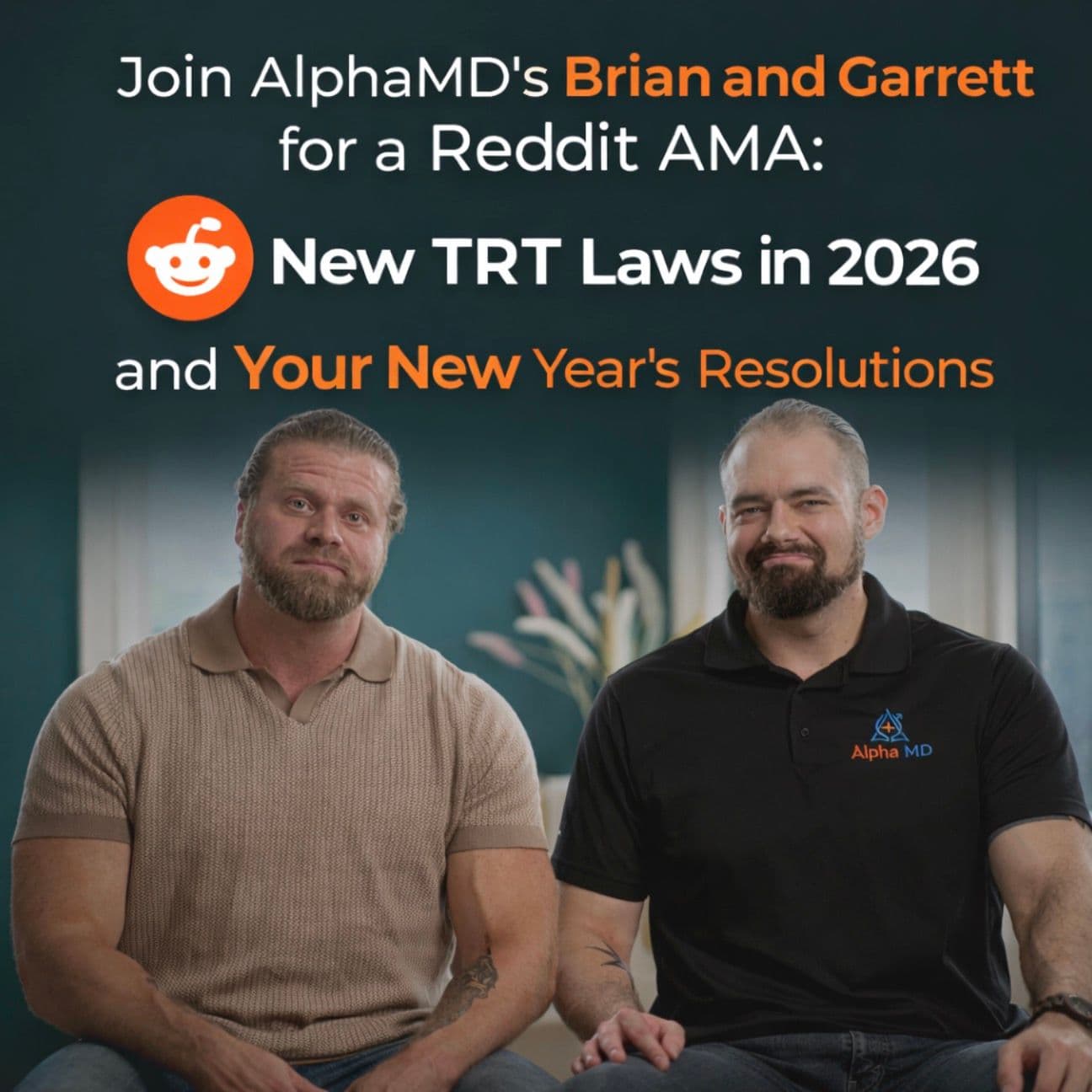
Join AlphaMD's Brian and Garrett for a Reddit AMA: New TRT Laws in 2026 and Your New Year's Resolutions
Published on:
Updated on:
People are asking...
Do you take people who have been on self prescribed TRT? Been on 4 years at 175mg and have been wanting to make the switch....
Yes. Anyone can get started with AlphaMD, regardless of how they started down their individual path — a licensed provider will review your history and current regimen.... See Full Answer
I’m wanting to switch clinics. The quality of care and communication has gone downhill. I am currently being treated and would love to switch to you ...
We’re sorry to hear about your experience with your current provider. Here's how switching to a provider through AlphaMD works if you're on an existing TRT protocol: We would like documentation of you... See Full Answer
As someone who just restarted TRT after 6 months off trying to see if my body would restart, I wish I’d reached out to you guys as well. What is the p...
All that's needed to get started is labs that are less than 12 months old. Transferring over is easy — you'll start with a brief consultation with a licensed provider. You can visit the website AlphaM... See Full Answer
Have a question? Ask us.
At AlphaMD, we're here to help. Feel free to ask us any question you would like about TRT, medical weightloss, ED, or other topics related to men's health. Or take a moment to browse through our past questions.
If you've been following testosterone replacement therapy news, you know that 2025 ended with a bang. The FDA convened a panel in December that could fundamentally reshape how TRT is regulated, prescribed, and accessed in America. And if you've been thinking about starting or optimizing your TRT protocol as part of your 2026 goals, you're not alone.
That's why we're thrilled to announce that AlphaMD is hosting a Reddit AMA (Ask Me Anything) to break down what these regulatory changes mean for you and how to approach TRT as part of your New Year's health resolutions.
When: Saturday, January 3rd at 2PM EST / 11AM PST through Sunday, January 4th at 8PM EST / 5PM PST
Where: r/Testosterone and r/TRT
Why This Timing Matters
The FDA panel that met on December 10th wasn't just another bureaucratic meeting. It was a resounding endorsement of testosterone replacement therapy from a 13-person panel composed primarily of urologists and federal health officials. The experts made it clear: TRT has been significantly underutilized due to outdated concerns about prostate cancer, stroke, and cardiovascular risks.
One panelist, an associate professor of urology at Indiana University School of Medicine, put it bluntly during the panel: "Testosterone is still regulated as if it were a dangerous, performance-enhancing drug from the athletic doping scandals of the 1980s."
This isn't just talk. The panel recommended real, tangible changes that could affect how you access and use testosterone therapy in 2026 and beyond.
What the FDA Panel Actually Recommended
The panel's suggestions were comprehensive and, frankly, overdue. Here's what they're pushing for:
Reclassifying Testosterone as a Non-Controlled Substance
Right now, testosterone is classified as a Schedule 3 controlled substance, putting it in the same category as ketamine. This classification creates significant barriers. Prescriptions must be carefully tracked, some physicians are hesitant to prescribe it, and many pharmacies limit their volume or choose not to carry it at all.
The director of the Male Fertility and Peyronie's Clinic in Utah pointed out that this restrictive classification has inadvertently fueled the rise of "pop-up T clinics" while discouraging primary care physicians, urologists, and endocrinologists from prescribing it to patients who could benefit.
Expanding FDA Approval Guidelines
Currently, the FDA has only approved TRT for men who have both low testosterone levels AND an associated medical condition like a genetic disorder affecting the testicles. The panel suggested expanding approval to include men with low testosterone and any related symptoms, which aligns with the American Urological Association's guidelines.
A panelist from Memorial Sloan Kettering Cancer Center argued that "thousands of patients in need of testosterone therapy have been and are being deprived of it" because of these narrow label restrictions.
Removing Outdated Cardiovascular Warnings
This one's huge. While the FDA had previously flagged reports of strokes and heart attacks in patients taking testosterone, a large clinical trial launched in 2018 found no such risks. In February 2025, the FDA recommended removing the cardiovascular warning from testosterone products, though they did add a new warning about increased blood pressure based on other safety studies.
The science has evolved, and the regulations are finally catching up.
What This Means for You in 2026
If you're currently on TRT or considering starting, these potential changes could have real implications:
Easier Access: If testosterone is reclassified, you might find it easier to get prescriptions filled at your local pharmacy without running into supply issues or pharmacies that simply don't stock it.
More Physician Buy-In: When the regulatory burden decreases and outdated stigma fades, more mainstream healthcare providers may be willing to prescribe and monitor TRT properly rather than leaving it to specialty clinics.
Clearer Qualification Criteria: Expanded approval guidelines could mean that if you have low T and related symptoms like fatigue, low libido, or difficulty building muscle, you may qualify for treatment without needing to prove an underlying medical condition.
Better Information: As the medical community acknowledges that previous cardiovascular concerns were overblown, expect more balanced, science-based conversations about TRT's actual risk-benefit profile.
TRT and Your New Year's Resolutions
January is when gyms fill up, meal prep becomes a national hobby, and men everywhere decide this is the year they finally get their health dialed in. If you're thinking about TRT as part of that equation, you're asking the right questions.
But here's the thing: TRT isn't a magic bullet. As a physician from NYU Langone Health explained, patient experiences vary widely. Some men report no noticeable change. Others say it genuinely transformed their quality of life. Most fall somewhere in the middle, feeling "a little bit better."
Setting realistic expectations is crucial. TRT works best when it's part of a comprehensive approach that includes proper nutrition, consistent training, quality sleep, and stress management. It's not a substitute for those fundamentals, but it can be the missing piece that allows your hard work to pay off.
Join the Conversation
The AMA runs for nearly two full days, giving you plenty of time to jump in with questions whether you're on the East Coast, West Coast, or anywhere in between. The AMA hosts will be monitoring both r/Testosterone and r/TRT, so pick whichever community you're most active in.
This is a rare opportunity to get transparent, informed answers about TRT at a moment when the landscape is genuinely shifting. Whether you're already on protocol and optimizing your approach, considering starting TRT for the first time, or just trying to understand what all the buzz is about, bring your questions.
The best way to start 2026 is with clarity, accurate information, and a plan that actually works for your body and your goals. We'll see you on Reddit this weekend.
Got questions about your testosterone levels or wondering if TRT might be right for you? Through AlphaMD, licensed providers offer comprehensive hormone optimization for men. Visit us at AlphaMD.org to learn more or schedule a consultation with a provider.
Have a question? Ask us.
At AlphaMD, we're here to help. Feel free to ask us any question you would like about TRT, medical weightloss, ED, or other topics related to men's health. Or take a moment to browse through our past questions.
People are asking...
Do you take people who have been on self prescribed TRT? Been on 4 years at 175mg and have been wanting to make the switch....
Yes. Anyone can get started with AlphaMD, regardless of how they started down their individual path — a licensed provider will review your history and current regimen.... See Full Answer
I’m wanting to switch clinics. The quality of care and communication has gone downhill. I am currently being treated and would love to switch to you ...
We’re sorry to hear about your experience with your current provider. Here's how switching to a provider through AlphaMD works if you're on an existing TRT protocol: We would like documentation of you... See Full Answer
As someone who just restarted TRT after 6 months off trying to see if my body would restart, I wish I’d reached out to you guys as well. What is the p...
All that's needed to get started is labs that are less than 12 months old. Transferring over is easy — you'll start with a brief consultation with a licensed provider. You can visit the website AlphaM... See Full Answer
Get $30 off your first month’s order
Enter your email address now to receive $30 off your first month’s cost, other discounts, and additional information about TRT.
Legal Disclaimer
This website is a repository of publicly available information and is not intended to form a physician-patient relationship with any individual. The content of this website is for informational purposes only. The information presented on this website is not intended to take the place of your personal physician's advice and is not intended to diagnose, treat, cure, or prevent any disease. Discuss this information with your own physician or healthcare provider to determine what is right for you. All information is intended for your general knowledge only and is not a substitute for medical advice or treatment for specific medical conditions. The information contained herein is presented in summary form only and intended to provide broad consumer understanding and knowledge. The information should not be considered complete and should not be used in place of a visit, phone or telemedicine call, consultation or advice of your physician or other healthcare provider. Only a qualified physician in your state can determine if you qualify for and should undertake treatment.