
HCG Is Back: How to Restore Testicular Function (And Why It's Not Just Cosmetic)
Published on:
Updated on:
People are asking...
Recently had a massive drop in quality of life over the last 10 months, after being fit all my life and a natural bodybuilder for the last 8 years. ...
So there is this strange rumor that somehow developed that hCG can “kickstart” normal testicular function. I’m not sure where it started other than it used to help restore function in men who suppres... See Full Answer
Is HCG the recommended product to return testicular size when on a TRT regimen?...
Generally yes. There are a few other things that can help, but HCG is going to be the most direct & effective.... See Full Answer
Do you recommend HCG along with TRT? Not for fertility but for other benefits? Like keeping testicle size normal?...
Most providers would be neutral on HCG with TRT if not for fertility. There is no long term side effect from using HCG all the time, so there's not a medical reason to not use it. However there is als... See Full Answer
Have a question? Ask us.
At AlphaMD, we're here to help. Feel free to ask us any question you would like about TRT, medical weightloss, ED, or other topics related to men's health. Or take a moment to browse through our past questions.
If you're on testosterone replacement therapy or thinking about starting, you've probably heard the warnings about testicular shrinkage. But the real concern isn't just about size or appearance, it's about losing critical functions that impact fertility, hormone balance, and how you feel day to day.
Human chorionic gonadotropin, better known as HCG, has emerged as a key tool in modern TRT protocols precisely because it addresses these deeper concerns. While the compound itself isn't new (it's been used in medicine for decades), its role in preserving testicular function during testosterone therapy has shifted from niche practice to mainstream consideration. Understanding why requires a closer look at what actually happens when you introduce exogenous testosterone into your system.
When Your Testes Go Quiet On TRT
Your body runs on feedback loops. When you inject or apply testosterone from an external source, your hypothalamus and pituitary gland sense the elevated hormone levels in your bloodstream. The response is logical from your body's perspective: if testosterone is abundant, there's no need to produce more. Your pituitary stops releasing luteinizing hormone (LH) and follicle-stimulating hormone (FSH), the two signals that tell your testicles to make testosterone and sperm.
Without these signals, your testicles essentially go into standby mode. Testosterone production inside the testes drops significantly. Sperm production slows or stops entirely. The Leydig cells, which manufacture testosterone locally, and the Sertoli cells, which support sperm development, reduce their activity. This is why testicular atrophy happens on TRT. The shrinkage isn't just cosmetic, it reflects a real decline in function.
For some men, this doesn't matter much. They've completed their families, they feel great on TRT, and testicular size isn't a concern. But for others, particularly younger men or those who want to preserve the option of biological children, this shutdown creates a serious dilemma. That's where HCG changes the equation.
What HCG Actually Does
HCG is a hormone most people associate with pregnancy tests. It's produced by the placenta and shares a nearly identical structure with LH, the hormone your pituitary releases to stimulate the testes. Because of this structural similarity, HCG can bind to the same receptors in your testicles that LH would normally activate.
When used alongside TRT, HCG essentially tricks your testicles into behaving as if they're still receiving signals from your pituitary. It stimulates the Leydig cells to continue producing testosterone locally within the testes, and it helps maintain the environment necessary for sperm production. This doesn't mean it fully replicates natural function, but it can preserve much of what would otherwise be lost.
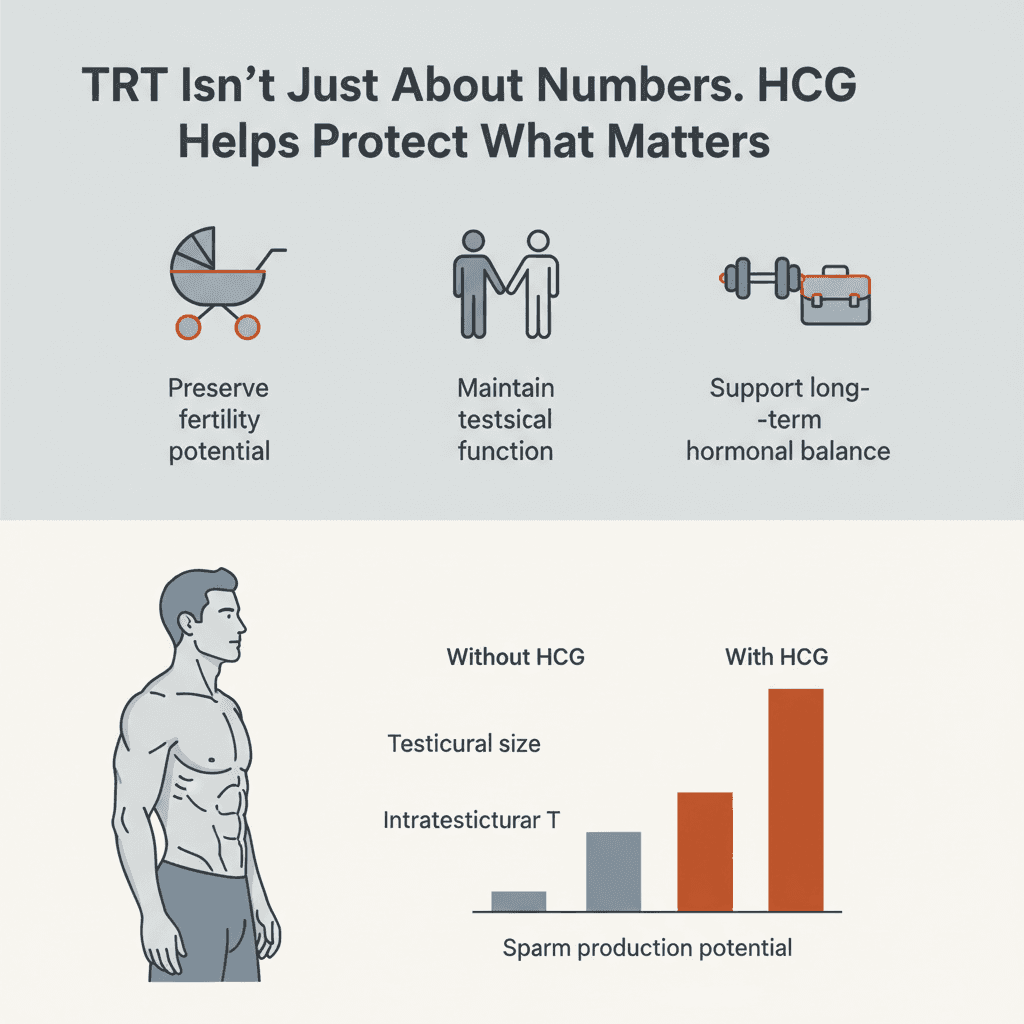
The result is measurable. Men using HCG with their TRT typically maintain testicular size much closer to baseline. More importantly, they maintain intratesticular testosterone levels, which some research suggests may play a role in sexual function, mood, and overall sense of wellbeing that total testosterone alone might not capture.
Why HCG Is More Than A Cosmetic Fix
Let's be direct: plenty of men start researching HCG because they notice their testicles shrinking on TRT, and they don't like how it looks or feels. That's a valid concern. Physical changes to your body matter, especially when they affect something as psychologically charged as your genitals.
But treating HCG as purely cosmetic misses the bigger picture. Intratesticular testosterone, the testosterone produced inside your testes, creates a much higher local concentration than what circulates in your bloodstream. This localized hormone environment appears to influence several processes.
Some men report better libido, stronger erections, or improved sexual sensation when they add HCG to their TRT protocol, even when their total testosterone levels don't change much. The mechanism isn't completely understood, but the working theory involves those high local concentrations of testosterone and possibly other hormones produced in the testes like pregnenolone and DHEA, which serve as precursors to other important compounds.
There's also the psychological element. For many men, testicular atrophy feels like a loss of masculinity or virility, even if rationally they understand it's a side effect of treatment. That psychological impact is real and shouldn't be dismissed. If maintaining testicular size improves your confidence and comfort in your own body, that's a legitimate therapeutic goal.
Fertility, Future Plans, And Tough Choices
Fertility is where HCG becomes non-negotiable for certain men. If you're on TRT and want to conceive, or if you want to keep that door open for the future, HCG needs to be part of the conversation from the start.
TRT alone will suppress sperm production in most men, often to the point of azoospermia (zero sperm count). While this suppression can reverse after stopping TRT, recovery isn't guaranteed, and it can take many months or even longer. For men who haven't completed their families, that's an unacceptable risk.
Using HCG concurrently with TRT helps maintain sperm production, though it doesn't guarantee fertility. Some men will need FSH supplementation as well, since HCG primarily mimics LH and doesn't directly replace FSH's role in sperm maturation. But HCG alone is often enough to keep the testicular machinery running at a level that preserves fertility potential.
If you're already on TRT without HCG and now thinking about having children, adding HCG may help restart sperm production. Response varies widely. Some men see improvement relatively quickly, while others need more aggressive interventions or time off TRT entirely. The earlier you address this, the better your odds.
This is also why age matters in the fertility discussion. A man in his late twenties or early thirties thinking about TRT needs to have a very different conversation about HCG than a man in his fifties. Your clinician should be asking about your family plans before writing a prescription.
The Reality Of Side Effects And Individual Response
HCG isn't a perfect solution, and it doesn't work the same way for everyone. Some men feel great on it. Others experience side effects that make it less appealing or not worth the trade-offs.
The most common issue is estrogen conversion. HCG stimulates testosterone production inside the testes, and some of that testosterone aromatizes into estradiol. For men who are sensitive to elevated estrogen, this can cause issues like water retention, nipple sensitivity, or mood changes. Managing this sometimes requires adjusting other parts of the protocol.
Some men also report that HCG makes them feel overstimulated, anxious, or emotionally volatile. The reasons aren't entirely clear, but individual hormone sensitivity plays a role. Response to HCG can also change over time, so what works initially may need adjustment down the road.
There's also the practical side. HCG requires more frequent injections than testosterone cypionate or enanthate, and it needs to be refrigerated after mixing. For some men, that's no big deal. For others, it's an inconvenience that affects adherence.
Not every man on TRT needs HCG. If you're not concerned about fertility, if you feel great without it, and if testicular atrophy doesn't bother you, adding another medication may not make sense. Treatment should be individualized based on your goals, symptoms, and how your body responds.
Coming Off TRT: The Role Of HCG In Transition
Some men decide TRT isn't for them, or their circumstances change and they want to try coming off. This is where HCG sometimes plays a role in post-cycle therapy or hormonal recovery protocols.
When you stop TRT cold, your natural testosterone production doesn't immediately resume. Your pituitary has been suppressed, sometimes for months or years, and it takes time for the feedback loop to reactivate. During that transition, testosterone levels can drop very low, leading to fatigue, depression, loss of libido, and other difficult symptoms.
HCG can help bridge that gap by stimulating testicular testosterone production even while the pituitary is still waking up. It doesn't fix everything, and recovery protocols often involve other medications as well, but it can make the transition less miserable.
That said, coming off TRT successfully isn't guaranteed, especially for men who had low testosterone to begin with or who've been on treatment for extended periods. Some men find that their natural production never fully recovers, and they end up restarting TRT. This is another reason why the decision to start testosterone should be made carefully and with full information upfront.
What To Ask Your Clinician Before Starting HCG
If you're considering adding HCG to your TRT protocol, or if you're starting TRT and wondering whether HCG should be part of the plan from day one, there are key questions worth asking.
What are your fertility goals, now and in the future? This should drive much of the decision-making. If biological children are important to you and you haven't completed your family, HCG deserves serious consideration.
What symptoms are you trying to address? If you're feeling great on TRT alone, adding HCG may be unnecessary. But if you're experiencing sexual side effects, mood issues, or concerns about testicular atrophy, it might be worth trying.
How will your clinician monitor your response? Effective HCG use requires follow-up labs to check hormone levels, including estradiol, and symptom tracking to see if you're actually benefiting. Cookie-cutter protocols without individualized monitoring rarely work well.
What's the plan if HCG causes side effects or doesn't help? You should know in advance how your clinician will adjust the protocol if things aren't working as expected.
These aren't one-time conversations. Hormone optimization is dynamic. What works at the start of treatment may need adjustment as your body adapts, your goals change, or new information emerges.
Comprehensive Care Means Thinking Beyond Testosterone Alone
The shift toward including HCG in TRT protocols reflects a broader evolution in how men's health is approached. Early TRT practices often focused narrowly on raising testosterone levels and checking a box. Modern approaches recognize that hormonal health is more complex.
Testicular function matters. Fertility potential matters. How you feel subjectively matters, even if the labs look perfect on paper. A good men's health provider takes all of this into account.
This is where services like AlphaMD come into play. On AlphaMD's online men's health platform, providers incorporate considerations like testicular function, fertility goals, and overall symptom relief into individualized treatment plans. The focus isn't just on a testosterone prescription, it's on a protocol that aligns with your specific health objectives and lifestyle. Whether that includes HCG depends on your situation, but having that option on the table, with proper monitoring and support, makes a meaningful difference.
Understanding HCG's role in preserving testicular function isn't about vanity or chasing perfect hormones. It's about making informed decisions that respect your body's complexity and your long-term health goals. Testicular function isn't just about size. It's about fertility, local hormone production, and maintaining physiological processes that contribute to how you feel and function.
For men navigating TRT, whether you're just starting or years into treatment, the question of HCG deserves thoughtful consideration. It's not the right choice for everyone, but for many men, it represents the difference between merely replacing testosterone and truly optimizing hormonal health in a way that protects future options and supports overall wellbeing. That distinction matters more than most people realize until they're facing the consequences of overlooking it.
Have a question? Ask us.
At AlphaMD, we're here to help. Feel free to ask us any question you would like about TRT, medical weightloss, ED, or other topics related to men's health. Or take a moment to browse through our past questions.
People are asking...
Recently had a massive drop in quality of life over the last 10 months, after being fit all my life and a natural bodybuilder for the last 8 years. ...
So there is this strange rumor that somehow developed that hCG can “kickstart” normal testicular function. I’m not sure where it started other than it used to help restore function in men who suppres... See Full Answer
Is HCG the recommended product to return testicular size when on a TRT regimen?...
Generally yes. There are a few other things that can help, but HCG is going to be the most direct & effective.... See Full Answer
Do you recommend HCG along with TRT? Not for fertility but for other benefits? Like keeping testicle size normal?...
Most providers would be neutral on HCG with TRT if not for fertility. There is no long term side effect from using HCG all the time, so there's not a medical reason to not use it. However there is als... See Full Answer
Get $30 off your first month’s order
Enter your email address now to receive $30 off your first month’s cost, other discounts, and additional information about TRT.
Legal Disclaimer
This website is a repository of publicly available information and is not intended to form a physician-patient relationship with any individual. The content of this website is for informational purposes only. The information presented on this website is not intended to take the place of your personal physician's advice and is not intended to diagnose, treat, cure, or prevent any disease. Discuss this information with your own physician or healthcare provider to determine what is right for you. All information is intended for your general knowledge only and is not a substitute for medical advice or treatment for specific medical conditions. The information contained herein is presented in summary form only and intended to provide broad consumer understanding and knowledge. The information should not be considered complete and should not be used in place of a visit, phone or telemedicine call, consultation or advice of your physician or other healthcare provider. Only a qualified physician in your state can determine if you qualify for and should undertake treatment.