
Gonadorelin vs. HCG: The Protocol Upgrade Most TRT Clinics Haven't Adopted Yet
Published on:
Updated on:
People are asking...
So I've been on TRT for 6 months, my clinic doubled my dose when I was at 615 with normal E2 levels then 3 months later. I'm only at like 718 and my E...
You already paid for it, there is no harm in trying it. It’s true, gonadorelin is a poor substitute for hCG, and has little benefit for this purpose, though there may be some while you wait on your ne... See Full Answer
What have you found to be best for fertility with your patients, clomid or something like hcg+fsh? Obviously people react differently on different med...
Generally speaking, providers on the AlphaMD platform have seen more success with hCG. This may have to do with the fact that many patients prefer hCG to clomid. Among patients whose provider added hC... See Full Answer
Why does institutional endocrinology insist on horribly outdated treatment protocols, when modern evidence says they're wrong? eg: I asked my nearly ...
If you don't mind, I will be a bit blunt here because this kind of thing is the reason we started our company, so I hope it doesn't come off as overly rude. Providers, even specialists, are people. ... See Full Answer
Have a question? Ask us.
At AlphaMD, we're here to help. Feel free to ask us any question you would like about TRT, medical weightloss, ED, or other topics related to men's health. Or take a moment to browse through our past questions.
Most men starting testosterone replacement therapy are told they have two options: accept that their natural hormone production will slow down, or add HCG to the protocol. What fewer men hear about is that there is a third path, one that works higher up in the hormonal chain, and it is quietly changing how forward-thinking clinics approach TRT.
Why Testicular Function Still Matters When You're on TRT
Testosterone replacement does exactly what the name suggests. It replaces testosterone. But the body's own production system, a tightly coordinated loop called the hypothalamic-pituitary-gonadal (HPG) axis, does not simply pause while external testosterone does its job. It suppresses.
When the brain detects adequate testosterone circulating in the bloodstream, it dials back the signals that would otherwise tell the testes to produce their own. Over time, this suppression can lead to testicular atrophy, reduced sperm production, and a drop in intratesticular testosterone, the concentrated testosterone environment inside the testes that is essential for sperm development. For men who are not thinking about children, this may feel like a non-issue. For men who want to preserve fertility, plan to conceive in the future, or simply prefer to maintain testicular size and function, it matters quite a bit.
This is not a flaw in TRT. It is a predictable physiological response. The question is what, if anything, to do about it, and that is where gonadorelin and HCG enter the picture.
HCG: The Long-Standing Workaround
Human chorionic gonadotropin, commonly known as HCG, has been used alongside TRT for decades. It earned its place in male hormone protocols because of one key property: it closely mimics luteinizing hormone (LH), one of the two main signals the pituitary gland normally sends to the testes.
In a man with a functioning HPG axis, LH travels from the pituitary to the testes and instructs them to produce testosterone and support sperm development. When TRT suppresses that natural signal, HCG steps in as a substitute. It binds to the same receptors in the testes that LH would, keeping those cells active even when the brain has stopped sending the original message.
The practical effect? Men on HCG alongside TRT often maintain greater testicular volume, preserve some degree of intratesticular testosterone, and retain a more viable environment for sperm production compared to those on TRT alone. HCG has a well-documented track record in both fertility medicine and TRT support, which is why it became the default add-on for men who raised concerns about shutdown.
That said, HCG is not perfect. It bypasses the upper portion of the HPG axis entirely. The hypothalamus and pituitary are not involved. The signal goes straight to the testes, which works, but it does not replicate the natural pulsatile rhythm the body uses, and it carries its own set of considerations.
Gonadorelin: Stimulating the System From the Top
Gonadorelin is a synthetic form of gonadotropin-releasing hormone (GnRH), the signal that originates in the hypothalamus, the brain region sitting at the very top of the HPG axis. Under normal circumstances, the hypothalamus releases GnRH in pulses, prompting the pituitary to release both LH and follicle-stimulating hormone (FSH). FSH is particularly important for sperm production, a role HCG does not fulfill in the same way.
When gonadorelin is administered in a pulsatile pattern, it activates the pituitary gland directly, encouraging the release of both LH and FSH. This is a meaningfully different mechanism. Rather than bypassing the pituitary and speaking directly to the testes, gonadorelin speaks to the pituitary and lets the downstream signaling cascade proceed more naturally.
For men on TRT, this matters because maintaining some degree of pituitary engagement may support a more complete hormonal environment, including FSH-driven support for sperm development. It also means the testes receive stimulation through a pathway that more closely resembles what the body does on its own.
Gonadorelin has been used in clinical contexts for years, primarily in fertility medicine and in diagnosing pituitary function, but its application as a TRT adjunct is a more recent development, and clinical practice around it is still evolving.
Comparing the Two: Where They Differ in Practice
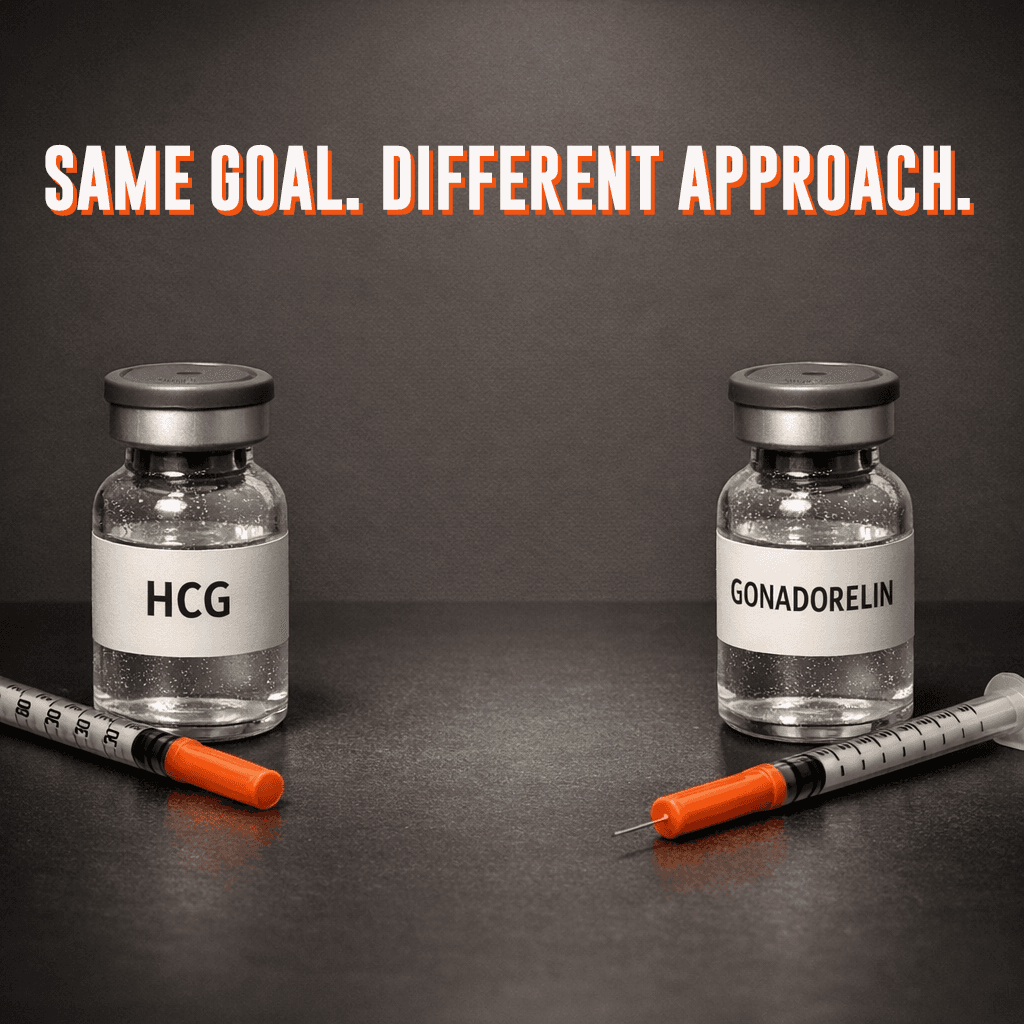
On paper, both gonadorelin and HCG share the same broad goal: maintain testicular function during TRT. In practice, they pursue that goal through different routes, and those differences can matter depending on what a man is actually trying to accomplish.
HCG acts downstream. It substitutes directly for LH at the testicular level. It has decades of clinical data behind it, a well-understood side effect profile, and a relatively straightforward monitoring approach. Its limitations include the fact that it does not stimulate FSH, and some men experience side effects related to the estrogen conversion that can accompany elevated testicular testosterone production. Because HCG has a longer action profile compared to natural LH pulses, the hormonal environment it creates is somewhat different from endogenous signaling.
Gonadorelin acts upstream. By engaging the pituitary, it triggers a more complete gonadotropin release that includes FSH. For men with fertility concerns, particularly those where sperm quality or quantity is a priority, this distinction may be clinically significant. The challenge with gonadorelin is that it must be administered in a way that respects its pulsatile biology. Continuous, non-pulsatile GnRH stimulation actually suppresses the pituitary rather than activating it, which is why dosing frequency and timing are particularly important considerations managed by the prescribing clinician.
From a practical standpoint, HCG has historically had stronger availability and a lower cost, though supply and pricing can fluctuate depending on compounding pharmacy access and broader market conditions. Gonadorelin has faced its own availability shifts in recent years, and cost considerations vary by region and provider. Neither option is universally superior on cost or convenience, and the picture changes over time.
Side effect profiles differ as well. HCG's most commonly discussed considerations include potential mood changes, fluid retention in some individuals, and the estrogen-related effects already mentioned. Gonadorelin's considerations tend to be milder for most men but may include injection site reactions, and because it acts at the pituitary level, its hormonal ripple effects require thoughtful monitoring.
Common Misconceptions Worth Addressing
A persistent misunderstanding is that gonadorelin and HCG are essentially the same thing with different names. They are not. They work at different levels of the axis, involve different mechanisms, and may have meaningfully different implications for fertility outcomes, particularly around FSH and sperm development. Treating them as interchangeable overlooks real biological distinctions.
Another common assumption is that adding either option to a TRT protocol guarantees fertility. This is not accurate. Both HCG and gonadorelin can support the conditions necessary for sperm production, but fertility is a complex outcome influenced by baseline sperm health, duration of TRT use, individual variability, and other factors. Men with active fertility goals should be working with a reproductive specialist alongside their TRT provider, not assuming that any adjunct protocol constitutes a fertility treatment.
Finally, some men entering a TRT conversation believe the only choice is to accept full hormonal shutdown or skip TRT altogether. That framing leaves a lot of clinical nuance on the table. Adjunct protocols exist precisely because the binary of "full replacement or nothing" does not reflect how individualized hormone management actually works.
Who Should Be Having This Conversation With Their Clinician
Not every man on TRT needs to add an adjunct protocol, and not every man who adds one will need the same approach. But certain situations make this conversation particularly worth having.
Men who are actively trying to conceive, or who plan to do so within the next year or two, have the most pressing reason to discuss their options. Sperm production can be affected by TRT relatively quickly in some men, and proactive planning makes a meaningful difference.
Men who have experienced fertility challenges in the past, whether or not TRT was a factor, may benefit from a more thorough workup and a protocol designed with reproductive outcomes explicitly in mind.
Men who notice testicular discomfort, significant size changes, or other physical symptoms during TRT may find that maintaining testicular stimulation addresses those concerns, though this should always be evaluated by a clinician rather than managed with self-directed supplementation.
Finally, men who are simply well-informed and want to understand the full picture of what TRT does to the HPG axis, and what tools exist to modify that picture, deserve a provider who can engage with those questions thoughtfully rather than defaulting to a one-size-fits-all protocol.
Monitoring, Safety, and the Importance of Individualized Care
Both HCG and gonadorelin are prescription medications that belong within a supervised clinical relationship. Neither should be sourced independently or adjusted without clinician guidance. The reason for this is not bureaucratic, it is physiological. Hormonal systems are interconnected, and adjustments in one area predictably affect others. Lab monitoring, symptom tracking, and periodic protocol review are not optional additions to a good TRT plan. They are the plan.
For gonadorelin in particular, the pulsatile nature of its mechanism means that how it is used matters as much as whether it is used. A clinician who understands GnRH physiology and is current on the evolving evidence around gonadorelin in TRT settings is better positioned to use it effectively.
The broader point is that clinical research in this space is still developing. Long-term comparative data between gonadorelin and HCG specifically in TRT populations is limited, and recommendations will continue to be refined. That is not a reason for alarm. It is a reason to stay engaged with a provider who tracks the evidence and adjusts accordingly, rather than locking into a protocol and never revisiting it.
Upstream vs. Downstream: Why the Distinction Changes the Conversation
TRT is not a single protocol. It is a framework that can be adapted, refined, and personalized based on what a man actually wants from his health and his life. The difference between HCG and gonadorelin is ultimately a difference between two philosophies of intervention: one that speaks directly to the testes, and one that engages the pituitary and lets the cascade proceed with more of its natural architecture intact.
Neither is universally better. Both have legitimate roles. And yet the majority of TRT clinics still default to HCG without ever introducing the gonadorelin conversation, often because protocols are standardized rather than individualized, or because providers are less familiar with the upstream option.
Understanding that distinction, knowing there is both a downstream and an upstream approach to preserving HPG axis function during TRT, gives men the vocabulary to ask better questions and expect more complete answers from their care team. AlphaMD was built to make exactly this kind of individualized approach accessible, connecting men with providers who consider not just what TRT to start, but how to optimize it thoughtfully over time with proper monitoring and protocols that match the person, not just the diagnosis.
Have a question? Ask us.
At AlphaMD, we're here to help. Feel free to ask us any question you would like about TRT, medical weightloss, ED, or other topics related to men's health. Or take a moment to browse through our past questions.
People are asking...
So I've been on TRT for 6 months, my clinic doubled my dose when I was at 615 with normal E2 levels then 3 months later. I'm only at like 718 and my E...
You already paid for it, there is no harm in trying it. It’s true, gonadorelin is a poor substitute for hCG, and has little benefit for this purpose, though there may be some while you wait on your ne... See Full Answer
What have you found to be best for fertility with your patients, clomid or something like hcg+fsh? Obviously people react differently on different med...
Generally speaking, providers on the AlphaMD platform have seen more success with hCG. This may have to do with the fact that many patients prefer hCG to clomid. Among patients whose provider added hC... See Full Answer
Why does institutional endocrinology insist on horribly outdated treatment protocols, when modern evidence says they're wrong? eg: I asked my nearly ...
If you don't mind, I will be a bit blunt here because this kind of thing is the reason we started our company, so I hope it doesn't come off as overly rude. Providers, even specialists, are people. ... See Full Answer
Get $30 off your first month’s order
Enter your email address now to receive $30 off your first month’s cost, other discounts, and additional information about TRT.
Legal Disclaimer
This website is a repository of publicly available information and is not intended to form a physician-patient relationship with any individual. The content of this website is for informational purposes only. The information presented on this website is not intended to take the place of your personal physician's advice and is not intended to diagnose, treat, cure, or prevent any disease. Discuss this information with your own physician or healthcare provider to determine what is right for you. All information is intended for your general knowledge only and is not a substitute for medical advice or treatment for specific medical conditions. The information contained herein is presented in summary form only and intended to provide broad consumer understanding and knowledge. The information should not be considered complete and should not be used in place of a visit, phone or telemedicine call, consultation or advice of your physician or other healthcare provider. Only a qualified physician in your state can determine if you qualify for and should undertake treatment.