
Daily Injections Sound Crazy Until You Try Them
Published on:
Updated on:
People are asking...
What’s your opinion on more frequent inflections, same weekly dose? I think there was a pretty big study in the ik about levels being more stable with...
We are definitely fans of more frequent injections. It makes for less of a difference between the highs and lows, which generally means fewer side-effects. The only real downside to daily injections i... See Full Answer
I am taking .2 ml a day of 200 mg/ml sub q. Would there be a benefit of doubling that and taking every other day? Would that allow some fluctuations o...
Most men do just fine with twice weekly injections and don’t notice the fluctuations. If you feel good now, then the “if it ain’t broke don’t fix it” approach works best. Though needle fatigue is a re... See Full Answer
For someone who is new to this topic, yet interested in TRT if needed, would a pill or topical form be a reliable method of TRT? I have no experienc...
In general oral medications tend to be the least successful with the most amount of side effects. Topical or injectable medications are more direct applications of Testosterone & much better for bene... See Full Answer
Have a question? Ask us.
At AlphaMD, we're here to help. Feel free to ask us any question you would like about TRT, medical weightloss, ED, or other topics related to men's health. Or take a moment to browse through our past questions.
When someone first mentions daily testosterone injections, most men picture a never-ending medical routine that sounds exhausting, painful, and frankly a little obsessive. But ask anyone who has actually made the switch from weekly or biweekly protocols to a daily schedule, and you will often hear a completely different story, one where the daily approach feels easier, more stable, and surprisingly simple once the initial mental hurdle is cleared.
The reality is that injection frequency matters more than most people realize when it comes to testosterone replacement therapy. How often you dose can influence everything from how you feel day to day, to the side effects you experience, to how well your body maintains stable hormone levels. While daily injections might sound like overkill at first, understanding the science and practical experience behind this approach often changes the conversation entirely.
Why The Idea Of Daily Shots Freaks People Out
Let's be honest. The thought of sticking a needle in your body every single day feels extreme. For most men hearing about this option for the first time, the immediate reaction is skepticism mixed with a bit of dread. Needle anxiety is real, and even if you are not particularly squeamish, the idea of adding a daily medical task to your routine can feel overwhelming.
There is also the commitment factor. Weekly injections already feel like a regular obligation, but daily? That sounds like you are signing up to be a full-time patient. The mental image many men have is clinical, complicated, and time-consuming. They picture lengthy preparation, significant pain, and a lifestyle that revolves around medication schedules. It is no wonder the default reaction is often, "That sounds crazy."
Misconceptions about pain and difficulty also play a role. Many men assume that more frequent injections mean more pain, more scar tissue buildup, and more opportunities for something to go wrong. If you have only ever experienced larger intramuscular injections done weekly or biweekly, the idea of doing something similar every day understandably sounds like a recipe for discomfort and burnout.
The Surprising Reality Once You Try It
What changes the game for most men is the actual experience, which tends to be radically different from what they imagined. Daily injections typically involve much smaller volumes of testosterone compared to weekly or biweekly dosing. Smaller volumes mean smaller needles, less discomfort, and faster injection times. Many men using daily protocols report that the entire process, from prep to finish, takes less than a minute once they get the hang of it.
Subcutaneous injections, which are commonly used for daily dosing, involve injecting into the fatty tissue just under the skin rather than deep into the muscle. This method is generally less painful than intramuscular injections and can be done with very short, thin needles. The injection sites are easier to access, the technique is simpler, and the recovery is virtually nonexistent. For many men, the physical sensation is barely noticeable, often described as less uncomfortable than a quick pinch.
The mental shift happens quickly too. What feels daunting on day one often becomes routine by the end of the first week. Humans are remarkably good at adapting to new habits, especially when those habits deliver tangible benefits. Once the injections become part of a daily routine, like brushing your teeth or taking a morning vitamin, the act itself fades into the background. The anxiety that felt so significant beforehand often evaporates with familiarity.
Hormone Stability Is The Key Advantage
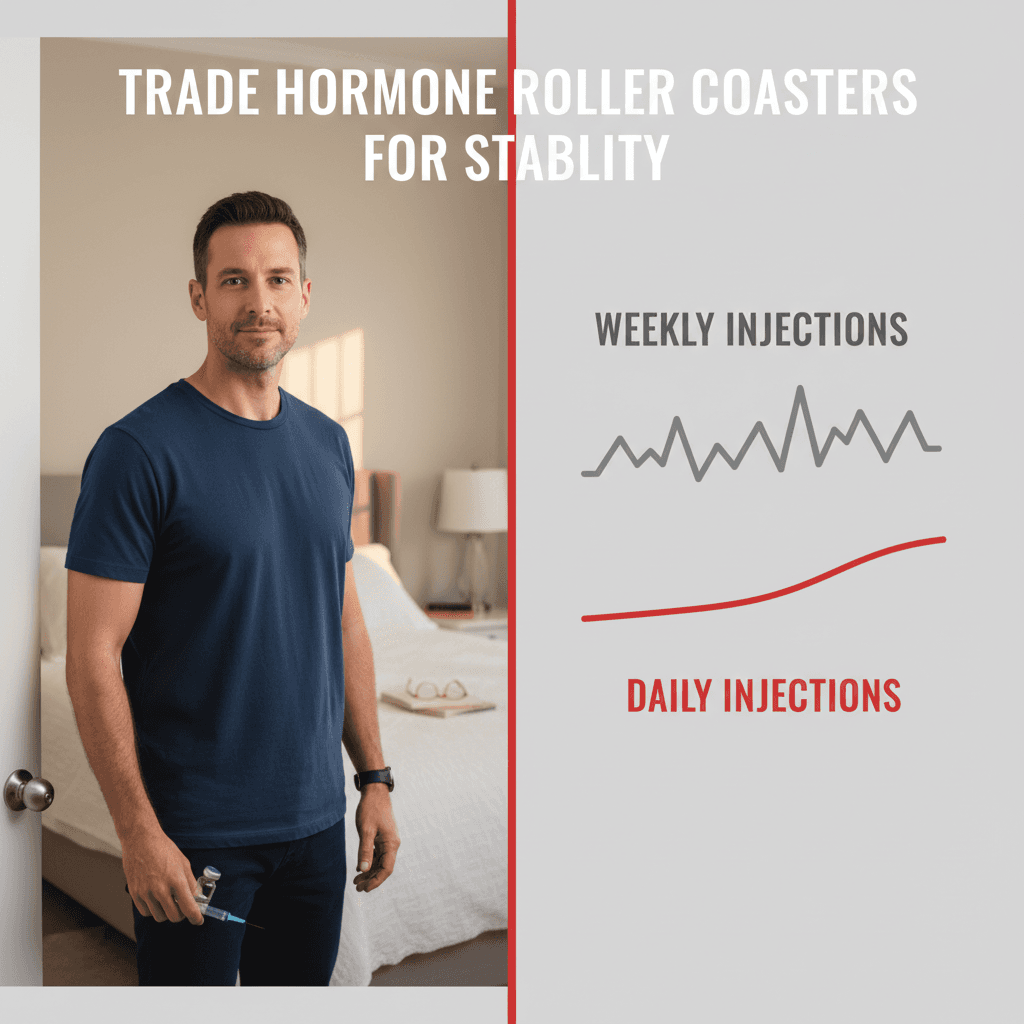
The biggest reason men stick with daily injections once they try them is not convenience or ease, it is how they feel. Testosterone levels fluctuate based on when and how you dose. With weekly or biweekly injections, you typically experience a spike shortly after the injection, followed by a gradual decline until the next dose. For some men, this rollercoaster is barely noticeable. For others, it creates a pattern of feeling great for a few days, then experiencing fatigue, mood changes, or other symptoms as levels drop.
Daily injections smooth out these peaks and valleys significantly. By delivering smaller amounts of testosterone more frequently, your body maintains more consistent hormone levels throughout the week. This stability often translates to more predictable energy, mood, and overall well-being. Many men report feeling more even-keeled, with fewer fluctuations in libido, motivation, or mental clarity.
Stable hormone levels can also reduce the likelihood of certain side effects. Spikes in testosterone can sometimes trigger increased estrogen conversion, leading to issues like water retention or mood swings. More frequent dosing tends to minimize these spikes, which can make managing estrogen and other downstream hormones easier. While everyone's body responds differently, the principle of steady dosing leading to steadier outcomes holds true for many patients.
Common Myths Versus Actual Experience
One persistent myth is that daily injections lead to excessive scar tissue or injection site damage. In reality, rotating injection sites and using proper technique minimizes this risk significantly. Subcutaneous injections spread across multiple areas, such as the abdomen or thighs, allow plenty of time for each site to recover between uses. Most men who follow basic hygiene and rotation practices experience no issues with scar tissue buildup.
Another misconception is that daily injections are too complicated for the average person to manage safely at home. While self-injection does require some initial education and practice, it is not a complex medical procedure. Most patients become comfortable with the process after their first few attempts, especially with guidance from their healthcare provider. The learning curve is shorter than most people expect.
There is also a belief that daily dosing is only for bodybuilders or extreme athletes, not for regular men on therapeutic testosterone replacement. This is outdated thinking. Daily and more frequent dosing protocols have become increasingly popular in mainstream TRT practices because of the physiological benefits and patient satisfaction, not because they are somehow more hardcore. The approach is about optimizing treatment outcomes, not about intensity for its own sake.
Building The Routine And Making It Stick
Routine is everything when it comes to daily injections. The men who find this approach easiest are the ones who anchor it to an existing habit. Some prefer injecting first thing in the morning, others right before bed. The specific timing matters less than the consistency. Pairing the injection with something you already do every day, like your morning coffee or evening shower, helps cement the habit.
Preparation also gets faster with practice. Initially, gathering supplies, prepping the injection site, and going through each step might take several minutes. Within a week or two, most men can complete the entire process in under a minute without thinking much about it. The efficiency comes naturally as the movements become automatic.
Travel and lifestyle flexibility can actually improve with daily injections compared to weekly protocols. Carrying a small supply of syringes and medication is straightforward, and missing a single day is generally less impactful than missing a weekly dose. While consistency is still important, the smaller individual doses mean that occasional schedule adjustments are easier to manage without dramatic effects on how you feel.
What Patients Worry About Before Starting
Before switching to daily injections, most patients share predictable concerns with their doctors. Pain and discomfort top the list, followed closely by time commitment and the fear of doing something wrong. These worries are valid and worth addressing openly.
Clinicians who recommend daily protocols typically emphasize the smaller needle size and lower injection volume as key differences. They may demonstrate the technique in the office or provide video resources so patients can see exactly what the process looks like. Seeing that the needle is often shorter and thinner than expected, and that the injection itself is quick, helps calm a lot of nerves.
Another common worry is what happens if you miss a dose or make a mistake. The answer is usually reassuring: missing a single daily dose is not a catastrophe. Hormone levels do not crash overnight, and most men will not notice a significant difference from skipping one injection. If a mistake happens, such as an injection that does not go smoothly, patients are encouraged to contact their provider for guidance rather than panicking. Mistakes are part of the learning process and are rarely serious.
Safety and hygiene questions also come up frequently. Patients want to know about proper disposal of needles, how to store medication, and how to keep injection sites clean. These are all straightforward topics that providers cover during initial education. Using sharps containers for disposal, storing testosterone according to label instructions, and cleaning the injection site with alcohol before each injection are simple practices that keep the process safe and hygienic.
The Importance Of Individualized Care
Daily injections are not the right choice for everyone, and that is an important point. Some men do perfectly fine on weekly or biweekly schedules and prefer the simplicity of fewer injections. Others find that gels, patches, or even pellets better fit their lifestyle and physiology. The goal of testosterone replacement therapy is not to follow a trendy protocol but to find the approach that works best for your body, your schedule, and your health goals.
Working with a knowledgeable healthcare provider is essential. They can help you understand the trade-offs between different dosing schedules, monitor your response through regular lab work, and adjust your treatment plan as needed. What works in the first few months might need tweaking later as your body adapts or as your lifestyle changes. Testosterone replacement is not a set it and forget it therapy. It requires ongoing communication and adjustment.
Some men start with weekly injections and later switch to daily dosing after experiencing the benefits of more stable levels. Others try daily injections first and decide the routine does not fit their life, opting instead for a less frequent schedule. Both paths are valid. The key is being open to experimentation and honest communication with your provider about how you are feeling and what is or is not working.
When The Needle Becomes Normal
One of the most striking transformations men report is how quickly the needle itself stops being a big deal. What felt scary or unnatural in the beginning becomes completely mundane within a few weeks. The anticipation is almost always worse than the reality. Once you realize that the actual injection is fast, relatively painless, and easy to control, the psychological barrier drops away.
This normalization extends beyond just the physical act. Many men describe feeling more in control of their treatment when they are dosing daily. There is something empowering about taking an active role in your health on a daily basis, rather than relying on weekly or biweekly administration. It shifts the relationship with the therapy from something that happens to you to something you actively manage.
That sense of control and routine often spills over into other areas of health. Men who commit to daily injections frequently report being more consistent with exercise, nutrition, and other wellness habits. Whether this is a direct result of the injection routine or simply a byproduct of being more engaged with their health overall is hard to say, but the pattern is common enough to be noteworthy.
Making The Decision That Works For You
Choosing a TRT protocol is a personal decision that should be made with professional guidance and a clear understanding of your own priorities. If the idea of daily injections still sounds overwhelming, that is completely reasonable. Start with a protocol that feels manageable and revisit the option later if your needs or preferences change. On the other hand, if you are intrigued by the potential for more stable hormone levels and you are willing to commit to a daily routine, it might be worth a trial period to see how your body responds.
Many men find that the benefits outweigh the initial discomfort of adapting to a new routine. Improved energy, more stable mood, better symptom control, and fewer side effects are powerful motivators. Once those improvements become clear, the daily injection routine stops feeling like a burden and starts feeling like a small price to pay for feeling significantly better.
Services like AlphaMD focus on helping men navigate these decisions with education, support, and easy access to individualized care. Whether you are exploring TRT for the first time or looking to optimize an existing protocol, having access to experienced providers who understand the nuances of different dosing schedules can make all the difference. The goal is not to push one approach over another but to find the right fit for your unique situation, and that often means experimenting with different methods until you find what works.
Daily injections might sound crazy at first. Most things that challenge our assumptions do. But for many men, the experience of trying them reveals a different reality, one where the routine is manageable, the benefits are real, and the initial fear gives way to confidence and consistency. What sounds extreme in theory often becomes the most natural choice in practice.
Have a question? Ask us.
At AlphaMD, we're here to help. Feel free to ask us any question you would like about TRT, medical weightloss, ED, or other topics related to men's health. Or take a moment to browse through our past questions.
People are asking...
What’s your opinion on more frequent inflections, same weekly dose? I think there was a pretty big study in the ik about levels being more stable with...
We are definitely fans of more frequent injections. It makes for less of a difference between the highs and lows, which generally means fewer side-effects. The only real downside to daily injections i... See Full Answer
I am taking .2 ml a day of 200 mg/ml sub q. Would there be a benefit of doubling that and taking every other day? Would that allow some fluctuations o...
Most men do just fine with twice weekly injections and don’t notice the fluctuations. If you feel good now, then the “if it ain’t broke don’t fix it” approach works best. Though needle fatigue is a re... See Full Answer
For someone who is new to this topic, yet interested in TRT if needed, would a pill or topical form be a reliable method of TRT? I have no experienc...
In general oral medications tend to be the least successful with the most amount of side effects. Topical or injectable medications are more direct applications of Testosterone & much better for bene... See Full Answer
Get $30 off your first month’s order
Enter your email address now to receive $30 off your first month’s cost, other discounts, and additional information about TRT.
Legal Disclaimer
This website is a repository of publicly available information and is not intended to form a physician-patient relationship with any individual. The content of this website is for informational purposes only. The information presented on this website is not intended to take the place of your personal physician's advice and is not intended to diagnose, treat, cure, or prevent any disease. Discuss this information with your own physician or healthcare provider to determine what is right for you. All information is intended for your general knowledge only and is not a substitute for medical advice or treatment for specific medical conditions. The information contained herein is presented in summary form only and intended to provide broad consumer understanding and knowledge. The information should not be considered complete and should not be used in place of a visit, phone or telemedicine call, consultation or advice of your physician or other healthcare provider. Only a qualified physician in your state can determine if you qualify for and should undertake treatment.