
Can You Stay Fertile on TRT? The HCG Protocol Your Clinic Didn't Mention
Published on:
Updated on:
People are asking...
I started trt few months back and been prescribed Enclomiphene 25mg twice weekly. I was wondering if I added HCG to that protocol to help keep fertili...
Are you saying that you're on Testosterone injections & Enclomiphene at the same time? Either way, if you're trying to have a child now or within the next 6 months, HCG can be a fine route to go — som... See Full Answer
I've been in TRT for near 10 years. No HCG as wife said no kids. Now she wants a child. Can I stay on my trt and add HCG? Or best to come off? I don...
It depends on your timeline. If there is any rush, the fastest route to fertility is quitting TRT. However, it only takes the majority of men 90-120 days after initiating hCG to their TRT protocol to ... See Full Answer
I still want to have kids and want to avoid anything that could possibly shut me down all together. Which treatment is best for me ?...
It depends on when you want to have children. If your intent is to conceive in the next 12 months, you should choose hCG alone or a SERM like enclomiphene. These will maintain or even likely increase ... See Full Answer
Have a question? Ask us.
At AlphaMD, we're here to help. Feel free to ask us any question you would like about TRT, medical weightloss, ED, or other topics related to men's health. Or take a moment to browse through our past questions.
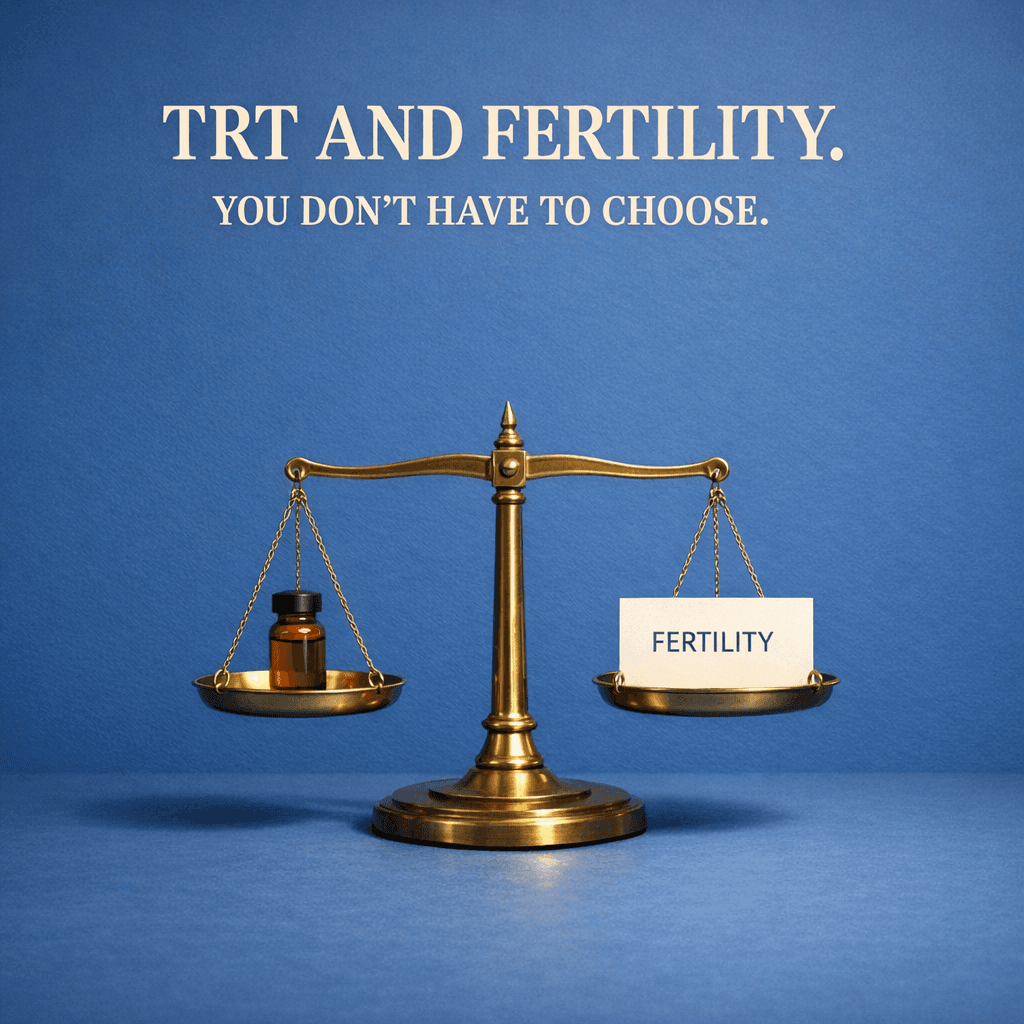
Most men starting testosterone replacement therapy are told what it will do for their energy, libido, and mood. Very few are told what it might do to their fertility - and that omission can have consequences that last years.
If you are on TRT or considering it, and fatherhood is anywhere on your horizon, this article is for you.
What TRT Actually Does to Your Body's Fertility System
Testosterone replacement therapy works by supplying your body with external testosterone. That sounds straightforward, but your body is always listening. The hypothalamic-pituitary-testicular (HPT) axis - the communication chain between your brain and your testicles - is designed to respond to circulating testosterone levels. When it detects enough testosterone in the bloodstream, it scales back its own signals.
Those signals are luteinizing hormone (LH) and follicle-stimulating hormone (FSH). LH normally tells the testicles to produce testosterone locally, inside the testes, at concentrations far higher than what exists in the bloodstream. FSH drives sperm production directly. When TRT suppresses LH and FSH, both of those processes slow down or, in many cases, stop.
The result is that the testicles themselves become less active. They may shrink noticeably. More importantly, sperm production - which depends on both high intratesticular testosterone and adequate FSH signaling - can decline dramatically, sometimes to zero.
This is not a rare side effect. It is a predictable physiological consequence of how TRT interacts with the HPT axis. And yet many men starting TRT are never warned about it.
Why Your Clinic May Have Skipped This Conversation
There are a few reasons this conversation gets missed. Some clinics operate with a narrow treatment focus and simply do not screen for reproductive goals. Others assume that a patient who is not actively trying to conceive does not need to think about fertility. Some practitioners are not well-versed in fertility-preserving protocols and default to the simplest version of TRT management.
It is also worth acknowledging that the fertility conversation takes time. A brief telehealth visit focused on fatigue and low libido does not always leave room for a nuanced discussion about the HPT axis and sperm banking.
None of this is meant to assign blame. It is meant to encourage you to bring this topic up yourself, because no one else may raise it on your behalf.
The Hormone Most Men on TRT Have Never Heard Of
Human chorionic gonadotropin, better known as hCG, is a hormone that mimics LH in the body. It binds to the same receptors on the testicles that LH would normally activate, signaling those cells to keep functioning even when the brain has stopped sending LH due to TRT suppression.
When used alongside TRT, hCG essentially steps in to fill the gap left by suppressed LH. By keeping the testicles stimulated, it can help maintain intratesticular testosterone production, preserve testicular size, and - critically for fertility - support the environment needed for sperm production to continue.
This is not a fringe approach. hCG has been used in male hormone medicine for decades, both as a standalone therapy and as an adjunct to TRT. Many men's health specialists consider it a standard part of fertility-conscious TRT protocols. The fact that it is not universally offered says more about variation in clinical practice than it does about the strength of the concept.
hCG is typically administered by injection, which adds a step to your routine. It requires a prescription and should be managed by a clinician who can monitor your response and adjust accordingly.
What hCG Can and Cannot Promise You
This is where expectations need to be grounded in reality.
hCG does not guarantee fertility. It creates conditions that may support sperm production, but whether that translates into healthy sperm in meaningful quantities depends on many individual factors - your baseline fertility before TRT, how long you have been on TRT, your age, your testicular function, and more.
Some men on a TRT-plus-hCG protocol maintain sperm counts that are compatible with natural conception. Others see improvement but not full restoration. Others see limited response. There is no way to know which category you fall into without actually testing.
The meaningful measure here is a semen analysis, not how you feel, and not your testosterone number. A man can feel fantastic and have a testosterone level well within normal range while having a sperm count close to zero. Fertility is invisible from the outside. Only laboratory testing tells the real story.
Timelines also vary. For men who stop TRT and want to recover fertility entirely, the process can take many months - sometimes well over a year. For men trying to maintain fertility while staying on TRT, hCG changes the equation but does not eliminate the need for patience and monitoring.
Who Should Be Having This Conversation Right Now
Not every man on TRT needs to think about this urgently. But some do, and they may not realize it.
Consider a man in his early thirties - call him Marcus - who started TRT two years ago for fatigue and low motivation. At the time, he was single and had no immediate plans for children. Now he is engaged and his partner wants to start a family within the next year. Marcus never had a fertility conversation with his prescribing clinic, and he assumes that because his testosterone levels are "in range," everything is fine. It is not a safe assumption.
Or consider a man in his mid-forties who has two children already but is uncertain whether he wants more. He figures fertility is not a concern. But if his situation changes in two years, starting TRT without any preservation strategy now means a much longer road back.
The men who should be most actively discussing fertility-conscious TRT include those who plan to try to conceive within the next one to three years, those who are uncertain about their future family plans, those with a prior history of fertility issues or low sperm count, and younger men who have a long treatment horizon ahead of them.
If any of those descriptions fit, the conversation needs to happen before assumptions pile up.
What a Fertility-Friendly TRT Plan Might Actually Look Like
A clinician managing TRT with fertility in mind will approach your care differently than one focused only on symptom management.
Before starting TRT, a fertility-conscious provider may recommend a baseline semen analysis so there is a reference point. They will ask about your family planning goals directly. They may discuss the option of sperm banking as a form of insurance, particularly for men who want absolute certainty before starting any suppressive therapy.
If TRT is initiated, hCG may be incorporated from the start rather than added later as a corrective measure. Ongoing monitoring may include periodic semen analyses, hormone panels that look beyond just total testosterone, and symptom check-ins that account for the effects of adding hCG to the picture.
Other options may also enter the conversation. Selective estrogen receptor modulators (SERMs) such as clomiphene or enclomiphene work differently from TRT - they stimulate the body's own hormone production rather than replacing it - and some clinicians use them as alternatives or bridges for men where fertility preservation is a priority. FSH therapy is another tool that some specialists employ when sperm production needs more direct support. These are clinician-directed decisions that depend on your specific profile, and they are mentioned here to help you know the questions worth asking.
The Side Effects and Tradeoffs Worth Knowing About
Adding hCG to a TRT protocol is not without its own considerations. Because hCG stimulates testicular activity, it can also increase estrogen production, since the testicles convert some testosterone into estrogen as part of normal activity. For some men, this means estrogen-related symptoms can become more noticeable - water retention, mood shifts, breast tissue sensitivity, or in some cases gynecomastia (development of glandular breast tissue).
Acne can worsen for some men when hCG is added. Testicular discomfort or achiness is occasionally reported, particularly early in use. And practically speaking, adding hCG means adding another injection to your routine, which matters for men who already find the injection schedule demanding.
None of these tradeoffs are reasons to avoid hCG if fertility preservation is important to you. They are reasons to be monitored properly and to have an open line of communication with your provider about how you are responding.
Questions to Bring to Your Next Appointment
Walking into a clinical conversation prepared makes a real difference. If you are currently on TRT and fertility has never come up, consider asking your provider directly: Has my TRT affected my sperm production? Should we do a semen analysis? Is hCG appropriate for my situation? What does my fertility window realistically look like given how long I have been on treatment?
If you are just starting TRT, ask before your first dose: What will this do to my fertility? What are my options for preserving it? Should I bank sperm before we begin?
A good provider will not be put off by these questions. They will welcome them.
Fertility on TRT Is Not a Guarantee - But It Is Often a Possibility
The takeaway here is not that TRT is incompatible with fatherhood. Many men successfully maintain sperm production while on TRT, particularly with a thoughtful protocol that includes hCG and appropriate monitoring. The path is more complex than TRT alone, but it is a path that exists.
What matters is that the conversation happens early, that the right testing is in place, and that your care team understands your goals - not just your lab numbers.
Through AlphaMD, you can connect with providers who take exactly this kind of individualized approach to men's health, navigating TRT in a way that accounts for the full picture, including fertility. If you have been on TRT and this topic has never come up, it may be time to find a provider who will take it seriously.
Have a question? Ask us.
At AlphaMD, we're here to help. Feel free to ask us any question you would like about TRT, medical weightloss, ED, or other topics related to men's health. Or take a moment to browse through our past questions.
People are asking...
I started trt few months back and been prescribed Enclomiphene 25mg twice weekly. I was wondering if I added HCG to that protocol to help keep fertili...
Are you saying that you're on Testosterone injections & Enclomiphene at the same time? Either way, if you're trying to have a child now or within the next 6 months, HCG can be a fine route to go — som... See Full Answer
I've been in TRT for near 10 years. No HCG as wife said no kids. Now she wants a child. Can I stay on my trt and add HCG? Or best to come off? I don...
It depends on your timeline. If there is any rush, the fastest route to fertility is quitting TRT. However, it only takes the majority of men 90-120 days after initiating hCG to their TRT protocol to ... See Full Answer
I still want to have kids and want to avoid anything that could possibly shut me down all together. Which treatment is best for me ?...
It depends on when you want to have children. If your intent is to conceive in the next 12 months, you should choose hCG alone or a SERM like enclomiphene. These will maintain or even likely increase ... See Full Answer
Get $30 off your first month’s order
Enter your email address now to receive $30 off your first month’s cost, other discounts, and additional information about TRT.
Legal Disclaimer
This website is a repository of publicly available information and is not intended to form a physician-patient relationship with any individual. The content of this website is for informational purposes only. The information presented on this website is not intended to take the place of your personal physician's advice and is not intended to diagnose, treat, cure, or prevent any disease. Discuss this information with your own physician or healthcare provider to determine what is right for you. All information is intended for your general knowledge only and is not a substitute for medical advice or treatment for specific medical conditions. The information contained herein is presented in summary form only and intended to provide broad consumer understanding and knowledge. The information should not be considered complete and should not be used in place of a visit, phone or telemedicine call, consultation or advice of your physician or other healthcare provider. Only a qualified physician in your state can determine if you qualify for and should undertake treatment.