
7 Health Problems That Develop When Low T Goes Untreated
Published on:
Updated on:
People are asking...
I'm 37. I went to a clinic with my complaints and a hormonal test was done: Fsh 2.69mIU/mL Lh 7.28mIU/mL Prolactin 3.95ng/mL Testosterone 18.0nmol...
Your doctors didn’t lie in saying your labs don’t show anything abnormal. But they won’t always because what is “normal” is based on population averages, not what is normal for you. There is a new di... See Full Answer
Hi, I’m 25 years old. Test is 404. I work out 5 days per week, am pretty lean and fit and healthy I had previously considered TRT but ultimately turn...
A few things to note: You may have relative hypogonadism where your numbers just being low aren't the main factor to determine treatment. 400 would be within that range. You will lose Testosterone ove... See Full Answer
Is any symptom considered more relevant for TRT than others? I.e. low libido versus ED versus muscular issues...
Some symptoms are more directly treated by TRT than others, and that makes them more relevant to diagnose it. Low energy, low libido, difficulty losing fat, difficulty gaining muscle, ED, body aches, ... See Full Answer
Have a question? Ask us.
At AlphaMD, we're here to help. Feel free to ask us any question you would like about TRT, medical weightloss, ED, or other topics related to men's health. Or take a moment to browse through our past questions.
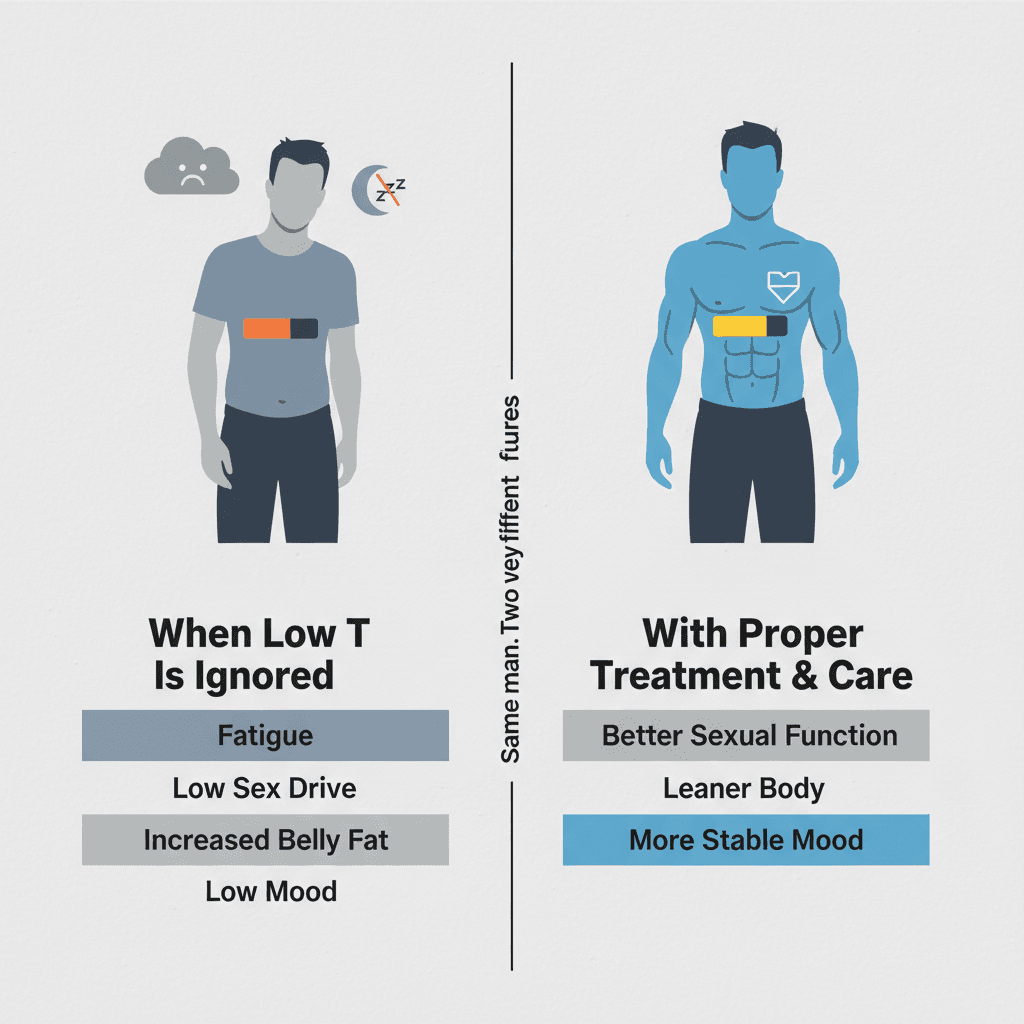
Low testosterone doesn't announce itself with a single dramatic moment. Instead, it quietly chips away at your health, energy, and quality of life, often in ways that feel so gradual you might not connect the dots until years have passed.
Many men dismiss the early signs as just getting older or being stressed at work. They push through the fatigue, accept the weight gain, and assume the bedroom struggles are temporary. But when low testosterone goes untreated, it doesn't stay confined to one area of your life. It creates a cascade of health problems that reach far beyond what most men expect, affecting everything from your heart to your bones, your mood to your metabolism.
Understanding what happens when low T remains unaddressed isn't about fear. It's about recognizing that these changes are real, treatable, and worth taking seriously. Let's walk through seven significant health problems that can develop when low testosterone is left to linger without proper attention.
When the Bedroom Becomes a Source of Stress
Sexual health issues are often the first red flag that brings men to consider whether something's off with their testosterone. It starts subtly: maybe you're not thinking about sex as much, or when the opportunity arises, your body doesn't respond the way it used to.
Testosterone plays a central role in sexual desire and function. When levels drop and stay low, many men experience persistent erectile difficulties, reduced libido, and less satisfying sexual experiences overall. This isn't just about physical mechanics. The psychological weight of ongoing sexual health struggles can create anxiety, strain relationships, and chip away at self-confidence in ways that extend well beyond the bedroom.
Over time, untreated low testosterone can make these issues more entrenched. What might have been responsive to lifestyle changes early on becomes a chronic pattern that affects intimacy, relationship quality, and overall life satisfaction. The longer these problems persist without addressing the underlying hormonal imbalance, the more complex the solution may become.
The Energy Drain That Never Quite Lifts
Fatigue from low testosterone isn't the same as feeling tired after a hard workout or a long day. It's a pervasive, unexplained exhaustion that doesn't improve with rest. You wake up feeling drained, struggle through the afternoon, and find yourself lacking the drive to do things you used to enjoy.
Testosterone influences energy production at a cellular level and affects motivation and drive. When it's chronically low, your body simply doesn't generate energy the way it should. This persistent fatigue becomes self-reinforcing: you're too tired to exercise, which leads to further physical deconditioning, which makes you even more tired.
Men often cope by loading up on caffeine, cutting back on activities, or just accepting exhaustion as their new normal. But untreated, this energy deficit doesn't just make days harder. It prevents you from maintaining the physical activity and healthy habits that support overall wellbeing, creating a downward spiral that affects nearly every other aspect of health.
The Shift in Body Composition You Can't Seem to Reverse
One of the most frustrating aspects of untreated low testosterone is watching your body composition change despite your efforts to stop it. Muscle seems to melt away while fat accumulates, especially around the midsection, no matter how carefully you eat or how often you try to work out.
Testosterone is essential for building and maintaining muscle mass, and it also influences how your body stores and burns fat. When levels drop, muscle tissue becomes harder to maintain and easier to lose. At the same time, fat storage increases, particularly visceral fat, the dangerous kind that surrounds internal organs.
This isn't just about appearance. The loss of muscle mass reduces your metabolic rate, meaning you burn fewer calories at rest, which makes weight management even harder. Meanwhile, increasing body fat, especially visceral fat, contributes to insulin resistance and inflammation. Left unaddressed, this shift in body composition becomes progressively harder to reverse and sets the stage for more serious metabolic problems down the road.
When Your Mood and Mental Clarity Start Slipping
The mental and emotional effects of low testosterone are real and often underestimated. Men describe feeling irritable for no clear reason, struggling with persistent low mood, or experiencing brain fog that makes concentration difficult. Motivation fades, and things that used to bring satisfaction feel flat.
Testosterone influences neurotransmitter function and brain chemistry in ways that affect mood, cognitive performance, and mental sharpness. When it's chronically low, many men experience symptoms that can look similar to depression, including sadness, loss of interest in activities, and difficulty experiencing pleasure.
These mood changes don't exist in isolation. They affect work performance, relationships, and your ability to manage stress. Over time, untreated hormonal imbalances can contribute to clinical depression and anxiety disorders. The challenge is that mood symptoms are often treated without ever investigating whether a hormonal component might be playing a role, meaning the underlying problem continues while men struggle with symptoms that could be addressed more directly.
The Sleep Disruption That Makes Everything Worse
Poor sleep and low testosterone create a vicious cycle. Low T can disrupt sleep quality and patterns, and poor sleep further suppresses testosterone production. Many men with untreated low testosterone find themselves waking frequently during the night, struggling to fall asleep, or experiencing sleep that doesn't feel restorative.
Testosterone levels naturally fluctuate throughout the day and night, with important production happening during sleep. When levels are chronically low, sleep architecture changes, REM sleep may be reduced, and some men develop or worsen sleep apnea, a condition where breathing repeatedly stops and starts during sleep.
The consequences compound quickly. Poor sleep worsens fatigue, mood problems, cognitive function, and metabolic health. It also makes it nearly impossible to maintain healthy eating habits or find the energy to exercise. When sleep problems persist month after month, year after year, they don't just make you tired. They increase risk for cardiovascular disease, diabetes, and other serious health conditions.
The Growing Risk to Your Heart and Metabolism
Perhaps the most concerning long-term consequences of untreated low testosterone involve metabolic and cardiovascular health. Low testosterone is associated with increased risk factors for heart disease, including unfavorable cholesterol patterns, increased inflammation, and greater likelihood of developing metabolic syndrome.
Metabolic syndrome is a cluster of conditions including increased blood pressure, high blood sugar, excess body fat around the waist, and abnormal cholesterol levels. Having metabolic syndrome dramatically increases your risk of heart disease, stroke, and type 2 diabetes. Low testosterone doesn't cause these problems in isolation, but it contributes to the hormonal and metabolic environment that makes them more likely to develop.
The relationship works in both directions. Low testosterone can contribute to insulin resistance, making it harder for your body to regulate blood sugar. Poor metabolic health, in turn, can further suppress testosterone production. Left untreated over years, this metabolic dysfunction becomes increasingly difficult to manage and significantly impacts both lifespan and quality of life.
The Silent Weakening of Bones and Joints
Most men don't think about bone health until something breaks, but testosterone plays a crucial role in maintaining bone density and strength. When testosterone remains low for extended periods, bones gradually lose density, becoming more porous and fragile, a condition called osteoporosis.
This process happens silently. You don't feel your bones weakening. But over time, the risk of fractures increases significantly, and fractures in older men can have serious consequences, including loss of independence, complications from immobility, and increased mortality risk.
Beyond bones, many men with low testosterone experience increased joint pain and stiffness. The exact mechanisms are still being studied, but testosterone appears to have anti-inflammatory effects and influences connective tissue health. When levels are low, inflammation may increase and recovery from physical stress becomes slower. These changes make staying active harder, which further accelerates the loss of bone and muscle strength.
Getting the Support You Need to Address Low T
Recognizing these patterns in your own life can be unsettling, but it's also empowering. These aren't inevitable consequences of aging, and they're not character flaws or signs of weakness. They're potential indicators of a treatable hormonal imbalance.
The first step is proper evaluation by a qualified healthcare provider who understands male hormonal health. This typically involves discussing your symptoms, medical history, and undergoing appropriate lab testing to assess your testosterone levels and overall health status. A thorough evaluation also considers other potential causes of your symptoms, because many conditions can produce similar effects.
For men looking for convenient, specialized care, platforms like AlphaMD make testosterone replacement therapy more accessible, connecting men with licensed providers who focus on men's health concerns. Through AlphaMD, men dealing with low testosterone can schedule online consultations with knowledgeable providers who deliver evidence-based assessment and ongoing follow-up without the hassle of traditional appointment scheduling. This kind of specialized approach can be particularly helpful for men who've struggled to find providers familiar with male hormonal health or who need more flexible access to care.
What matters most is taking action. The health problems that develop from untreated low testosterone don't improve on their own. They accumulate, interact with each other, and become progressively more difficult to reverse the longer they persist. Your energy, strength, mental clarity, sexual health, and long-term disease risk are all on the line.
Getting properly evaluated doesn't mean you'll necessarily need treatment. But if low testosterone is contributing to your symptoms, addressing it can make a meaningful difference in how you feel day to day and how healthy you remain in the years ahead. The changes that happen when low T goes untreated aren't subtle or superficial. They're real, they're significant, and they deserve real attention.
Have a question? Ask us.
At AlphaMD, we're here to help. Feel free to ask us any question you would like about TRT, medical weightloss, ED, or other topics related to men's health. Or take a moment to browse through our past questions.
People are asking...
I'm 37. I went to a clinic with my complaints and a hormonal test was done: Fsh 2.69mIU/mL Lh 7.28mIU/mL Prolactin 3.95ng/mL Testosterone 18.0nmol...
Your doctors didn’t lie in saying your labs don’t show anything abnormal. But they won’t always because what is “normal” is based on population averages, not what is normal for you. There is a new di... See Full Answer
Hi, I’m 25 years old. Test is 404. I work out 5 days per week, am pretty lean and fit and healthy I had previously considered TRT but ultimately turn...
A few things to note: You may have relative hypogonadism where your numbers just being low aren't the main factor to determine treatment. 400 would be within that range. You will lose Testosterone ove... See Full Answer
Is any symptom considered more relevant for TRT than others? I.e. low libido versus ED versus muscular issues...
Some symptoms are more directly treated by TRT than others, and that makes them more relevant to diagnose it. Low energy, low libido, difficulty losing fat, difficulty gaining muscle, ED, body aches, ... See Full Answer
Get $30 off your first month’s order
Enter your email address now to receive $30 off your first month’s cost, other discounts, and additional information about TRT.
Legal Disclaimer
This website is a repository of publicly available information and is not intended to form a physician-patient relationship with any individual. The content of this website is for informational purposes only. The information presented on this website is not intended to take the place of your personal physician's advice and is not intended to diagnose, treat, cure, or prevent any disease. Discuss this information with your own physician or healthcare provider to determine what is right for you. All information is intended for your general knowledge only and is not a substitute for medical advice or treatment for specific medical conditions. The information contained herein is presented in summary form only and intended to provide broad consumer understanding and knowledge. The information should not be considered complete and should not be used in place of a visit, phone or telemedicine call, consultation or advice of your physician or other healthcare provider. Only a qualified physician in your state can determine if you qualify for and should undertake treatment.